Ted Lasso, Rom-Coms, and Emotional Vulnerability

Why is it important that a show about men who play soccer did a rom-com homage?

Dickinson Behind-the-Scenes: An Interview With the Artisans

Meet the artists who brought the Apple TV+ series to life!

If You Like This, Watch That

Looking for a new TV series to watch? We recommend them based on your preference for musicals, ensemble shows, mysteries, and more!

Thursday, May 9, 2019

Grey’s Anatomy 15x24 Review: “Drawn to the Blood” (Storm’s A Brewin’) [Contributor: Julia Siegel]


“Drawn to the Blood”
Original Airdate: May 9, 2019

The end of the season is quickly approaching us at rapid speed, as all the season-long storylines take big twists and turns to set up what is sure to be yet another unforgettable Grey’s Anatomy season finale. All of the characters are being forced to face their demons under harrowing circumstances, which start coming to a head in the last ten to fifteen minutes of the penultimate episode. Let’s dive in and see who is on the mend and which characters’ times are quickly running out.

ADMITTING YOUR FAULTS


The plot that has had the most impact over the past handful of episodes is Jo’s struggle to accept her beginnings and come to terms with the truths she learned when visiting her birth mother in Pittsburgh. Alex has resorted to sending Meredith to stay with Jo until she finally spills her secret while he stays at Meredith’s house. It takes quite a bit of time, but Meredith eventually gets Jo to open up by saying that she has gone through every bad situation and lived to talk about it. Jo tells Meredith that she could not possibly know what it feels like to be born from rape and know that violence is not only inside you, but your fate.

Meredith gives Jo one of her famous monologues and tells Jo that she is the exact opposite of violence. Mer describes how much balance Jo has brought to the world through all the good she has done in Seattle. Jo understands Meredith’s points more when Meredith opens up and tells her about drowning during the ferry accident back in season three. The two decide that they need to talk to Alex and Bailey, explain Jo’s situation, and get her a proper leave of absence; that way she can get the help that she needs without jeopardizing her career. When they arrive at Grey Sloan, they find a group of doctors surrounding a conference room in which Bailey and Catherine have been all day, which no one takes as a good sign.

Meredith asks DeLuca to wait outside the room with Jo until Bailey is free to talk, while she goes to hunt down Alex. After she leaves, DeLuca is called into the conference room by Bailey, and we learn that the meeting is about Meredith’s insurance fraud from the previous episode. If anyone actually thought that this was going to be a one-time thing and kept a secret, a point is clearly made that the issue will not be resolved quietly or easily.

Bailey and Catherine want DeLuca to tell them exactly what happened, which leads to surprising results. Catherine and DeLuca go to the hypobaric chamber that Meredith and Alex are in (more on that next), and DeLuca tells Meredith through the window that he lied and didn’t tell them that their young patient was uninsured, so he used her daughter’s name on the insurance forms. DeLuca has decided to fall on the sword and turn himself over to the police, much against the wishes of the begging Meredith. This will be very interesting to watch play out in the finale, and I’m not sure what’s going to happen next.

HELP IS ON THE WAY


Alex has finally found Gus, the boy with golden blood, a donor and has her flying in from London. However, there is a catch: Francis, the donor, is extremely agoraphobic and refuses to get off the plane after her therapist is detained for an issue with his visa. Schmitt is tasked with picking Francis up and delivering her to the hospital, but she won’t leave without her therapist. Schmitt calls Owen for help, who decides to take matters into his own hands and go to the airport to help. Meanwhile, Gus is getting worse and has a heart attack, while his father slips on some Legos and breaks his coccyx and tears his rectum. Alex takes Gus to the hypobaric chamber to help with his oxygen levels, which is where Meredith finds them.

Owen and Schmitt have a very frank discussion with Francis about fulfilling her promise to donate her blood. Francis is too overcome with fear and explains that anything she does could cause her harm. Eventually, Owen convinces her to get out of the plane by video calling Alex that way Francis and Gus could meet. Gus’ mother speaks for her unconscious son and explains how desperate they are to help him. Francis finally agrees to go to the hospital after Owen tells her that he will protect her from any harm that will come her way. Owen, Schmitt, and Francis start making the drive to the hospital, but get postponed by a nasty fog that has settled over the city and is making it impossible to see. Out of nowhere, a massive multi-car pileup starts to occur around them, leaving the group stranded and at risk in the middle of a highway.

BURSTING AT THE SEAMS


The mystery of who Owen loves will have to wait for the finale because he didn’t have any time to speak to anyone other than Schmitt and Francis. That doesn’t mean the two women in question couldn’t start to make their intentions clear. Teddy and Tom begin the episode looking at cribs for the unborn baby online, but Teddy is being strangely uncommitted to everything he suggests. She goes on to help both Gus and Kari, the paralyzed woman being treated with stem cells following a snowmobile accident. Teddy’s feelings become more open and apparent when Kari tells Toby how much she loves them and accepts who they are unconditionally. She further opens up with Gus’ mothers’ pleas to Francis to save her son.

Meanwhile, Amelia and Link reach a new step in their relationship when they wake up in the same bed. Amelia is freaked out since they haven’t spent the full night with each other before and subconsciously realizes their relationship is becoming realer than she intended. When Owen gets called to help Francis, Amelia wants to take Leo home to Owen’s house since the baby is suffering from a cold. On her way out the door, she is confronted by Link, who wants to know whether Owen is her past or future. He realizes that he might be getting strung along and doesn’t want that to happen, given he has started having feelings for Amelia.

Amelia doesn’t know how to respond and asks Link to give her some time to think about it. While at Owen’s house, Amelia hears a knock on the door and finds Teddy on the other side. Teddy asks Amelia if she still loves Owen or if they are totally over and finally confesses her own love for Owen. Teddy wants to take a shot in the dark and tell Owen how she really feels and gets Amelia’s blessing right before her water breaks. The two doctors and Leo start making their way towards the hospital, only to be caught in the fog too.

CAMPING


Maggie makes good on her promise to let Jackson take her camping, but the results are mixed. While she likes feeling relaxed, Maggie finds herself hating the great outdoors after getting stung by a bee and twisting her ankle while running away from said bee. This is the comic relief section of the episode, but it turns grim quickly when Jackson sees that Maggie has countless texts from Alex about Gus and his condition. Jackson and Maggie know that they are needed back at Grey Sloan and start packing up their gear, only to be interrupted by a text from Teddy saying that her water broke. Maggie is now the only cardiothoracic surgeon that can help Gus, so Jackson suggests that they leave all their possessions in the tent and come back for them later. As they unzip their tent, the sky opens up and it starts pouring on them. They appear to be stuck in their current position while they are very sorely needed at the hospital.

Tuesday, May 7, 2019

The Flash 5x20 Review: "Gone Rogue" (Just Gone) [Contributor: Deborah MacArthur]


“Gone Rogue”
Original Airdate: April 30, 2019

In the latest episode of The Flash, Nora throws yet another tantrum. This time it’s because everyone she’s been lying to for months is understandably wary about her partnership with a time-traveling murderer. She teams up with third-tier villains for a heist, because sure, that sounds like a great way to get back into the good graces of your heroic friends and relatives.

Additionally, Iris and Barry fight some more before agreeing that what they really want is Nora “home” with them, even though her “home” is actually about thirty years into the future. Where are those Time Wraiths, anyway? Extended coffee break over in the Speed Force? Maybe all the universe’s time travel fail safes are so sick of dealing with Barry Allen and his timeline-annihilating kin they’ve all formed a union and have gone on strike. Their demands are as follows: stricter narrative rules regarding time travel in the Arrowverse, more erased babies, and better dental.

NORA, NO!


When did Nora find time for a costume change? She’s sporting a purple-and-black getup for her stroll on the Dark Side, although I guess it’s more like... the Charcoal Gray Side than the Dark Side, since she’s not actually evil. But I have no idea why she bothered with a costume at all, since all the “Rogues” (Weather Witch, Bug-Eyed Bandit, and, to my horror, Rag Doll) she gathers for her plan already know who she is. Like, literally — they even know her name is Nora and it takes them five minutes to figure out the Flash is her dad. It’s unclear why no one asks how the Flash can be her dad when they’re roughly the same age.

Anyway, Nora kidnaps Cisco and Sherloque because Cisco needs to use his technical know-how to help her with that meta-powered phone from the beginning of the season and Sherloque was just there, I guess. When Cisco agrees to reprogram the phone for her (after Nora threatens him with a Thawne-esque hand phasing through the chest — not cool, Nora!) and successfully does so, Nora and the Not Rogues use it to break into a vault holding power-dampening tech. Rag Doll is really gross in the scene where he breaks into the vault, by the way. Man, that is a creepy character.

Of course, Nora’s new pals turn on her as soon as she’s fulfilled her job of strategizing. We even get a little indication that Weather Witch — the character the show dedicated a whole episode to portraying as repentant — maybe killed Silver Ghost, the meta she’d tentatively partnered with during her most recent appearance, and stole her idea of forming a metahuman villain crew. Cool. So that whole episode is retroactively pointless. Good to know this show is capable of wasting my past self’s time as well as my present self’s time.

Weather Witch et al. demand the Flash save his daughter by turning himself in to them and unmasking in front of the whole world. Uh, question: why? The Flash isn’t Batman (or Green Arrow — a.k.a., Budget Batman). His secret identity — at least as far as the show is concerned — holds no significant place in his mythos. If there have been lines about people in Central City speculating on the identity of the Flash, they were long enough ago that I don’t remember them. It’s basically a running joke that Barry takes so little care guarding his identity the citizens of Central City are probably just humoring him about the whole thing being “secret” at all. Like, aw, the dumb human Labradoodle thinks the mask that leaves a third of his face uncovered actually makes him unrecognizable? No, don’t tell him the truth, it’ll make him sad.

Barry does show up, but he’s a hologram played by Sherloque. Then the real Barry shows up along with Iris and Joe, all three having disguised themselves as armed guards. Everyone stops the bad guys. Nora and Barry have a heart-to-heart. Turns out, Nora’s whole ploy was an effort to get a device capable of destroying Cicada’s dagger, rather than Cicada herself. Good thing Team Flash has stumbled into a way to stop Cicada II, since the B-story of the episode involved figuring out Cicada’s master plan is to atomize the deadly failed metahuman cures and kill all the metas in the world.

REALLY THOUGH, NORA, NO.


The Flash has, I think, a tendency to get sloppy as it closes in on its season finale. I’ve banged the drum of “just make shorter seasons!” for years now, but these later episodes — where the writing should be calculated, details should be critical, and absolutely everything should be leading up to the climax of the season — truly emphasize how necessary tighter writing is for this show. I managed to summarize all the critical points of this episode in the previous five paragraphs and tucked those critical points within hundreds of words of time-wasting asides and inconsequential details. This, the third-to-last episode of the season, had only two truly important revelations: Nora’s retrieval of the meta-tech-destroying gun and Cicada II’s plan for mass murder.

That isn’t good, people. This late in the season, we should not be getting episodes in full of stuff that doesn’t matter. Also not good: the portrayal of one of the season protagonists as someone capable of flying into a red-eyed rage when faced with ideas she doesn’t like. Why did Nora “go rogue” for an episode? Because she was afraid Barry and Iris wouldn’t trust her plan if she told them outright. So instead, she broke the law, threatened her friends with bodily harm, and continued to profess the “good” qualities of a confirmed murderer who traumatized her father for life.

And what’s worse? The show agrees with her! We can tell the show agrees with her because Iris thinks Thawne cares about Nora, and Barry is the one — not Nora — who really apologizes in the end, telling Nora he’ll never abandon her again and she’ll stay with them forever, and blah, blah, blah, Time Wraiths! For the love of all that is good, where are the Time Wraiths! Why have all the consequences of time travel been abandoned? We explored the consequences of time travel in this very season as a reminder! Remember the metaphor of a broken coffee cup never being the same even if it’s put back together? Nora is pulverizing that metaphorical coffee cup every second of every day! Nora cannot stay with Iris and Barry, and it’s ridiculous that the two of them think she can, and it’s ridiculous that the show is keeping up this charade! Aaaaaaaaargh!

Other Things:

  • "You're not fireproof are you, Monsieur Ramon?" "Am I fire— oh, god!" Carlos Valdes is just, so great with his line deliveries.
  • Barry, you don’t think maybe the reason why you feel weird when Nora calls you “dad” is because you’re not actually a dad yet and she’s in her mid-twenties? It really ain’t that deep, buddy.
  • I guess Grace has a murder-suicide plan in mind, considering that she’s a meta and would definitely die if set off her meta destruction bomb.
  • If the show is hinting at Thawne being kind of good (which he is not, by the way), I kind of wonder if they’re setting things up for him to be next season’s Harrison Wells/Tom Cavanagh character. It’d certainly explain why he still has Wells Face.

Saturday, May 4, 2019

Female Empowerment and the Rise of Antiheroes: An Exploration of Good Girls [Contributor: Jenn]

(Image credit: NBC)

Women are expected to be everything.

We’re supposed to be smart, kind, and tough (but not too tough), funny, beautiful, trendy, thin, cellulite-free, and wrinkleless. But perhaps the most dangerous thing a woman is expected to be is likable. When unlikable female characters grace television screens men and women alike don’t quite know how to handle them, especially if they’re not outright villains. Critics take to social media and blogs demanding that the female characters meet their expectations.

But what if female characters don’t have to be likable to be good?

What if they can be problematic instead?

As you might have guessed from the title of this post, we’re going to be talking about antiheroes. Traditionally, you’re used to seeing male antiheroes on television (Breaking Bad’s Walter White is one of the most oft-referenced recent examples) — an antihero is, by definition, the protagonist of the story but someone who lacks heroic qualities. They might do morally decent things from time to time, but they might not be for the right reasons. And, traditionally, an antihero will make you question whether you’re supposed to be rooting for them in the first place.

That’s kind of the joy of well-written characters, in my opinion. I don’t want clean-cut heroes who always do the right thing; people are, realistically, far more morally grey than they are black and white. So if a character makes a choice that is within the scope of their characterization, habits and patterns, and fits with their journey (all of those are key) but it isn’t a “good” one, I’m usually more inclined to be drawn to them.

I think there’s a deep fear within writers to construct antiheroes who are women. And I think that’s why shows try to make their female characters either the clear-cut, morally conscious, and generally “good” women — who tend to serve as angels on the shoulders of male protagonists — or just straight-up villains. Not many shows take risks by presenting unlikable women whose personalities are more abrasive than inviting, and who tend to make bad decisions with self-focused moral justification (while still having sympathetic character traits). But when shows can present female antiheroes well, they have the opportunity to really thrive.

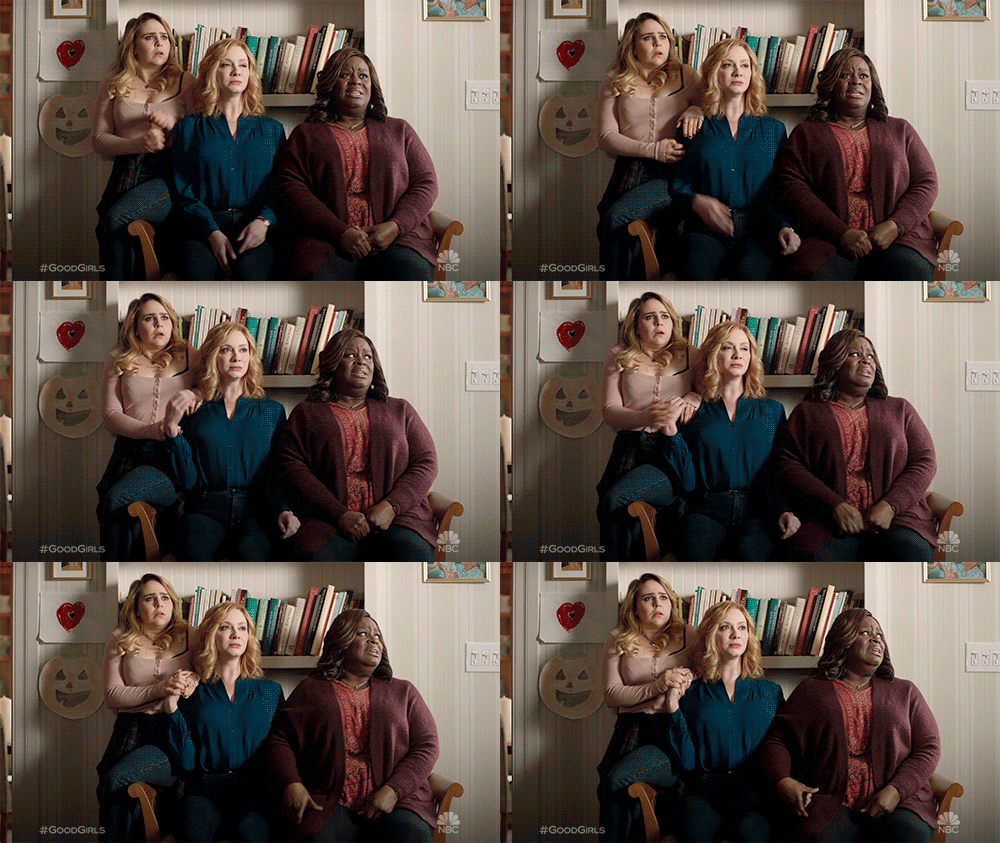
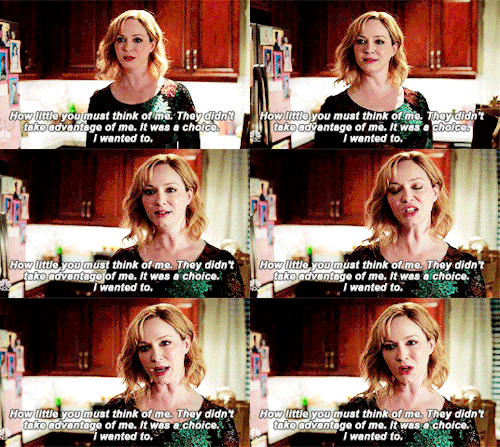
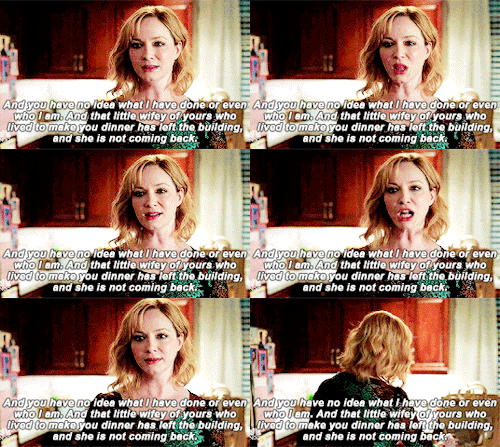
One of the most recent shows to portray a dynamic female antihero with skill is NBC’s Good Girls.

Note: Spoilers for the series will follow!

Image result for annie good girls gif

“GOOD” GIRLS


This NBC drama follows a trio of women — Beth, Annie (Beth’s sister), and Ruby — who are struggling financially. Beth’s husband has cheated on her and gotten their family into serious financial trouble. Annie is a single mother trying to make ends meet with a grocery store gig. And Ruby’s a working mom who’s desperately trying to support her family, including medically caring for a daughter who has kidney disease. The women are desperate, and when they hatch a plan to rob the store that Annie works at, they do so because they feel like they have no options left. No extra shifts or job will help cover the holes they’re buried under. And they justify their decision — no one will get hurt, they’ll use fake guns, and they won’t get caught. It’ll be one job, then they’re done.

Unfortunately, things don’t quite go as planned. Not only does Annie get recognized but the women realize the money they stole actually belongs to a gang, led by a man named Rio. He wants his money and that’s how three mothers get involved with a gang. The curious thing — and most interesting — is to explore how each woman has developed, morally, since the show’s pilot.

Obviously in this post I want to talk about who I view to be the series’ primary antihero (Beth), but in order to do that we need to talk about how each of these women began their journeys.

Related image

ANNIE IS GREAT


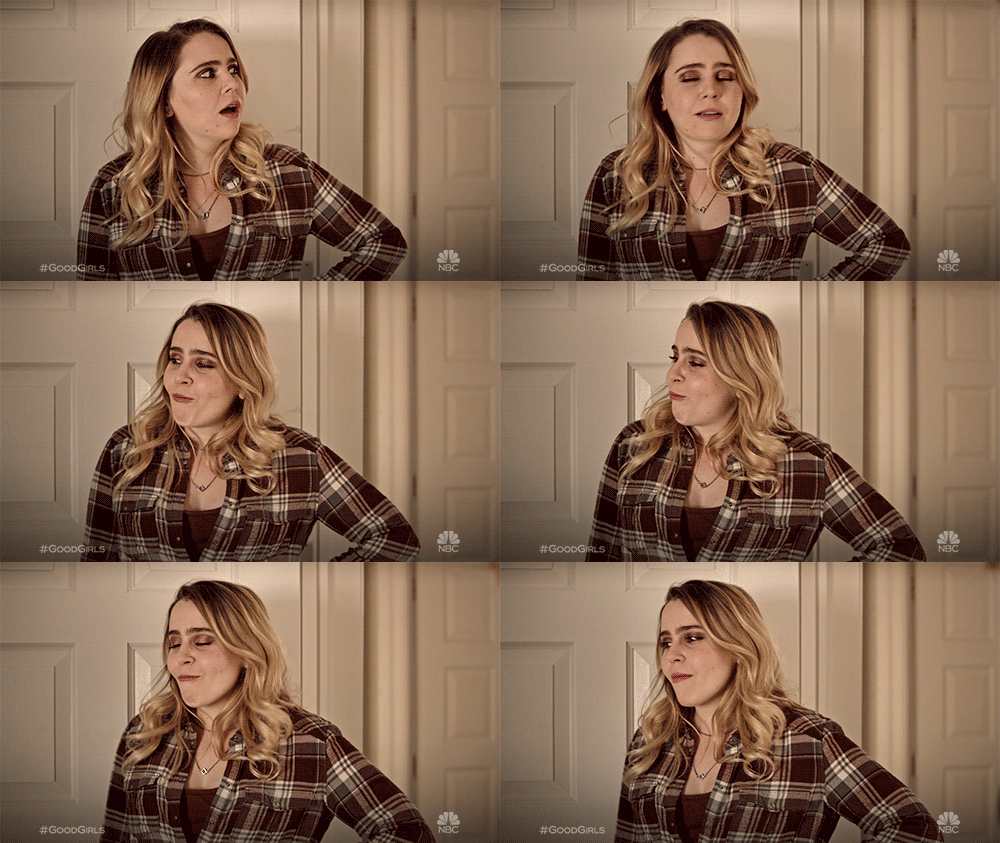
Annie was the most flippant of the group at the beginning; she casually talks about robbing banks and killing a dude who tried to rape her (because hello, he tried to rape her). She’s quick on her feet, scrappy, and sassy. But while Mae Whitman is an absolute delight in her comedic beats of Annie, she also does a fantastic job though portraying Annie’s emotional nuances. The reason why Annie is the way that she is? Because she has to be. She’s barely scraping by, and she’s not getting help from her ex.

Moreover, Annie really does also have a heart. She can joke with gang members and make rapid-fire sarcastic comments but she cares deeply about the people around her. She loves her sister. She loves her child. She loves her friends. But she also spends time with an elderly woman because she feels so guilty for something that the woman doesn’t know about (and that Annie didn’t technically do). That is who she is.

Annie’s also the kind of person who’d do whatever it takes to protect and keep Sadie, her child. Since Annie had Sadie when she was a teenage, Annie and he are close. Really close. In a lot of ways, they take care of each other instead of presenting a traditional mother/child dynamic. But there comes a tipping point in this season of Good Girls where Annie and Sadie’s relationship fractures because of Annie’s moral choices. Annie isn’t exactly a cut-and-dry antihero; while she does make mistakes, she ultimately does the right thing most days. She has a line she will not cross, and a set of standards she adheres to. Her decisions aren’t always morally upright, but she’s doing them because she feels she has no options. I don’t think she’s truly an antihero.

Unlike Beth (who we’ll discuss later on), Annie and Ruby have made choices in Good Girls that put themselves and their own interests on the line for the sake of doing what is “right.” Annie comes clean to Sadie about something she’s been hiding, and Ruby decides to talk to Detective Turner and offer him information about Beth in order to save her husband, Stan. And speaking of Ruby...

Image result for ruby good girls gif

RUBY’S PRIORITIES


Ruby is the one in the group who has the most on the line in a lot of ways. She has a husband who’s a cop. She’s got two kids, one of whom has kidney disease and medical bills that pile up. And she’s willing to do whatever it takes to protect her family. However, Ruby and Stan’s relationship is what sets her apart from the other women in the group. While Beth is still technically married, she’s more or less still married to Dean for the sake of convenience instead of love; Annie has a complicated relationship with her ex and a new one with her boss, Noah (who she doesn’t know yet is actually an undercover agent).

Ruby is willing to sacrifice herself, her own interests, and Beth (though she doesn’t pull the trigger, she did think briefly about turning in Beth’s whole operation) because there’s nothing she wouldn’t do to save her husband. She knows how great of a man she is — and he is such a great guy and husband — and it’s that kind of love that leads both of them to make sacrifices and sometimes bad decisions for the sake of one another. Ruby is also the one of the group who’s come clean to her significant other about everything — everything the women have done, from start to finish, that’s been illegal or illegal adjacent.

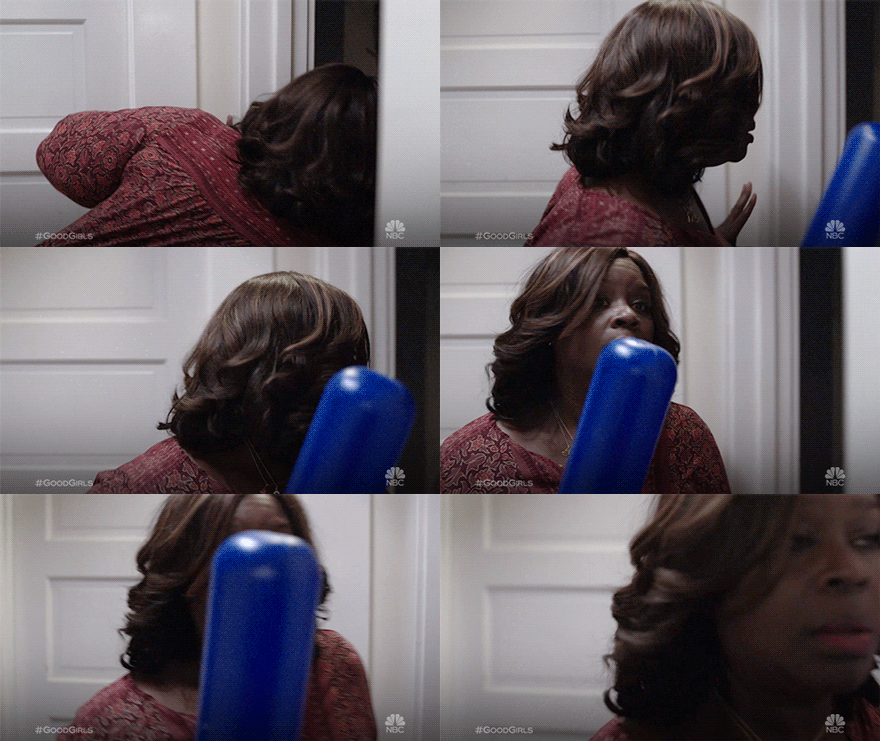
Stan, of course, had to catch Ruby in a lie in order for this all to come to light. Still, she tells him what she’s done because she weighed the cost — she couldn’t gain the money and resources for her family but lose her family in the process. Ruby is such a fantastic character because she’s layered (again, she returns to illegal activities in order to try and save her husband from jail), passionate, and a caretaker for the women. Retta does an amazing job conveying each of these layers with precision and empathy.

Ruby’s generally the one of the group who’s most uncomfortable with lying — even making a joke about how Beth mentioning a new plan gives her hives — and the exploits, unless she can justify them. While both Annie and Ruby lie repeatedly and compulsively throughout the series to people, neither of them do it so deftly and with skill like Beth.

Image result for beth good girls gif

AN ANTIHERO TO ROOT FOR (SOMETIMES)


Beth has spent her life being looked at as “just” a housewife and mother — and her husband is included in that group of people. Dean cheated on Beth with multiple women, got their family and his business into financial ruin, and refused to see Beth as his equal or partner. He doesn’t respect her, and Beth spent her life being okay with that. When you’re not used to having power, you easily slide into mediocrity. Beth was content to make sandwiches for her kids, snacks for sporting teams, and pick up kids in carpool. She coasted. She was fine.

Until she realized how much trouble her family was in. They were going to lose their house, their stuff, their ability to provide for their children. Beth’s children ultimately are what drive her throughout some of her decision-making. The other thing — the main thing — that drives Beth though is power.

When you’re not used to having power — when people around you, including your own husband have denied you of your agency and reduced yoru identity to nothing — acquiring it is life-changing. It can be used for good. Or... well, not. I’m not saying Beth isn’t genuinely motivated in instances by her children. It, however, is what all three women tell themselves to justify their behavior. If Beth says she’s gotten into bed (literally and figuratively) with Rio because she needs to right the financial wrongs Dean made because she wants to protect and provide for her family, she sounds noble. If she says she’s done all of it because she loves the rush of being in control, of being in power, of being at the top… well, then she’s an antihero.

And that’s exactly what I love about her.

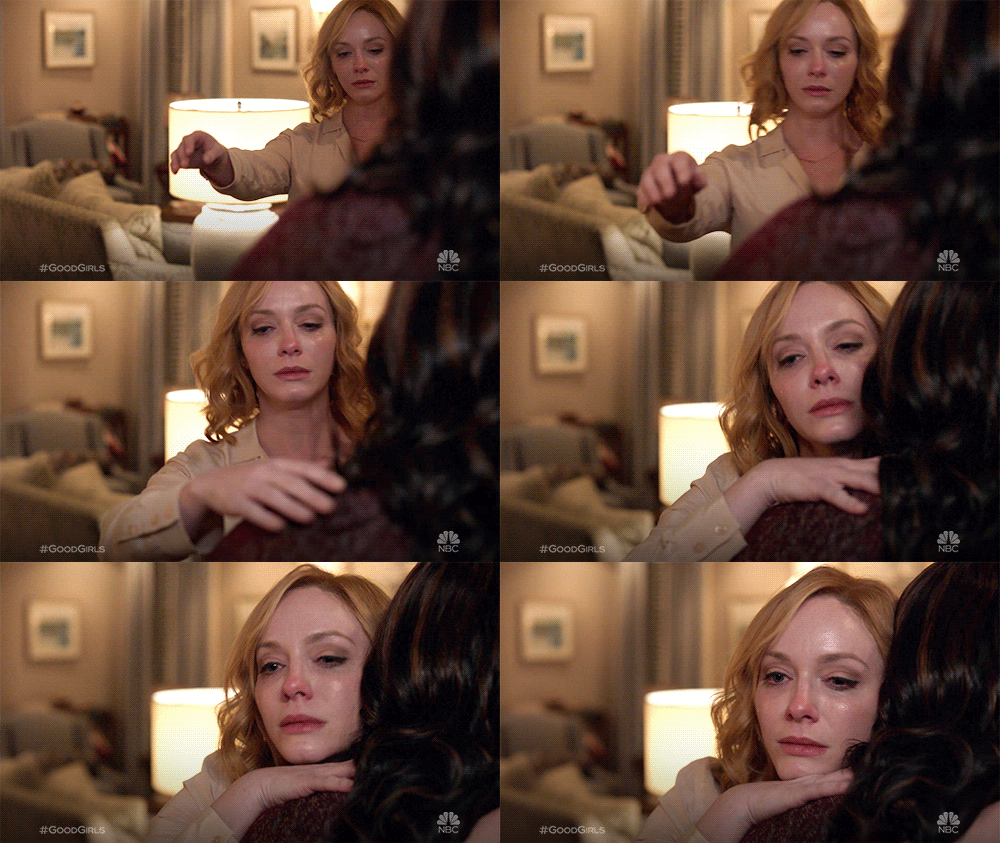
Because the truth is that Beth really does do all of this because she wants to reclaim the power she’s lost over the years. In some ways, you can empathize with her struggles (and Christina Hendricks truly is a force to be reckoned with when she gets the chance to unleash the full range of Beth’s emotions).

But this is where antiheroes get sticky — can we empathize with all of Beth’s decisions? The funny thing is that Beth is so good at lying, at manipulating, at bending people to do what she wants, at covering her tracks, at thinking ten steps ahead, at playing the game... that she doesn’t want to give it up.

Who would she be if she went back to being a housewife and mother? Would she be okay with giving up her power for the sake of her family? “One Last Time” told us that Beth would be leaving a life of crime. She had one last hook-up with Rio, and seemingly said goodbye. I don’t know about you but I’m not sure that will stick. Not only because Rio and Beth have insane chemistry and she won’t be able to stay away, but because Rio knows Beth has tasted power and that she’s not going to handle returning to a life without it easily.


Power is like a drug for Beth. She’s willing to do whatever it takes to get it. She brings her children with her to scope out a house for a drug delivery. She rushes to check on her money when her house is robbed instead of checking on Dean. She lies and justifies and blackmails and makes promises because she’s good, really good, at what she’s doing. There’s a reason she’s the leader and it’s because she’s embraced her role as an antihero.

She justifies her decisions but at the end of the day, most of what Beth does isn’t morally upright and she’s kind of okay with it as long as she continues to benefit. Now, Beth is also a sympathetic character — she’s a woman who’s been wronged, repeatedly, by a man and has children — and because of that, she’s the perfect antihero. The line between “hero” and “villain” with her shifts with every decision she makes. Is she truly doing something for her kids? Or is she doing it because it makes her feel good? Is she lying because she feels like she has no other choice? Or because she knows she’s just good at it and can get away with it?

Good Girls doesn’t ask us to decide whether Beth is right or wrong. There are characters throughout the series who have their own opinions, and we’re asked to frame our perception of her decisions through their interpretations, as well as our own. Agent Turner thinks she’s a villain and wants to take her down. Annie and Ruby think she’s in deep but that ultimately she’s a good person (that scene where Dean takes the kids is, again, a sympathetic one). Rio respects her — something she’s never had from her own husband — and thinks she’s incredibly capable.

But how do you feel about Beth? Is she a good girl? Or is “good girl” her cover? And what about Annie? Ruby?


Good Girls is such a compelling show for a variety of reasons — it’s funny, dramatic, fast-paced (I binge-watched the first season in less than a day; I have no regrets) — but chief among them is its portrayal of complex, nuanced female characters who aren’t always likable and aren’t always right. They live and thrive in morally grey areas and that’s pretty great to see. It’s up to us to decide whether they’re the heroes or antiheroes of their own stories.

I’m just happy to be along for the ride.

Friday, May 3, 2019

Grey’s Anatomy 15x23 Review: “What I Did For Love” (Facing the Music) [Contributor: Julia Siegel]


“What I Did For Love”
Original Airdate: May 2, 2019

After a week off, Grey’s Anatomy returns with a special two-part crossover with spin-off series Station 19, though only the Grey’s Anatomy hour was a true crossover. Most of the event focuses on Seattle Fire Department Chief Lucas Ripley being treated by Maggie after collapsing outside of a flower shop. In other storylines, Meredith creates a problem, while Alex is left cleaning up her and Jo’s messes. And, with love very much in the air, all of the couples face challenges.

WEIGH AND MEASURE


The action of the episode begins as several doctors prepare for an incoming trauma. They are surprised to see intern Schmitt pop out of the ambulance and describe what happened to his John Doe patient. In case you missed the previous episode of Station 19, Schmitt was at the same flower shop as Ripley and found the fire chief facedown and unresponsive on the sidewalk. Bailey recognizes Ripley, and everyone, especially Schmitt, is surprised at who they are treating. Maggie is called in to help out and discovers that Ripley has an unnamed underlying heart condition that caused him to pass out.

Of course, Ripley is a terrible patient and constantly tries to convince Maggie and Station 19’s Captain Sullivan, Andy Herrera, and Ben Warren that he is fine enough to leave the hospital for a little while. While they all feel bad that he wants to go accept Victoria Hughes’ marriage proposal, Maggie explains that he isn’t stable enough to leave and she needs to get his test results back to see if anything else is wrong. The trio of firefighters eventually get kicked out, which leaves Maggie and Ripley alone for some unexpected bonding time. Ripley tells her about Hughes and how he regrets not saying yes to her proposal right away. Maggie then tells him about her lack of commitment to moving in with Jackson. Ripley convinces Maggie that if she really loves Jackson, she already knows the right choice to make.

Apparently that’s all Maggie needs to hear because she runs off to tell Jackson the good news. She almost ruins the moment by telling him that he should have said, “Would you consider moving in with me?” since she is a scientist and likes to weigh and measure the pros and cons of every situation. Maggie has Jackson promise that he will love her even with all of her science quirks, and the two agree to move in together. Maggie gets Ripley’s test results and goes to check on him, only to find his bed empty. She alerts the other firefighters that they need to find him and get him back to the hospital immediately because he has low calcium levels, indicating hydrofluoric acid poisoning from the coffee brewery explosion.

The Station 19 hour sees Sullivan, Andy, and Ben trying to get a hold of both Ripley and Hughes, while going to Hughes’ location since they expect Ripley to be wherever she is. While en route to Hughes, Sullivan gets Ripley on the phone and tells him the bad news. Ripley gets himself to Seattle Presbyterian Hospital and has them call Maggie, who is the only Grey’s character to cross over. The trio eventually finds and brings Hughes to Ripley, who accepts her proposal before succumbing to the hydrofluoric acid poisoning. It’s a pretty sad outcome considering Ripley was a great addition to the regular Station 19 cast. He will be missed.

FIGHTING THE SYSTEM


Back at Grey-Sloan, Alex has a new patient: a young girl suffering from a bowel obstruction. The girl and her father are refugees seeking asylum and tell a very timely story of being separated at the border. Alex brings Meredith in for a consult, and they learn that the father doesn’t have health insurance. Both doctors assure the father that they will figure something out and have DeLuca help him fill out a state aid form in hopes of getting the family temporary insurance. The girl’s MRI scan reveals that she has a mass in her intestine which will need to be surgically removed. The father quickly learns that he isn’t eligible for state aid because he makes too much money at his job, yet not enough to qualify for normal insurance. Meredith is very upset that the system is failing good people and takes matters into her own hands by committing insurance fraud to get the girl the surgery she needs.

Richard sees Meredith’s daughter Ellis’ name on the operating schedule and rushes to find out what happened, only to discover Meredith’s lie. He can’t believe that she would risk her medical license and potential jail time, but she argues that she can’t stand by and do nothing. After the surgery, Meredith is summoned to Richard’s office. He tells her that, against his best instincts, the best thing to do now is to further the lie by falsifying records to make the girl look sicker on paper. If they keep her in the hospital for at least 30 days, then state aid automatically kicks in. Meredith decides to roll with it, so this should be a storyline that continues to play out through the finale.

MISUNDERSTANDING


After a rocky few weeks, Jo shows up to work in a pretty chipper mood. Her sole job of the day is to watch Gus, the autistic boy with golden blood. A call from a hospital in Winnipeg boosts Jo’s spirits further when she learns that they have a golden blood patient too. The woman on the phone was calling for Alex, so Jo hangs up to find him. On her way, she bumps into Gus’ mom and tells her that they might finally have a donor. The mother is overjoyed at the news, and Jo couldn’t be in a better mood.

Alex is very happy to hear that Gus can finally get his blood transfusion and tells Jo to call the Winnipeg hospital to confirm and tell them to send blood immediately. The call doesn’t go as Jo planned, since she finds out that they were calling to see if Gus could donate blood; their patient had an accident and needs surgery. Jo is devastated that Gus isn’t getting the blood and that she told his mother he was. Jo runs into Ben in the hallway and has a mini-meltdown before finding Teddy and starting the process over. Teddy offers to help Jo tell the family that a simple misunderstanding happened, but Jo wants to do it on her own.

At the same time, Ben and Teddy go to Bailey’s office to warn her about Jo who, in turn, talks to Alex. Bailey and Alex get to Gus’ room right after Jo tells the mother what happened, and they find Jo uncontrollably sobbing. Alex has a conversation with Bailey about not knowing how to deal with Jo, who is beyond a hot mess at this point. Jo needs to start to talk about meeting her birth mother before she loses her job and husband.

LOVE PENTAGON UPDATE


It’s time for the weekly love pentagon update! Owen finds out that Amelia is seeing Link, and he isn’t happy about it. He tries to talk her out of it, but Amelia puts Owen in his place by saying he doesn’t get to have an opinion on her life anymore. Owen’s less happy to see Tom and Teddy moving forward with their home search and the knowledge that Tom cancelled his Baltimore trip to be there for the birth of the baby. Tom buys Teddy her dream apartment and the two continue to be going strong. Owen is continuing his therapy sessions and admits they are working. He tells his therapist he feels clearer than ever and is ready to tell her that he loves her.

Of course, we don’t get to find out whether “her” is Teddy or Amelia, but since the episode leads the viewers to believe Owen still has feelings for Amelia, it’s probably a bait and switch and he will profess his love for Teddy.

Monday, April 29, 2019

Avengers: Endgame is the Series Finale We All Deserve [Contributor: Jenn]


When you’re an avid TV fan, you know the satisfaction or, conversely, disappointment that comes with watching the series finale of a beloved television show. There are great series finales but there are also some pretty terrible ones. Numerous components make a great series finale — one that feels earned on emotional and plot-based levels, that leaves the audience feeling satisfied and that, most importantly of all, feels like a fitting send-off to characters we've come to know and love.

Both TV critics Daniel Fienberg and Mo Ryan (along with others, I am sure) mentioned recently that Avengers: Endgame feels like the series finale of a 22-episode television series. Until I read those tweets, I couldn’t pinpoint why I enjoyed the film so much (there was certainly plenty to love though). But every TV-loving fiber in my body realized that this is exactly why it worked so well as a movie.

So as we talk about Endgame, I’m going to frame my discussion of it within the context of a television series finale. After thinking about it and polling some of my Twitter followers, I’ve narrowed down a few things that great TV series finales accomplish and will apply them to Endgame, while also providing you with some actual television-based examples.

(And please note that yes, I watch a lot of comedies so a lot of these examples will be sitcoms and while I love the MCU if I get a detail or two wrong here and there and/or do not remember every exact detail about the comic book canon... forgive me. Be kind, people.)

So grab your tissues, popcorn, and some movie theater-style candy (Twizzlers for me, please) and let’s get started.

NOTE: MAJOR SPOILERS FOR AVENGERS: ENDGAME WILL FOLLOW. You’ve been thoroughly warned.

Image result for captain america endgame gif

Great series finales focus on in-character resolutions and payoff.


Let’s kick off our discussion of finales with arguably the most important achievement: character-rooted resolutions and payoff. There’s nothing worse than spending years with characters — seeing them fail and then evolve — in a television series, only to have all of that fantastic character development undone in the final hours.

There are a few core character arcs in the MCU we focused on in the “series finale”: Tony, Steve, Nat, and Thor. As our premise suggests, let’s assume that the MCU really has been a series of events leading up to a finale. How did the finale’s writing do with their development?

Image result for tony stark endgame

Tony’s arc made the most sense to me. It is your typical heroic journey from beginning to end — from a self-centered, genius playboy billionaire to a devoted father, husband, and true hero. Tony is the prime example of character growth. He’s stumbled over the years. When we met him, he was charming and funny but not always likable. He hasn’t always made the right choices and even if he has, he’s been no stranger to struggle and loss. He’s overcome his own demons and in Endgame, we got the chance to see him finally happy.

It wasn’t an unrealistic sense of happiness though that can plague series finales — a saccharine filter over years of trials or trauma. No, everything that happened in the last 22 films led up to Tony’s ultimate sacrifice for his friends, his family, and his world. His arc, as even he noted, didn’t end with a “happily ever after” coda on it, but it ended in a way that honored the man Tony Stark became and the ultimate hero he always was.

I’ve always been a fan of Tony, mostly because even in his most unlikable moments there was something so utterly real and redeeming about him. Endgame was another recognition that even in a character’s low points (that bitter speech about defeat Tony gives to the team for example), as a writer you don’t have to assassinate the character in order to make them complex. Tony went out exactly who he was. And that will always be enough.

Image result for steve rogers endgame

Steve’s journey does end with a “happily ever after” coda that I’m still trying to decipher because of time travel logistics, y’all. Time travel and branch reality issues aside, while I’m happy that Steve got his dance and his girl and lived out his life happily, it felt a little off. But I also have to remind myself that every hero’s journey doesn’t end the same way. Tony’s journey had to end in sacrifice born out of love; Cap’s had to end in rest out of a life well-lived as Steve.

And I have to assume that this means he lived a life as Steve Rogers, not “Cap.” An old Steve tells Sam that he followed Tony’s advice to live his life, but I think some part of Steve knew he was going to need to do that as himself, not Captain America. Maybe a life of normalcy is what he secretly wished he could give himself all along? As Cap told Nat earlier in the film, he just didn’t know how to get a life; he kept coming back to the heroics. I think at some point (perhaps after Tony’s death), Steve realized he’d have to return to the past and deliver the Infinity Stones as Captain America but come back to 2023 again someday as Steve Rogers.

And while it’s unclear, again, how this time travel business worked or HOW he managed to live his life undetected (is this a Captain America-less branch reality? Or is there another Cap? How did this happen?), I think Endgame!Steve wanted the thing that Tony had: something, as the TV show Arrow would say, to live for. And it needed to be personal, and it needed to be quiet.

While I know a lot of people have mixed reactions to that final scene as it relates to his arc throughout the series, I think it made sense to me in the lens of thinking about how Tony and Steve chose similar but different paths. At some point, even the people who give the heroic speeches arrive at a place where they’re not sure if they can go on anymore.

Or maybe I’m totally wrong and the end of Steve’s character arc was just a writing misstep. Everyone is entitled to their opinion, right?

Image result for thor endgame

Thor’s end is another stereotypical, but no less satisfying, end to a character-based saga. Sometimes the hero doesn’t die: sometimes he just realizes he needs to switch gears entirely and move from something known to somewhere unknown. Not only does Thor do the expected “passing of the torch” of leadership to Valkyrie, but earlier in the film he also experiences the scene many main characters do: being visited and advised by a mentor.

The scenes between Thor and his mother don’t just serve as sweet, sentimental moments — they’re also critical to propelling Thor into discovering who he is. He’s spent his whole life forcing himself into what’s expected of him; with everything he loves more or less gone and everything he’s seen in Endgame, it was time for him to move forward and leave his previous life behind.

It’s time for a new journey — maybe one featuring the Asguardians of the Galaxy?

Image result for natasha endgame

And finally we have Nat. I’m torn with this ending, honestly. Because there’s a part of me that believes Clint’s arc would have been more satisfying had he died: an atonement for the sins of his (recent) past, giving up his life for the woman who never gave up on him, etc. Nat’s arc makes sense too in other ways (she believed in her family so much that she was going to have to give up that which she loved most to save them all), but if we’re talking personal opinion? I still think it should have been Clint.

Nat’s always been messy in a beautiful way, but in Endgame alone she spent five years desperately clinging to saving the world because it was all she knew how to do. She was scared to move on because... what would she move on to? Her whole world was the Avengers. Nat’s unwavering commitment to the cause was her strength to the very end. And the Avengers really did avenge her death.

(TV notes: How I Met Your Mother is a perfect example of what NOT to do with character-related stories in your series finale. I’ll never be over the out-of-character ending and the storyline that existed just so the show could use a years-old filmed reaction shot. The Office teetered on that line with its downhill character development of Andy in the final season or so, too.

Meanwhile, shows like Psych and Crazy Ex-Girlfriend were far more successful in the character development and payoff department.)

Image result for endgame gif

Great series end with hope for the future... and just a little tease.


I wanted to leave this series of the MCU knowing that even though the characters wouldn’t be perfect, they’d be okay. When a television series ends, chances are you’ve spent years getting to know the characters (main and recurring), so there’s a desire for us all to believe that the town will go on without us — that things will be okay and the next generation will be too. Thor passed the torch on to Valkyrie, so we know that New Asgard is in capable hands. Steve gives his shield to Sam. Happy comforts Morgan. Scott and Hope watch fireworks with Cassie. T’Challa, Shuri, and Ramonda look over Wakanda proudly. Clint and Wanda carry on the memories of those they lost.

Sad things happen. But the MCU is okay. It moves on, and the characters who remain carry the legacies of those they’ve lost. The world isn’t falling apart (that day), but the people who remain have been permanently changed by the people they loved. And life continues to move on. That’s what gives us hope for the new “season,” if you will, of the MCU: Wakanda is out there. Carol still patrols the skies. Heroes are being born and reborn.

That funeral shot near the end of the film made me cry both times I saw it. Apart from it being touching, it was a distinct visual reminder of everything Tony Stark helped create — of everything the original Avengers inspired.

So yes, let’s weep for the fallen.

But let’s celebrate that the MCU doesn’t die with the OGs — quite the opposite, actually. This universe continues to thrive on the examples they set.

(TV notes: We don’t speak of the final season of Scrubs, but in this instance I will. The series finale passed the torch to a series of new doctors. And even though the show didn’t work well in its final season, it’s important for those who loved the show to know that Sacred Heart changed but still kept going.

Parks and Recreation did a great job of flashing forward and showing us that the characters we loved and rooted for in Pawnee over the last seven years continued to thrive long after we left them.)

Image result for endgame gif

A series finale should be entertaining and well-paced.


Avengers: Infinity War was narratively set up for difficulty. It had to cram every MCU character into an almost 3-hour film, which meant constantly jumping back and forth to different locations in space and Earth. As a result, I didn’t feel like it was a satisfying film holistically (it really served as part one of the series finale), though it was ambitious in all the plot it jammed in there and had its great moments of action and character development.

Conversely, Avengers: Endgame was three hours long but felt incredibly well-paced. Only a few scenes felt like they were stalling or rehashing old information (the Avengers taking stock of all the Infinity Stones and their history really just served for Scott to hear what he’s missed), and most of those scenes were still necessary to the plot overall. While the first third of the film was a bit slow, the final two acts — and third specifically — flew by.

Not only was Endgame engaging and well-paced, but it was also wildly entertaining. My favorite part of a second viewing in theaters was getting to witness everyone’s reactions to Scott’s taco lunch, Thor’s BIG reveal, Bruce’s fiddling with time travel, and even Hulk’s awkward lunch. So much of this MCU series was focused on the balance between humor and drama. The final film didn’t disappoint at all, and I’m glad that it managed to perfect the line between sadness and resolution.

(TV notes: Friends used the few episode leading up to the series finale to set up a lot of the plot that the show wrapped up in the series finale, which was a great move (Rachel and her job offer, Phoebe and Mike deciding on a future, Monica and Chandler moving away, etc.). Too many shows do slow builds in the series finale alone that end up making the episodes too rushed and packed with plot to breathe.)

Related image

 A series finale succeeds when it remembers its roots. 


My favorite thing about finales is the plethora of callbacks. Throughout all of the MCU, callbacks and little Easter eggs were more than just commonplace — they were expected. Everyone waited on the edges of their seats through scrolling credits. More than any other MCU film, though, Avengers: Endgame did what some great series finales do: take a literal walk down memory lane.

In order to get the Infinity Stones in the past, the Avengers literally take some trips down memory lane (in 2012 where the battle for New York is raging, 2014 where we re-meet Peter Quill, and even in the 1970s). It serves a plot-related purpose but it’s also the kind of stuff that leaves me with little warm fuzzies. Endgame remembers where it’s been — where it came from — and it’s not ashamed of it. (And who didn’t love the culmination of that callback from Age of Ultron of Cap being worthy to wield Mjolnir???)

A lot of movie series try to move past their histories. A lot of television shows do similarly. But there’s a joy when people recognize the missteps and successes of their pasts, embrace them, and celebrate them.

(TV notes: New Girl’s series finale twist featuring a flash forward, sentimental game of True American left me with more than a few tears in my eyes. Psych and Community were the kings of callbacks in their finales and throughout their series as wholes. And Ugly Betty came full circle when Betty became a boss and Daniel joked about being her assistant. Plus how wonderful was it for the show to drop the “Ugly” from its name in the final title card?)

Related image

A series finale deserves earned emotional moments. 


No writer should ever try to evoke emotion in a person just for the sake of emotion. The moment an emotional scene feels exploitative is the moment it loses all power and credibility. Many a television show and film have suffered from unnecessary deaths for shock value. And that’s the danger in a series finale — with a franchise like the MCU, you might expect bloodbaths and major deaths. But that’s not what was true to most of these characters. Endgame wasn’t going to give us death for death’s sake. And I’m glad for that.

The emotional moments in the film each served a purpose — to remind us of where we’ve been, to display incredible character growth, to demonstrate the power of a legacy, etc. Tony’s death wasn’t long, drawn-out, and dramatic; it was sad and simple (it did feature a heartbreaking repeated “Mr. Stark” from Peter).

Even the smaller emotional beats in the film served a purpose. I got chills when Cap’s radio began to crackle and we heard Sam’s “on your left.” I got a little weepy when Captain Marvel returned on the scene with an army of women beside her. I felt surges of joy and sadness when Tony got to say a hello and goodbye to Howard. And there was sweetness and emotion in the final shot of Steve and Peggy.

Emotion doesn’t equal sadness — good media will always understand the “why” of the emotional scene and focus on its depth rather than its tear-to-tissue ratio. If a film or television show does its job right, you should feel emotional but ultimately satisfied.

(TV notes: Parenthood was always a series that delivered emotional one-two punches and the series finale was no exception. The emotional moments were so well-earned, and the character development that led up to and through the finale was perfect.)

Image result for endgame gif

Finally, a finale needs an appropriate sense of... well, finality. 


A series finale (unfortunately in the age of peak TV, this happens more often than not) deserves to be the culmination of a journey. Too many great television shows are gone so soon that their writers don’t have the opportunity to wrap up the storylines before cancellation, leaving gaping cliffhangers and holes and stories that they’ll never be able to tell.

Ultimately the goal for the series finale of a television show is for viewers to acknowledge that the arc has ended, the journey has concluded, and all — for the most part — was well with their favorite characters.

I’ve spent the last thousand or so words talking about how I feel like Avengers: Endgame accomplished this. Was the film perfect? No, but there will never be a perfect film. Did I feel satisfied with the way every character’s journey ended up? Yes, for the most part, I was. Even more minor characters in the Avengers-verse got the chance to say their farewells and continue their journeys in 2023.

Tony can rest. Cap can rest. Thor can rest. Nat can rest.

The universe is in safe hands. And Avengers: Endgame reminds us that as long as there are heroes out there — people willing to make sacrifices for strangers and loved ones and planets — there will always be hope. That’s enough.

That’s a series finale.

(TV notes: I enjoyed The Newsroom’s series finale in terms of its finality and wrapping up of storylines and arcs. Despite my earlier qualms with Andy, The Office provided great closure for every major character on the series and the assurance that they’d all be fine.

Conversely, shows that were cancelled too soon like Pitch, Pushing Daisies, Sweet Vicious, Selfie, Go On, Happy Endings, etc. ec. didn’t get proper wrap-ups to storylines and, unfortunately, left viewers hanging on cliffs forever.)

Image result for endgame gif

What did you all think of Avengers: Endgame? Did it feel like a television series finale of the MCU? Sound off in the comments below!

Sunday, April 28, 2019

The Flash 5x19 Review: "Snow Pack" (An Icy Reception) [Contributor: Deborah MacArthur]


“Snow Pack”
Original Airdate: April 23, 2019

This week on The Flash: two storylines tenuously linked by... making the right choices where one’s loved ones are concerned? Family trouble? Suffice to say, the connection between Metahuman of the Week plot and the Westallen family drama is an emotional one, rather than any interlocking stories. Also, Cicada II shows up out of absolutely nowhere. And here I thought “Snow Pack” was gonna be a filler episode.

I’M OUT OF FAMILY-RELATED SUBTITLES


Man, this one starts off with an emotional bang. Right out of the gate, Iris and Barry are having a total blow-out over Barry taking Nora back to the future in the previous episodes. It turns into a broader fight about Barry’s tendency to act based off his emotions — and only his emotions — without consulting anyone else in his life. Including, ostensibly, the most important person in his life: Iris. While Barry is hung up on how he can no longer trust Nora after her partnership with Thawne, Iris’s point is that Barry shouldn’t speak for the whole team, and he certainly shouldn’t speak for her.

We know the Westallen couple will be okay by the end of the episode (thankfully, the show left relationship drama in the dust early in its run) but there’s something more... real, I guess, about the fight that opens the episode. Like, it’s not the usual “you take risks and it worries me” fight you usually see between couples in superhero narratives: it’s a deeper issue regarding trust, open communication, decision-making. Y’know, couple stuff. Except it also involves transporting one’s grown daughter who hasn’t been born yet back to the future without consulting one’s wife or team of superheroes first.

When Barry uses the “you don’t understand how I feel about Eobard Thawne because you didn’t watch him kill your mother” card against Iris, that’s Iris’s cue to step away. She apparently saves whatever (likely vicious, likely focused on Barry’s utter stupidity) words she would have said to him for a letter, which Cecile and Ralph stop her from writing. Instead, Iris and Ralph decide to take a trip to the future to either bring Nora back or, at the very least, just talk to her.

And what is Nora doing now that she’s back in 2049? Why, the exact thing that made her father turn against her and banish her from the past, of course! Yes, although Eobard Thawne only has short amount of time left to live (allegedly) he’s spending at least some of it coaching Nora West-Allen in the ways of the Negative Force. Nora wants to get back to 2019 undetected by Barry, who would sense her presence in the Speed Force, so she needs Thawne’s help tapping into the rage-fueled Negative Force instead. Unfortunately for her, she’s not angry enough to use it. Unfortunately for us, she’s about to be.

Back in 2019, Caitlin Snow’s ice-powered dad shows up looking like Jack Frost on the cusp of a midlife crisis. Thomas Snow — or Icicle, I guess — wants to make his “Snow Pack” whole again by turning Caitlin’s mother Carla into an ice meta as well, then destroying the human sides of both Caitlin and Carla. Caitlin and her mother spend most of their time arguing bitterly, and when they’re not arguing they’re dealing with Icicle’s... uh, icicles? He throws ice knives at people a lot is what I’m saying.

Carla gets captured and put into a meta-making machine. Barry shows up just in time to take over rescuing Carla while Caitlin/Killer Frost chases after her dad via many swirly ice slides. Icicle apparently didn’t really have his heart set on a nuclear family after all, because he tries to kill Caitlin outright — only to be stopped by Thomas, who resurfaces and banishes his frosty personality long enough to have a heartwarming reunion with Caitlin and Carla. Then Cicada II shows up, stabs him, and absconds with a piece of cryo-tech. Woops! You almost made it, Thomas. Unfortunately, everyone Caitlin loves is doomed in some way.

If it makes everyone (sans Thomas, who is dead) feel better, Caitlin and Carla don’t really seem all that broken up about the situation? In fact, their relationship appears to be much better after the events of the episode. So much so, in fact, that neither one of them notices a testing vial changes color, signifying the continued presence of dark matter in Carla after Barry “stopped” the process to turn her into an ice meta.

From a repaired mother-daughter relationship to a fracturing one: In 2049, Iris and Ralph have tracked Nora down to Iron Heights, where they know Thawne is being held, and Ralph has managed to knock out (and impersonate) a guard so that Iris can talk to her daughter. Quick aside: I really liked the duo of Iris and Ralph, and I’m shocked to realize that Ralph seems to pair well with just about everyone? It’s a far cry from last season, when he paired well with literally no one. I liked the Ralph/Iris plot so well that I was pretty disappointed that it wasn’t more of a focus, perhaps with a small subplot dealing with Nora’s interactions with Thawne and virtually nothing with the rest of Team Flash. While it was nice to see a conclusion to the Snow family saga, that half of the episode felt out of place this late in the season, with a tacked-on appearance by Cicada II to keep it from being narratively pointless.

But anyway, Nora doesn’t respond well to the presence of her mother without Barry. While I get that Nora was, on some level, betrayed — how awful must Iris feel about that reaction from her daughter? Iris was the one who let Nora out of the holding cell, Iris was the one who stole a time machine to get to her, Iris was the one who stood up for Nora while Barry completely wrote her off as untrustworthy. Beyond those most recent actions, Iris has consistently been in Nora’s corner while Nora herself treated her like dirt, and when they actually made up and developed a decent relationship, Iris made an adorable list of all the stuff she wanted to do with Nora and pushed for them to spend as much time together as possible. But all Nora cares about is Barry? Jeez, I can’t even imagine how much that blatant favoritism must break Iris’s heart.

Since only one parent matters to Nora and that parent isn’t the one who shows up, Nora throws a temper-tantrum big enough to access the Negative Force and zips off, showing up in 2019. Thawne shows some confusion concern for Nora as well as the West-Allen relationship, imploring them all to stay together and work through their problems as a family. Uh. Thanks for the impromptu family counseling, time-traveling murder man.

Other Things:

  • “Thawne is manipulating [Nora]!” Barry says, while defending his decision to send Nora back to the future. Where Thawne is. And can manipulate her.
  • Joe West just... rips a metal door off a cabinet when Barry is in danger. Why is no one mentioning this?
  • I’ll never understand why Killer Frost consistently chooses to fight in close combat when she can just... throw ice at people. That Cicada II battle? Could’ve ended with an icicle right in Grace’s glow-wound.
  • I don’t know why Barry and Iris act like Nora belongs in 2019. She doesn’t. The only thing keeping everything from unraveling due to time travel shenanigans is the writer’s blatant disregard for their universe’s rules. Nora should be Time Wraith chow.

Grey’s Anatomy 15x22 Review: “Head Over High Heels” (Overexposed) [Contributor: Julia Siegel]


“Head Over High Heels”
Original Airdate: April 18, 2019

Whether it was a weakness or strength, most of the characters on Grey’s Anatomy found themselves overexposed in the latest episode of the medical drama. Jo continues to cope poorly with meeting her birth mother, while the love pentagon of Owen, Amelia, Teddy, Link, and Koracick gets a peek under the hood. Meredith and DeLuca deal with two surprising situations, and Nico and Schmitt have their first really big fight.

WHAT COMES AROUND GOES AROUND


Once again, there were a lot of moving parts in the latest episode. The ongoing storyline of Jo trying to come to terms with the truth she learned from her birth mother still weighs heavily over the entire episode because she refuses to discuss it. She claims she needs more time to process things before talking about it, but Jo is more than likely stalling until she makes a decision on whether she runs away again or gets help.

Jo finally decides to live a little and shows up for work after taking at least a week off. She’s clearly not doing any better, considering that she shows up drunk and with a thermos full of alcohol. Jackson tries to get through to Jo by inviting her to help him with his spray-on skin project. Jo tells Jackson that he was right about not digging up the past, but she refuses to tell him anything further than that she made a mistake by seeking out her mother. Jackson tries his hand at giving her the wake-up call she needs by letting her know that he knew she showed up to work drunk and threatens to have her fired if it ever happens again. Jackson does tell Alex off-screen that Jo was drunk at work because Alex is in a real mood when he gets home. The inevitable fight between Jo and Alex occurs, and Alex is worried that he is going to have another situation on his hands. The newlyweds are not in the best place at the end of the episode, and it doesn’t seem like things are going to change anytime soon.

Richard also finds himself in a pickle when an old friend, Jemma, from AA winds up in the ER with a stiletto sticking out of her chest. Jemma has fallen off the wagon since their shared sponsor, Olive, passed away. Richard wants to help Jemma get sober, but she wants nothing to do with him. Jemma doesn’t even want Richard to help on her case, but she doesn’t have a choice when Maggie gets called into another surgery, leaving Richard to complete Jemma’s surgery. Jemma isn’t pleased to learn that Richard wound up operating on her, but the two make up when Richard tells her about how he lost it after Olive died too. They bond over his story about destroying a bar with a baseball bat and getting arrested, and it’s nice to see Richard getting a little stability back in his life when it comes to talking about being an alcoholic.

THE TRUTH ABOUT LOVE


When season fifteen was dubbed “the season of love,” I don’t think any of us imagined that a love pentagon would happen. The relationships between Owen, Amelia, Teddy, Link, and Koracick continue to intersect and cause each person to contemplate where they stand. Owen spends the day at his first therapy session, at Megan’s request. Owen’s therapy session was pretty uncomfortable at times. I don’t know if it was the therapy he was getting or the writing, but something in those scenes was off. Also Owen winds up in a pretty good place following his first session, and it is highly unrealistic that he would be that cured after one session. The only good thing that came out of it was the therapist making Owen realize that he sabotages every decent thing that happens to him.

Amelia and Link appear to be becoming more of a couple and spend the episode working with Koracick using stem cells to treat Kari Donnelly, the woman who was paralyzed in a snowmobiling accident a few episode ago. Amelia and Koracick have a few heart-to-heart conversations about their current relationship statuses and what the future holds. Koracick feels that he and Teddy are in a really good place, but Amelia tells him that he shouldn’t get too invested because she feels it is inevitable that Owen and Teddy will want to get together. She reveals that she still does, and may always, have feelings for Owen but it’s too complicated to try and work things out with him.

Amelia says that she is happier taking the easier option — being with Link — because she is happy and can enjoy herself. She suggests that Koracick not get too infatuated with Teddy because Owen and Teddy still love each other. Koracick doesn’t want to believe Amelia and wants to keep fighting for a future with Teddy, which is really sweet. We unfortunately don’t get to see whether the stem cell treatment cured the paralysis, but the ongoing storylines with the patient and the romantic advances should continue to be very entertaining. I also want to take a moment and praise the writers for their brilliant writing for Greg Germann, who plays Koracick. Germann is so wonderful to watch and constantly lightens the mood with his quippy one-liners and sarcasm. They utilize Germann and his character perfectly and deserve some recognition for doing so.

SURPRISE!


Meredith and DeLuca wind up having a crazy day when they have not one, but two surprises thrown their way. As teased before the episode aired, DeLuca finds himself in an awkward situation when he tries to leave Meredith’s house in the middle of the night, only to be caught in the act by Zola. Meredith has not told her kids about her new relationship with DeLuca yet and feels that she is being forced into telling them now that Zola might know something. She turns to Bailey for advice, since she had to have the same conversation with Tuck when she started seeing Ben. Bailey suggests that Meredith be honest with her kids and tell them that she will be spending more time with DeLuca, but won’t be taking time away from them. Meredith is worried about what her kids will think, so DeLuca reassures her that he loves kids and kids love him.

DeLuca finds himself in another odd situation when he takes on a case from the ER. His new patient is complaining of intestinal distress and thinks that she has a bowel obstruction, based on previously having several. While the woman is getting an MRI, DeLuca has Meredith stop by for a consultation because he thinks that his patient’s bowel might be perforated and require surgery. The two doctors are shocked to discover that the scans show that the patient is pregnant and crowning. Turns out, the patient didn’t even know that she was pregnant and Bailey comes to help and sees on the images that the patient has two uteri and is pregnant in only one. This super interesting case gets quickly thrown to the sidelines and doesn’t get any attention once Meredith delivers the baby. It was odd that a rare medical condition was revealed, only to not be discussed in full.

OVERCONFIDENT


The saddest plot of the episode focuses on the aftermath of a complex surgery. Nico divulges to the audience for the first time that his fellowship year is almost up and that he is looking for permanent positions across the country, much to the chagrin of Schmitt, who wants his boyfriend to stay in Seattle. Top hospitals and sports teams are trying to woo Nico, which has gotten his confidence level pretty high. Nico has Schmitt assist him on a difficult surgery to fix a young man’s fractured vertebrae. The surgery seems to be a huge success, but a post-op complication occurs when the patient collapses after standing up.

Nico brings Maggie onto the case when he realizes that the patient’s heart has a problem. Unfortunately, they are unable to save the patient, who dies in surgery. Nico is pretty shaken up about his mistake and goes off on Schmitt about how he isn’t like him and never fails. Schmitt is hurt by Nico’s words, and I’m hoping the incident will take Nico’s ego down a notch. However, this actually turns out to be setting up the big Grey’s Anatomy/Station 19 crossover that airs on May 2. At the end of the April 18 episode of Station 19, Schmitt is at a flower shop looking to buy apology flowers for Nico when he bumps into Station 19’s Chief Ripley, who doesn’t look like he’s feeling well. Ripley leaves the shop before Schmitt, and Schmitt finds Ripley face-down on the pavement on his way out the door. It seems like Schmitt will have a big part to play in the crossover.