Ted Lasso, Rom-Coms, and Emotional Vulnerability

Why is it important that a show about men who play soccer did a rom-com homage?

Dickinson Behind-the-Scenes: An Interview With the Artisans

Meet the artists who brought the Apple TV+ series to life!

If You Like This, Watch That

Looking for a new TV series to watch? We recommend them based on your preference for musicals, ensemble shows, mysteries, and more!

Showing posts with label guest poster: amir. Show all posts

Wednesday, October 12, 2016

Growing Up and Living With It: A Discussion of You’re The Worst's Third Season So Far [Guest Poster: Amir]


You’re the Worst has always been a show about growth, first and foremost. That’s the charm and brilliancy of creator Stephen Falk, who navigates the dysfunctional adventures of a couple too inept to not be together with such honesty and unabashed brazen humor. Every episode from the beginning has been an exercise in seeing how this unromantic couple learns to be a couple. Each episode tackles a new trope within dating, while also having our side characters chime in with hilarious heart. Edgar, our PTSD war veteran, serves not only as house chef and punching bag, but also as the voice of reason that Jimmy desperately needs. Lindsey, our sex-addicted ditzy best friend, provides not only some of the best laughs in the series, but also support to Gretchen in ways that were thought unimaginable. Their involvement within this series is just as important as the growth of Gretchen and Jimmy, and with each new season, we see them pressing forward within not only the main narrative, but also their own. Not many series today manage that juggling act well, and less manage it with such great chemistry that Chris Geere, Aya Cash, Desmin Borges, and Kether Donohue provide.

One episode in its seminal second season has our lovable jerks “checking in” on each other, which they both gaff at initially, but throughout the episode unintentionally end up doing. Another episode has the two of them coming to terms with the fact that they’re “exclusive,” which for any normal relationship would be just that: normal. For Gretchen and Jimmy, this is a major step not only as people, but as a unit. That happens to be one the joys of You’re the Worst — watching our merry band of a-holes (which would be a generous comment more than anything) learn to live with each other and grow as people. If season one was a perfect introduction to the razor sharp humor and concept of watching two terrible people beginning to date each other, season two ups the ante by giving the series a beating heart, with the finale giving even the most cynical viewer a moment of pause; Gretchen and Jimmy really do love each other.

Season three of You’re the Worst looks to be a merging of what made season one work and what made season two so affecting. The first episode reintroduces us to our favorite anti-couple working on their relationship in new and honest ways. After Gretchen slips out of her depressive spell, she makes attempts to get better by seeing a therapist, played by the always welcome Samira Wiley, while Jimmy does his best to actually show that he loves Gretchen as opposed to just drunkenly admitting it. Meanwhile, Edgar has found happiness with his own cutesy love story, and Lindsey is taking strides in making her marriage with Paul work — kind of. With so many stories going on, the juggling begins to get more difficult, and while this season isn’t as cohesive as it’s first season, or nearly as funny its second, what this third season retains more than anything is awareness of emotion.

Each episode this season has been a perfect merging of deranged humor and emotion as the real seeps into these characters' lives. Jimmy calls up his estranged father with the expectation to tear into him and get some form of closure in his life. But he ends up leaving him a voicemail saying he’s sold a book, hoping it’d make him proud. It’s only when he realizes that his father actually passed away, and that his moment of vulnerability for all for naught, does Jimmy sink into a minor sad spell which Gretchen desperately tries to fix. It’s an ironic trade considering last season Jimmy desperately tried to do the same for Gretchen.

Further on in the season, we finally get an episode revolving around Edgar’s PTSD which includes sleepless nights, a trip to the VA that doesn’t go well, paranoia, and how Jimmy’s offhand comments actually have great detrimental effect on Edgar. It’s an episode carried by Borges’ phenomenal performance and one that may be the best half hour of television not only in this series’ career, but also of the year. Lindsey, meanwhile, finds out that she’s actually got the capacity to be a great mother — even outshining her older demeaning sister who’s been prepping to be a mother for what seems to be her whole life. And yet despite that, she still has no real understanding of what being a mother and forming a family really means. Naturally, like all of our characters, they’ll grow to become better not only with themselves, but with each other.

We’re only on episode six of this third season and with the rest of this season, anything can happen. So much can change and so much can go wrong. That’s not just the nature of television — that’s just the nature of life in general. Despite Jimmy and Gretchen’s way of laughing everything off, they are still living breathing human beings who feel things like everyone else. Despite Edgar’s support system with his girlfriend and friends, he’s a hair trigger away from slipping off the edge, and despite Lindsey’s motivation in being a better wife to Paul, she’s still capable of having it all fall apart. That’s what this third season has given us: real stakes. The hard part of getting into a relationship is in the past, the bigger challenge comes from living with one another. Is it possible? Can it be done? This has always been questions not only for our characters, but for us as well.

Stephen Falk knows that uncertainty is the real enemy of life, but there’s always hope that tomorrow everything will be okay. With season four of You're the Worst greenlit, one can only hope that our lovable crew manage to keep it together. From the looks of it though, they seem to be doing all right and that’s about as much as one can hope and ask for.

Wednesday, September 7, 2016

Halt and Catch Fire 3x03 Review: “Flipping the Switch” (Powering On) [Guest Poster: Amir]


“Flipping the Switch” 
Original Airdate: August 30, 2016

Halt and Catch Fire has always been a show about forward progression, both in a literal sense and in a meta-sense. Season one of the series stumbled in finding its footing but still managed to keep the pace, while season two not only quickened the pace but also kept it consistent. We saw Donna go from being merely a wife with tech expertise to being a company owner and content creator, and we saw Bosworth go from being someone in charge with a Texas attitude to an invaluable asset for Mutiny and lovable father figure for Cameron.

In "Flipping the Switch," we find Joe making leaps and branching out of the mold that he was once stuck in. And that, in and of itself, is exciting. No longer restrained to filling out the Don Draper archetype, Joe taking classes to learn coding and programming in an effort to create something himself. This not only allows for endless possibilities in his character, but it also shows a sense of vulnerability that his character was lacking. “Flipping the Switch” seems like a very apropos title for this episode — we see our characters kicking into gear as they take the next steps toward bettering not only themselves and their relationships with one another, but their progression within Mutiny. After all, they are taking off with acquiring Swap Meet and moving forward with their own plans.

... Except things aren’t generally as simple as that. This seems to be the motto with Halt and Catch Fire, and it shows up throughout this episode in many ways. Joe catches up with Ryan (who I’m growing to enjoy more and more) and explains that while they’ll be finding a new way to make money, they might fail. Gordon tries to create a HAM radio in an effort to connect with people with middling results, despite technology favoring online communication to do that. Bosworth and Diane go over to handle the takeover of Swap Meet — which would be a good move for Munity — only to find that the company seems worryingly small and reeks of a bad investment.

This discovery leads to some of the best lines to come out of Bosworth in a long time. Truthfully, watching Bosworth work and handle clients was always a major highlight of the series, with Toby Huss’ charismatic and assertive performance winning anyone over. Nothing comes easy, which is not new for any television series in 2016. And yet, Halt and Catch Fire seems to capture that spirit far greater than any series out now. There are genuine fears of failure that would be disastrous for everyone involved, and Mutiny moving on with their plans in spite of that shows how strong their commitment is — not only producing great content, but also working together as a team. But they’ve still got a long way to go before they’re the well-oiled machine. And we see this when Gordon is brought into business discussions and it starts a very heated argument between Gordon and Donna.

Scoot McNairy and Kerry Bishé make their argument honest, devastating and rewarding — they butt heads in a way that we’ve never seen before. It’s as if all of season two (infidelities, sicknesses, and disappointments) was bottled up between the two of them. And then, all of the secrets and things they’ve never discussed openly just came spiraling out for the first time. It adds to the show’s "go big or go home attitude," and it’s a scene that’s important for building the two characters. Some things need to be out in the open — sometimes fights allow for better structure between people. In the end, Gordon and Donna only grow from the experience. It doesn’t help that we get moments of levity from Cameron and Bosworth — who watch from a window, Bosworth looking on casually while Cameron peeks her head out like a small kid watching her parents fight. It’s sweet, amusing, and fitting for the characters, even when Gordon points to her and she dips down to get away.

Not only do we see Gordon and Donna work out their relationship for the better, but we also see Gordon and Cameron get some time together as well. And all I have to say is that it's about time. Gordon and Cameron have been in contention with each other since the first day — with Cameron representing the new school and Gordon representing the old. Naturally, Gordon has always been threatened by Cameron, not only in terms of her youth in the business, but also her intelligence. It doesn’t help that Gordon feels cramped in his own house with Cameron there, so it’s finally nice the two of them get to air out their grievances. Cameron even admitted that staying with them is completely temporary. Soon, the two of them were sharing laughs, expressing apologies, and being genuinely honest and caring for each other. It’s been a long time coming, but this is a good step not just for the two of them, but for Mutiny as a whole.

Ever since season two, Joe has been apart from the rest of the characters of Halt and Catch Fire, seemingly operating in his own lane and on his own terms. Joe is a conqueror -- always looking to expand and find new ways to make his mark on the world. And yet it’s here that we see Joe in a position we’ve never seen him in before. A master of his own destiny before, Joe now has bosses and board members he has to answer to. His claim on bringing his security program Citidal to the general public for free is being reneged in favor of turning a profit. Which leaves him not only in a tight spot, but also leaves Ryan -- the one who he took under his wing because of his conference from episode one -- in one as well.

Joe is no longer the loner-island type. He now has to rely on people to get where he wants to go and that’s exciting to see. When Ryan chews him out for going against his word and his promise, he’s not chewing him out merely for the words — Ryan’s attacking Joe's character, which is what Joe needs to hear. Ryan may prove to be a more valuable asset to Joe than we’ve been made to believe, and it’ll be fun seeing the two of them moving forward.

Even Joe and Cameron get some alone time, which — admittedly — made this reviewer anxious. Not just because the two of them finally met up in California, but because of the possibility of the series returning to season one antics. Despite that scene, the two of them don’t feel like past lovers, but instead competition. And it’s Joe’s humble attitude toward Cameron (wanting to be more than just a man with good ideas, he wants to create them, much to Cameron’s disbelief) that makes this scene less regressive and more progressive. Cameron’s exit from their scene together shows that both of them have genuinely moved on, but their paths will — inevitably — cross again.

Season three of Halt and Catch Fire is shaping up to be a change of pace not only for its characters, but for the show as a whole. Like all good families, Mutiny will bicker, but in the end, they’re going to try their hardest because they’re all they’ve got. That’s real progress.

Wednesday, August 31, 2016

Halt and Catch Fire 3x01 & 3x02 Reviews: “Valley of the Heart’s Delight” & “One Way or Another” (Welcome to the Jungle) [Guest Poster: Amir]


“Valley of the Heart’s Delight” & “One Way or Another” 
Original Airdate: August 23, 2016

At some point in the two-hour season three premiere of AMC’s criminally underwatched series Halt and Catch Fire, something snapped in me and made me smile. This happened relatively early on in the episode, as Donna and Cameron are seated together discussing their latest creation at Munity. They never look at each other, just at the screens, speaking and typing without missing a beat, as if the rocky road to them being business partners has led them to this. It was refreshing, and for some reason filled a hole that had been missing for a while. It’s nice to see Munity again, and better than ever. Following the journey of Munity, Cameron and Donna’s little tech outfit, throughout season two was rife with excitement, anxiousness, heartbreak, and revitalized energy. It was a dynamic change for the series, that initially started with its hyper focus on mysterious main player Joe MacMillan. The problem wasn’t that AMC couldn’t tell a great story about computers and the people who have a hand in them in the 80s. But with Mad Men on the way out at the time, much pressure was placed on Halt and Catch Fire to fill the gaping void that would be left in Mad Men's absence. Then something amazing happened; they pulled focus from Joe to Cameron and Donna, who — during season one — seemed to only revolve around Joe and Gordon as opposed to being in their world. Now we’re in Cameron and Donna’s world, and what a wonderful world it is.

Still, it wouldn’t be Munity unless something was going haywire at an inopportune time. That’s where we pick up on our merry band of misfits, commemorating their 100,000 users and their newfound independence. Munity has come a long way from a large group of people occupying a house that was seemingly falling apart and barely able to handle the most minor set of issues. The new Munity has gotten an upgrade, and with it, also gained some new faces. But no worries — all the familiar faces you grew to love in season two return as well.

One of those new faces happens to be Ryan, a very intelligent, yet socially awkward member who, after the very first moments of meeting him, we can already tell will cross his paths with Joe MacMillan. His ideas are great, but he’s been relegated to sprite duties and is hungry to do bigger and better things. What’s interesting about this dynamic is that not only does it mirror Joe’s desire to do bigger and better things, but it also mirrors Cameron’s desire to expand and exact new and innovative ideas. When Ryan does meet Joe for the first time later on in the episode, one can see Joe looking unto him as his next protégé, but also as someone full of youth that Joe doesn’t have anymore. Maybe it’d be a possible passing of the torch, but it certainly opens up an interesting dynamic. It doesn’t help that upon Ryan leaving Mutiny, he tells Gordon to his face that he’s leaving to work for Joe. That has got to sting.

Mutiny not only gets an upgrade this season, but the dynamics between characters are much more fluid and less stiff. Season two was a great step in building this world of computers and tech geeks, and season three progresses this further by showing our coders and creators having a strong sense of unity. They goof off, make the occasional fart joke, and by the end of the first episode, seem to have taken in Gordon as an easy to mock, but easy to respect, authority figure. After a long overnight session of coding, Gordon gives a speech about the true nature of Joe MacMillan, and how evil he really can be. Props to Scoot McNairy for delivering one of the most powerful scenes in the series, and in the first episode no less!

In a scene between Gordon and Bosworth, the latter drops what may be the most essential line of this new season; in reference to Cameron and Donna, “I find it wise not to interfere with the brain trust. They run the place; I just work here.” A rather telling statement considering how far Bosworth has come from owning his own business to now just being a part of another. This season really pushes Cameron and Donna so far into the forefront that the first time we even get a glimpse of Joe is from a phone call with Bosworth about his new grandchild. Joe always has been an omnipotent character in Halt and Catch Fire, and this season decides to prove no different. When we finally see Joe, he’s giving his own press conference for his own business, alone in a small theatre. He makes a surprise appearance during Gordon’s deposition to offer him a portion of his company, asking him to be his partner again. It’s no surprise that Joe has already jumped ahead in making his own business plans, but what’s so surprising is how singular it all feels. He, at times, feels away from the cast, and yet a part of it at the same time. I imagine that’s how Joe should have been during season, and yet it’s here where the writers of the show finally manage to make it all work out. No longer the focus of the show, he’s allowed more freedom to drift in and out of the lives of those he’s seemingly ruined, and we see Joe moving right along as if nothing’s happened.

By the time we get to the second hour of the premiere, we’ve already been reacquainted with Mutiny, so now it’s time to follow Cameron and Donna on their quest for investors. This is where the episode shines the most. Watching Cameron and Donna working together as business partners was akin to watching The Odd Couple back in season two. Now, Cameron seems way more comfortable, less abrasive, less a sore thumb at these conferences than before, and it’s a testament to the chemistry of Mackenzie Davis and Kerry Bishe. They play off of each other so well, taking in what the other has to offer and how different they are, while at the same time respecting them all the same. Last season, we got to see how much pushback these two ladies got just trying to get anything done, and this season raises the stakes even higher by making their gender more pointed.

In arguably the best scene in the episode (and of the week, maybe even month) Cameron and Donna are seated at a dinner with potential investors. It starts out benign enough, but as the conversation continues, it becomes more lecherous to the point of being downright uncomfortable. It becomes apparent that these men only invited these women out to have a good time and once that realization hits Cam and Donna, the fear comes out. “This is how we do things out here,” says one of them, while the other drops this: “But nobody wears that shade of lipstick unless they’ve come to play.” It’s a remarkable scene, well directed, and most of all impeccably acted by Davis and Bishe. Where Donna is more vocal about their outrage, it’s Cameron’s facial expressions that sell it. When Cameron, who usually is the hothead of the two, has to pull Donna away from a fight, that’s when you’ve got something great.

At one point during the episode, Donna runs into Diane, a character introduced to us when her daughter has a fight with Donna’s daughter. She’s getting dressed up in soccer gear, a brief exchange is had, and then Diane says this, “I like it, that we’re both raising girls who are fighters, don’t you?” Donna doesn’t really have much of a response to that. But in her own way, Donna is raising fighters. Her evolution from dutiful housewife to company owner fighting to keep it afloat would make her a fighter, and in a meta sense, any girl that would come across this series while growing up could find themselves inspired by these characters. Halt and Catch Fire has a lot of weight to carry with a lot to say, but with these episodes, I don’t think it’ll be a problem here on out.

Mr. Robot 2x07 & 2x08 Review: “eps2.5_h4ndshake.sme” & “eps2.6_succ3ss0r.p12” (Above All, Trust...) [Guest Poster: Amir]


“eps2.5_h4ndshake.sme”

Original Airdate: August 17, 2016

When we first met Elliot in season one, he seems well adjusted enough to be able to take down a pedophile who owns a chain of coffee shops. Yet there was just enough margin for something to be off on a much deeper level. In a sense, that’s how one can look at Mr. Robot as a whole. Throughout season one of Mr. Robot, the concept that Elliot being an unreliable narrator has been on the minds of many viewers, and yet the reveal of who Mr. Robot is (and Darlene for that matter) sent waves throughout the narrative. Even those jaded by the Fight Club references couldn’t help but find the twist to be a very potent one for the series. Not only did we find out Mr. Robot was Elliot’s father, but that Elliot was making him up in his head the entire time. With such a strong reveal out of the way, many people felt that there was no real way to top that reveal, but season two has proven to be a different beast entirely. This season of Mr. Robot has done a wonderful job of depicting the deteriorating mental state of Elliot while keeping us engaged in his regiment, but it’s “h4ndshake” where Sam Esmail decides to finally pull the rug over us in a spectacular fashion, giving us a dynamic episode, despite using well-worn tricks.

First things first: Elliot killed Tyrell? It’s a statement that makes sense for the episode, but how can we trust it? It does come from Mr. Robot as opposed to Elliot, and we never see it happen. It’s certainly possible that he did do it, but can we trust his word? We haven’t been able to trust him at all throughout this series (and he hasn’t been able to trust us either). But Elliot has more pressing matters to deal with, like being in deep trouble with Ray. Elliot finding out that the quiet and personable Ray runs a .tor site filled with hitman contracts, sex trafficking, and drugs was not only a shocking twist, but it was also a wonderful callback to the first episode of this series. Even Mr. Robot himself makes a reference to it, in an effort to make Elliot realize this isn’t the same thing.

Comparatively, season one seems incredibly tame to the out of the control spiral of season two, but that comes with the territory when you wreck a global economy. The callback isn’t just a reminder of simpler times for Elliot — the episode feels like something we’d see from season one. Elliot using his intelligence to get his way back to Ray’s computer not only to get in contact with the Dark Army, but to also tip the feds off to Ray’s site, felt like a logical progression for Elliot’s brand of vigilante justice. When Elliot and Ray share their final chess game and Ray reveals the true origins of the site, that’s where the progression shows. Before, Elliot did all the talking, leaving his first mark flabbergasted. This time out, Ray does all the talking and elicits probably the most endearing moment of the show to date, which Craig Robinson pulls off with such sincerity and vulnerability that it’ll be hard not to look out for him come award time. It’s not long before the police swarm the place, and Ray is arrested. It was nice knowing you.

Even better, Elliot has come to terms to who he is and Mr. Robot’s role in his life. A father in life and in death, their scene together shows what Elliot has been running away from: being a leader. Throughout this series, we’ve been led to believe that it was Mr. Robot’s doing that led to the major hacks of season one, even with the knowledge that Elliot is Mr. Robot. It’s not until this scene that Elliot admits to himself — through Mr. Robot — that it was him the entire time, and that he’s got the capacity to lead people into a new revolution because he was the one that led them in the first place. Elliot has the power to do it; he just doesn’t believe in himself any more than he believes in us.

That all changes when he finally confesses the biggest twist of the series to date; Elliot’s been in prison this entire time. The reveal itself isn’t so shocking in a series filled with shocking turns, but it’s Sam Esmail’s ability to reveal the twist itself that is something worth noting. But it’s Elliot’s line that from here on out he’s choosing to tell the truth. Whatever the truth is in his mind is completely up to him, and we’re now at the mercy of him and not the other way around.


“eps2.6_succ3ss0r.p12” 
Original Airdate: August 24, 2016

By comparison, “succ3ss0r” is filled just as many twists, as we shift to the fsociety crew. This episode is rife with many 70s paranoia government films, as we follow Darlene, Mobley, Trenton, and Cisco as they hack into the FBI. The group begins to splinter off in different opinions as they soon find out that they are in fact being watched by the FBI (albeit illegally). It’s a very relevant topic considering it wasn’t so far off that NSA and Snowden was a talking point in the American landscape. The group decides to drop the information that the FBI has been illegally tapping networks and phones, which manages to get some of the heat off of them. That is, until the house they’ve been vacating up until now has been compromised when the original owner comes back.

This episode, while a great one, feels slightly off for many reasons. Filler doesn’t seem to be the right word to describe this episode, but it certainly gives off a bottle episode vibe, even though we move around a lot, focusing on Angela and FBI agent Dom. But throughout the episode our attention tied to the question of how on earth these people will get out of their crazy shenanigan. It’s an episode that, at points, is excellent at showing how differently people are responding to the situation they are in — not just with their hostage, but with fsociety in general. Mobley is already wanting out after feeling the heat while Trenton is stays on, albeit with reservations all her own. Cisco and Darlene appear to be on the same page about this, finding new ways to get themselves out the situation they're in. But it’s Darlene in particular, who seems to be going off the deep end in her own mind, taking the title of radical to new heights. Carly Chaikin, who plays Darlene, has taken a character to a whole new level. Her portrayal in this episode makes us question what reasoning she may have had in doing this to begin with. Was she in it to destroy E-Corp, or deep down was this out of revenge? It’s hard to say, but once she kills Susan Jacobs in an act of defiance to all preconceived notions, it strikes a chord. There’s was no going back before, but now Darlene has sealed everyone’s fate entirely. Can Elliot save them all? Who knows. But one thing has been made clear by the end of the episode — the Dark Army has been keeping tabs on all of them, and it won’t end well for anyone involved in this.

These two episodes work as showing two sides of the same coin. Elliot and Darlene are both leading through their own methods and means. Darlene clearly is losing control of what’s going on and where fsociety should be going, while Elliot is slowly growing into the idea that he’s the leader that they all need him to be. It’s a fitting comparison to make between the two of them — the idea of leadership. It makes sense too considering they are siblings, have lost the very thing that sets them off onto their crusade, and what will inevitably bring them together and apart.

Now that Elliot may be getting out earlier than expected, it’s only a matter of time before the major players get together and finally see what will be of fsociety. One can hope for the best, but when has that ever worked out?

Thursday, August 18, 2016

Mr. Robot 2x06 Review: “eps2.4_m4ster-s1ave.aes” (Only 90s Kids Will Remember This) [Guest Poster: Amir]


“eps2.4_m4ster-s1ave.aes”
Original Airdate: August 10, 2016

Let’s dispel with this fiction that Sam Esmail doesn’t know what he’s doing; he knows exactly what he’s doing. Throughout season one of Mr. Robot, we journeyed through the mental state of hacker Elliot trying to make a difference. As we followed this engaging character trying to hack his way to a better tomorrow, while also battling his slowly decaying mental state, we were treated a hodgepodge of audio visual tricks, red herrings, and a major case of unreliable narration. While the psychological effects on Elliot were present, it certainly wasn’t in the front seat like it is in season two, where we were at the mercy of Elliot’s fragile mental state as just much as he was. Scenes cut jarringly, people appear and disappear, and glitches infect the screen, making one question what’s going on; but they all seem to play at teasing and toying with the audience as opposed to providing anything that can be worked with. Even Sherlock didn’t throw so many red herrings at once. So when “m4ster-s1ave.aes” starts up, the word "gimmick" quickly came to mind. However, this may be Sam’s masterstroke at playing with his audience. This episode may be the best episode of the season, and I doubt there will ever be an episode like it.

Nostalgia is a pretty painful thing and Sam Esmail manages to evoke that throughout the first few minutes of this episode by giving us a 90s-inspired sitcom introduction that leads to a full on mini-episode. Terrible lighting, fake backdrops, laugh tracks, and awkward jokes (“It’s one for Alderson and...” “...Alderson for one...?”) reinforce an image that is fondly remembered, but skewed just enough in all the right places to make even the most die-hard 90s kid nervous. After a rather authentic opening credit sequence that would put Full House and Family Matters to shame, we have Elliot, Darlene, Edward, and mother traveling on a road trip, with a man in the trunk, and the mother repeatedly beating up Darlene. Sporadically, we’re treated to Elliot in real life being beaten up by Ray’s goons through Darlene’s Gameboy, and later through the side mirrors of the car. Elliot’s father keeps him from looking, telling him to keep his eyes forward, in an attempt to keep him from floating back to the real world. It’s subtle in the approach and admittedly was something this reviewer wasn’t looking out for until he thought about it more.

Throughout this mini-sitcom episode, we’re treated to Gideon as a cop unceremoniously run over by Alf of all people (and yes, Alf makes an appearance in one of the most bizarre yet fitting cameos of any show) and Tyrell is revealed to be the special guest in the trunk (“The shoes, they’re Ferragamo!”), but no answers or resolutions can help pinpoint where he is. Angela shows up as well, only to be maced by Elliot’s father, claiming she’s one of them now. And for added meta, Edward comments on Elliot’s relationship with Angela, throwing the "will they, won’t they" trope not only in his face, but our face.

At times, this segment of the episode seems to be just another giant joke played out for full effect, but there are nuggets of truth laid around by Edward. He reassures his son that it’s much easier to believe in the fakeness of all of this, to just let go for a little bit, and by the end of the trip, stating he’s just trying to help him, “put it all in the rear view.” It’s a noble act that when Elliot wakes up in the hospital, it begins to make sense. Only towards the end of the episode, when Elliot is taken by Ray’s goons to a secret location does Mr. Robot finally admit to his plan: “All I was trying to do was take those punches for you.” It comes across as on the nose, but when Elliot hugs him in tears, thanking him for what he’s done, it becomes an incredibly heartwarming moment. Elliot, for all the crap his gives his alter ego, sure does appreciate him a lot more than he lets on.

Back in the real world, Darlene begins to put into motion the plan to hack into the FBI, with Angela leading the charge. An impressive one-take-shot follows Angela across the 23rd floor of E-Corp, with spy music to go along with it. It’s fun seeing Angela get a chance to prove herself among the f-society crowd. And the sequence makes sure to keep it tense by throwing enough obstacles (script not working, FBI agent flirting, Wi-Fi being disrupted) her way to keep it engaging, ending with Angela coming so close to finishing... only for FBI agent Dom to approach Angela. Tough break.

This episode showcases not only what made Mr. Robot an engaging show to begin with, but it also expands on it to full effect. No show on television right now has the courage to do what this show has done and get away with it without the moniker of gimmick attached to it. As the tension mounts, and we find our beloved characters getting themselves deeper into this mess, one can only question how they’ll figure out how to get out of them. The only man who happens to know that is Sam Esmail. And somehow, through all the misdirection and red herrings, that seems like a fair deal.

Stray Observations:
  • I am covering for Jon with this review, so let’s hope you all don’t mind the jarring shift in writing styles. 
  • Craig Robinson is really working miles ahead of what we’ve anticipated out of the comedic actor. His name should be a contender for best guest actor, come Emmy time.
  • Mobley and Darlene finding info on the FBI Agent flirting with Angela is a unique way of keeping the scene from being boring, in a quasi-Watch_Dogs sort of way. 
  • Special mention to the theme song of that episode, which upon listening closer, is a lot funnier given the context of the show (and unnerving given this is happening in Elliot’s head). 

Sunday, June 19, 2016

Series: Summer Lovin' - Week 13


It's been a pretty crazy week in the world. It seems like everywhere you turn, there is some sort of darkness or sadness that makes you want to curl up in a ball and never leave your bed. But just like spring at the end of a long winter, there are good stories and things to look forward to each day. Even though it's not majorly significant to many, Summer Lovin' is a series that means exactly that to me and our staff. We love taking a small break each week from whatever hardships have occurred in the "real world" in order to spend some time celebrating the things that we love.

Joining me this week are the following delightful people:

Let's get started!

Monday, June 13, 2016

Outcast 1x02 Review: “(I Remember) When She Loved Me” (Memory and Belief Drive Us All) [Guest Poster: Amir]


“(I Remember) When She Loved Me”
Original Airdate: June 10, 2016

Belief is a hallmark of any religion, and it’s powerful enough to drive any man or woman to do what they feel is right, because they believe it so. Reverend Anderson believes in the war between good and evil so devoutly that any other option doesn’t exist for him. Considering what went down last episode, it’s not that much of a surprise really. Memory has just as strong an effect on a person, driving us to make a decision based on the past. It’s what drives Kyle Barnes as a person these days. But what if the memories and beliefs we held so sacred and true are wrong? How far are you willing to go to make it true in spite of what you already know? “(I Remember) When She Loved Me” touches on these themes in a number of interesting (and spooky) ways and further solidifies that Outcast is a show to keep an eye one with this great follow-up episode.

Following the events of “A Darkness Surrounds Him,” we see Reverend Anderson giving a sermon to his congregation after having defeated an evil force and saving a small boy. With the knowledge and insight of before, Anderson is ready to preach the word and to prepare people, but getting people to believe anything is always harder than it seems. It doesn’t help if people don’t bother to show up to church at all. It almost mirrors the way people view religion today, and how few of them bother to believe in the stories of God anymore. “People will tell you this is full of stories but what good are they if people don’t believe them,” says Reverend Anderson to Kyle, and there’s a point to be made. For all the work that Reverend Anderson and Kyle will inevitably do together in the future, what good is it if people don’t believe them? Even Kyle has his reservations about what’s happened, but his reasoning stems a lot deeper than just simple denial of the facts. “I don’t remember it happening like that with her,” Kyle says, and no matter how much Reverend Anderson tries to reassure him, he just can’t seem to believe it.

One of the things that make Outcast really great as a show is how we’re not just following two men and how they deal with things, but how the town of Rome deals with things. In the previous episode we had Kyle’s adoptive sister Megan write off his mother as being sick, while Megan’s husband and cop Mark doesn’t believe a word of anything that Reverend Anderson says in regards to demons. Allison opts to just not talk about what went down with her and Kyle, and hopes her daughter learns to avoid it too. We even get Reverend Anderson’s small group ready fight off the demons by trying to get more “asses on those pews.” Everyone in this show has an angle and everyone believes in something different, which gives everyone a unique quality to them. They all just want what’s best for everyone, even if sometimes what’s best is a bit reckless — as we find Kyle breaking his mother out of her nursing home to tend to her himself, out of guilt or out of fear that maybe whatever demon claimed her isn’t finished with her.

This launches into an incredibly heartbreaking scene as Kyle is desperate to save his catatonic mother, all because he didn’t remember seeing the demon actually leave her. The truth of the matter is — as we learn at the end of the episode — the demon did leave her, but he has no memory of it. Kyle still believes he can make amends and try to save her, but even Reverend Anderson knows that she’s already been saved and there’s nothing Kyle can do for her. Kyle just needed to see for himself, and that’s always the hard part of believing anything. That the good memories Kyle had with his mother, which we get to see in a wonderful flashback sequence, will never return, and that Kyle has to move on.

Outcast still delivers its promise of providing spooky things with engaging characters and situations in “(I Remember) When She Loved Me” and still it sets us up for something much darker to come, as we meet a mysterious stranger speaking to Kyle’s mother at the end of the episode, as well as Chief Giles and Mark stumbling upon dead animals nailed to trees out in the forest. Something wicked this way comes, and hopefully it’s not just Kyle and Anderson who need to be ready to take it on, but for the people of Rome to believe them when it happens.

And now some stray observations:
  • Apparently saying “putting asses in pews” is saucy language. Interesting to know how conservative some people of Rome are. 
  • Special shoutout to Howard Deutch, director of Pretty in Pink and one of my all-time favorite teen films Some Kind of Wonderful for directing this great episode. 
  • The relationship between Reverend Anderson and Chief Giles is briefly touched on and further supports that they scratch each other’s back when necessary. 
  • Atticus and Leopold, and Claudia Sarne are the composers of this show, and their music suits it perfectly, especially during the opening flashback scene. 
  • Kyle gives his daughter a copy of Homer Price, which is pretty interesting considering Home Price also delves into the lives of a small town and a boy caught up in a series of crazy incidents.

Tuesday, June 7, 2016

Outcast 1x01 Review: "A Darkness Surrounds Him" (Bringing Horror Back) [Guest Poster: Amir]


"A Darkness Surrounds Him" 
Original Airdate: June 3, 2016

Horror on television has seen better days. When The Walking Dead and American Horror Story debuted, they changed the way we see horror on television by providing genuine thrills, while also keeping the promise of sustainability. Times have changed though and so have the shows that set the standard for horror on television. Where The Walking Dead gets by on killing off characters to keep its pulse raised, American Horror Story has all but given up, swapping out horror and terror for extreme shock value. On top of that, we've also had Scream and Scream Queens, but neither of these shows really fill the gaps that The Walking Dead and American Horror Story leave us viewers with, given that the latter is a horror trope parody and the former is just not good.

Whatever case can be made against horror television gets erased pretty quickly upon watching the newest offering to the genre, Robert Kirkman's Outcast. Offering genuine thrills with an engaging premise, and a stellar combination of crew and cast, Outcast does something that hasn't been seen on television in a long time — be scary.

Demon possession is nothing new, and yet many movies manage to not only pump out films on the subject every year, but manage to find new ways to tweak them. In a post-Insidious landscape, telling demon possession stories comes with a certain “been-there-seen-that” mentality. So it's refreshing that Outcast takes a bold approach by not trying to reinvent the wheel, but instead maximizing its atmosphere and ambience for an unnerving feeling that's hard to shake throughout the pilot. It doesn't help that the town of Rome in West Virginia, where the show takes place, is a gloomy and quiet overcast town, not unlike what Stephen King has written about in countless novels. Crickets can be heard at night, dead trees hang ominously, and in the first scene alone we're witness to a child in the throes of a demonic possession; he bashes his head against his wall where an insect was sitting, devouring its remains, and scratching himself repeatedly. This sequence works because of its restraint that director Adam Wingard (You're Next, The Guest) pulls off magnificently, and it's very telling that the only real instance of gore comes a second near the end of the sequence with a bitten off finger. If Outcast was looking to pass a litmus test, they succeeded.

We meet our bearded and wayward hero Kyle Barnes sleeping on a mattress in a very dilapidated family home, where mirrors are broken, trash is strewn around, and children's drawings are seen on the inside of a pantry door. A dream of him with a woman — who we find out is his ex-wife — harkens back to simpler times, and not one but two horrifying flashbacks all serve to paint a picture of who Kyle was and who Kyle has become. Patrick Fugit plays Kyle as a shell of a man and a recluse from society, but the outside world comes knocking (literally) in the form of Megan, Kyle's adoptive sister. Kyle is desperate to get away from his own personal demons and is in no rush to deal with actual demons that plague the town, but he certainly can’t catch a break.

Neither can Reverend Anderson (Philip Glenister), a devout Christian tasked with dealing with the demonic possession of a small child. One of the strengths that "A Darkness Surrounds Him" has as an episode is that it establishes a world that feels very lived-in and has an authentic quality to it. Where most pilots would spend precious time feeding us exposition, this pilot opts to give us tiny glimpses that will certainly grow as the series goes on. Reverend Anderson plays poker with law officials, while Kyle can’t seem to connect with his ex-wife and child. There’s a lot to grab at in this episode, and hopefully as the series goes on, it’ll deliver.

It doesn’t take long for Anderson and Kyle to link up and take on this possessed child. The relationship between the loner Kyle and devout Reverend Anderson is an intriguing one that gives off a promising dynamic as Anderson treats Kyle almost like a surrogate son. The minute the two of them are in a room together handling the endlessly creepy possessed child, watching them go to work attempting to exorcise him becomes extremely entertaining. While Reverend Anderson has God on his side. Anderson — exhausting all of his knowledge in handling the boy — turns to Kyle and asks, “Will you pray with me?” Kyle, looking at Anderson, opts to just remove the blinds, which he knows has a better effect on the child. It’s a darkly amusing bit and one that shows promise that these two will have a good rapport together as they take on other cases. By the end of the episode, some questions get answered, but those only lead to more questions as Kyle and Anderson now have to deal with what's to come.

Horror, like comedy, is a very subjective thing, but Outcast knows the key to good horror is to build it slowly — shroud our possessed child in darkness, add an unsettling score, and let it all play out. Boasting strong performances, atmosphere, mood, and technical prowess, Outcast comes out the gate ready to stake its claim and ready to be the horror show that TV has sorely needed. While American Horror Story and The Walking Dead prepare to carry on with their new seasons, it's good to know we have an alternative. It just happens that the alternative is also a really great show.

And now, some stray observations:
  • I just wanted to say that I'm happy to be writing reviews for this series for Just About Write, and wanted to thank everyone with the site for allowing me the chance to do that!
  • Seeing Kate Lyn Sheil, who is probably one of my favorite actresses working right now, is always a pleasure, as is seeing Reg E. Cathey! I look forward to seeing how the two of them shape this story. 
  • "Did you run out of minutes or something?" was something I wasn't expecting to hear in the year 2016, but here we are. 
  • I may be wrong on this one but I believe Adam Wingard and Robert Kirkman slipped in a Prince of Darkness homage. It could be coincidence, could not be. 
  • Kudos to Adam and company for going through with Patrick Fugit beating up a demon-possessed kid. 

Sunday, May 8, 2016

Our Favorite Fictional Moms: A Celebration of Mother's Day


Is there a fictional mom that you absolutely adore? One who has made an impact on your life? (Or multiple ones, perhaps?) It doesn’t matter if they’re from television, film, webseries, or books — mothers impact us. Well-written female characters are so important (in life in general and especially to us here on staff), and they can often feel more personal and real to us than our family sometimes.

It's Mother's Day, and we thought that in lieu of a TV MVP Series post, we would celebrate fictional moms in addition to our real-life motherly figures. There are so many amazing fictional moms and we know that we can't celebrate them all, but we thought we would highlight some of the most important and influential ones for each of us. Some of these are from the 90s — moms we literally grew up with — and some are from the present-day. But one trait is shared among them all: they have all influenced us for the better.


LILY POTTER
(Harry Potter)


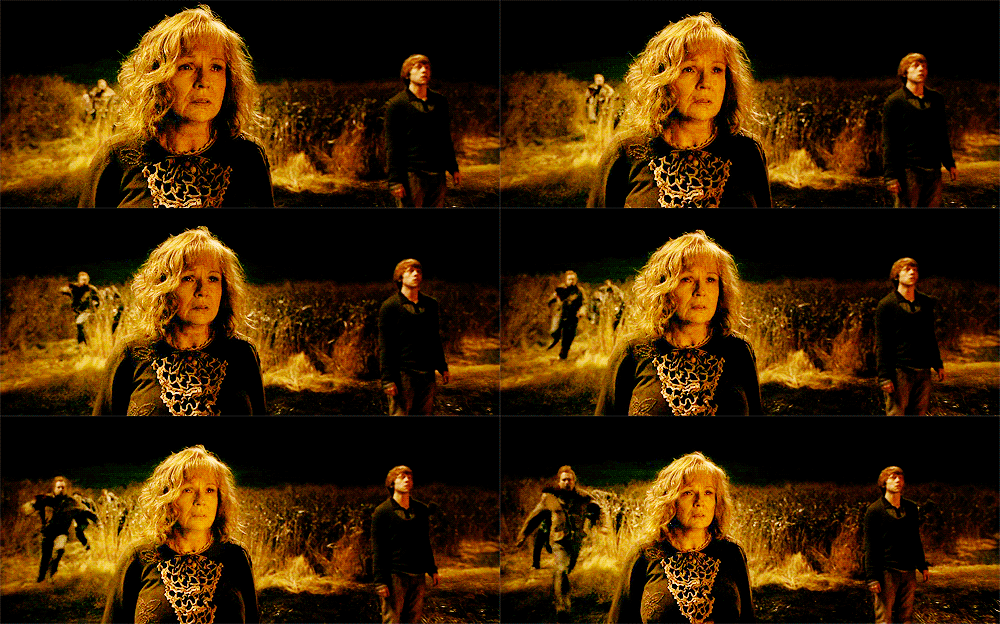
Mel: When people think of motherly influences and figures in Harry Potter, it is likely that Molly Weasley comes up first, and for a good reason. But Lily Potter has always been a lingering favorite of mine both as a character in her own right and her role as a mother. She’s a constant presence in Harry’s life and often her memory is used as a source of comfort for both him and those that knew her. She gets little live screen time in the series, but her aura of protective motherhood is what truly defined her character. After all, it was her sacrifice that saved Harry and granted him lasting protection throughout his life, even when she wasn’t physically there to help him. At the young and tragic age of 21, she gave her life for her only child, knowing the lasting affects it would have. The moment in which Dumbledore informs Harry that the “far more ancient magic” of love protected him from Quirrell and Voldemort in the dungeons is poignant and is a motif that returns multiple times throughout the story.

Lily’s sacrifice pervades the story and serves as the catalyst for Harry’s own ability to provide the same sacrifice for his fellow students the night of the Battle of Hogwarts. She is more a presence and symbolic character than an active mother like Molly Weasley who represents a different, but no less important, form of motherly protection. And I’ve always been drawn to Lily — how the mention of her name seems to quiet rooms and the reminder that one brave young woman, who wanted nothing but to see her son live, could topple the greatest dark wizard in history with something so simple but so deeply felt. Lily Potter is a grade-A mom, despite the tragedy that prevented her from ever truly getting to live out her potential as such.


BEVERLY GOLDBERG
(The Goldbergs)

Maddie: The interesting thing about Beverly is that there is an actual, real Beverly Goldberg (and she is hilarious on Twitter) — which is part of the reason why I think the character is written so well. Beverly could easily fall into a stereotype, but the show conveys her with nuance, depth, and heart. Furthermore, Wendi McLendon-Covey embodies the role so well that she is not just one of the best fictional moms, but one of the funniest characters on television. In my opinion, the core of the humor just comes from the innate truth in the story and her performance. Sure, with a personality even bigger than her hair sometimes, Beverly is a little over-the-top and obsessive, but it doesn’t feel forced. That’s just who Beverly is. She loves so deeply and believes in her kids so much. The show does a good job of show both perspectives. From her kids’ point of view she is “The Original Smother” but we also see that Beverly just wants the best for each of her kids and will not let anything prevent her for being for them every step of the way (even when they don’t ask her to be) or she “has failed as a mother.”

But I love that she is so unapologetically confident in who she is. One of my favorite episode of the show ever is “The Kremps” which contrasts the Goldbergs with their much quieter and seemingly perfect neighbors. At first, Beverly tries to be more like them but realizes that is not who she or her family is. She’s loud, a little overbearing, and drops the F-bomb a little more than occasionally, but on the other hand she is confident and unafraid to stand up for herself or her family. Furthermore, McLendon-Covey plays Beverly with such earnestness and warmth that you can’t help but love her.

clair huxtable gif   clair huxtable gif

CLAIR HUXTABLE
(The Cosby Show)

Amir: Watching Clair Huxtable with her children is to truly understand not only the mechanisms of motherhood, but the mechanisms of black motherhood. Stern, assertive, funny, loving, intelligent, scary, independent, and — most importantly — fair, Mrs. Huxtable manages to balance all of these traits to bring a character who both immensely loves her children, but also has no qualms setting them straight if she has to. She shows care and affection for everyone who crosses her path, but will never allow herself to be stepped over or spoken down to. She tears into a son-in-law who doesn't grasp that his wife shouldn't "serve" him, and she puts fear into her own children when they do anything she deems unacceptable like lying, dressing too provocatively at a young age, and doing anything against the law. While growing up I always sided with the children with a "but that's not fair!" attitude, as I've grown, I appreciate Clair in the same way I appreciate most adult characters from John Hughes movies. She speaks the essential truth that children don't want to hear, ranging from being their safety net to being their voice of reason. If any character has a chance of surviving the tattered reputation of The Cosby Show in this day and age, I sincerely hope it'll be Clair Huxtable.


LORELAI GILMORE
(Gilmore Girls)

Lizzie: Before Lorelai Gimore, I thought mothers were supposed to be... well, more like my mother. Loving and kind and giving, but still, at the end of the day, a mother — the authority figure, and not a friend. Certainly not a partner-in-crime. A mother, to me, was someone who inspired you and showed you the way, but not someone who walked the road of life with you, side-by-side.

Oh, how very wrong I was.

Lorelai showed me that mothers don’t have to be these mythical creatures who know everything — they can be like me: flawed individuals who, in spite of their mistakes, try their best. She showed me that it might be okay to one day think about kids, because, though I’ve never felt I could aspire to be my mother, I always did feel I could do the Lorelai thing — that this version of motherhood was attainable. And mostly, she inspired me to break the wall within my own family. She made me see that we didn’t have to conform to stereotypes, and that our relationships were entirely ours. And she managed to do this all while teaching Rory how to love, how to find your way in the world, and how to be true to yourself.


DONNA SMOAK
(Arrow)

Maddie: Plain and simple, Donna Smoak is the embodiment of sunshine. She is fabulous and I love her. Upon first introduction, Donna simply seems to be a flash of bright colors, big blonde curls, and squeals meant to serve as a foil to Felicity. But we learn that she is so much more than what she wears. She may be different than her daughter in some ways, but Donna Smoak highlights the true strength required to remain positive and see good in the world — a trait we all admire in her daughter. Donna had always wanted to be there for her daughter, but just initially didn’t know how to connect with her. However, as her relationship with Felicity has deepened, the audience sees how fiercely Donna loves and how well she knows her daughter. Donna’s unconditional love, as well as her warmth and wisdom is evident in each of her scenes with Felicity.  She’s a refreshing light in the world of Arrow and has been one of the highlights of this season — largely in part to Charlotte Ross’ amazing and endearing performance. She truly is a character who is both delightful and admirable.


LILY POTTER
(Harry Potter)

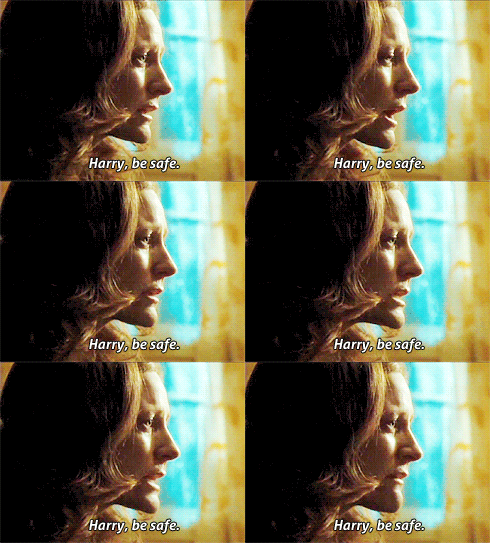
Connie: My love for Harry Potter is two-fold. There is, of course, my love for the world J.K. Rowling has created and her genius in executing it. Then, there is the big similarity between Harry and myself, which brings us to our Mother’s Day post. It is well documented that Rowling wrote much of Harry Potter after the death of her mother. The themes of different kinds of motherly love are spread throughout the series and give the books much of their heart and magic. Lily Potter doesn’t get a lot of page time, but everyone knows her story: a brilliant and spunky witch, she lived during a war, chose to have a child anyway, and sacrificed herself to save him. The magic of her sacrifice ensured Harry could not only live, but defeat the darkest wizard of their age.

Like Harry, my mother also died when I was very young. Too young, in fact, to remember her. I didn’t have a Dursleyish upbringing (I was more like Neville, living with my grandmother), but the similarities in wanting to know more about someone very important to you, but who you have never met always brought me closer to Harry’s story. One of my favorite moments in Deathly Hallows is when Harry finds Lily’s letter. He reads her words, tracing the letters she wrote in her own hand, wanting so very much to be closer to her. The photo he finds, torn in half by Snape, also resonated with me. It’s the one photo Harry finds where he and his mother are in the same photo — yet it is ripped apart. A few years after Deathly Hallows came out, after searching through the massive amounts of photos in my apartment, I came to the realization that there is not one single photo of my mother with me — she’d been too ill or in the hospital. I did, however, find a photo of my mom that she’d sent to my grandmother, where she’d written a letter on the back. I similarly traced her letters and looked to see how my handwriting matched hers — looking for the nature where there was no nurture.

Yet, there is one more similarity I have with Harry that Lily helped me realize. It seems that my mother sacrificed herself to save me. My mother was sick with cancer, off and on for much of her life, but it hit her heavily around the time I was born. That’s one version of a war, isn’t it? She only lived six months after my birth and was sick for that entire stretch of my infancy. The very act of having me was a sacrifice. She’d had two boys before and wanted a girl so much, but in giving that girl life, she lost her own.

Mothers like Lily and my own are actually seen quite often in media, particularly superhero/fantasy stories — it probably explains why I am drawn to them so much. Mothers like them represent the pinnacle meaning of a mother’s love and sacrifice. This year, on Mother’s Day, I want to thank Lily Potter (and J.K. Rowling) for showing me the love my own mother had for me, for showing me what I can never know through fiction.


MARIA VON TRAPP
(The Sound of Music)

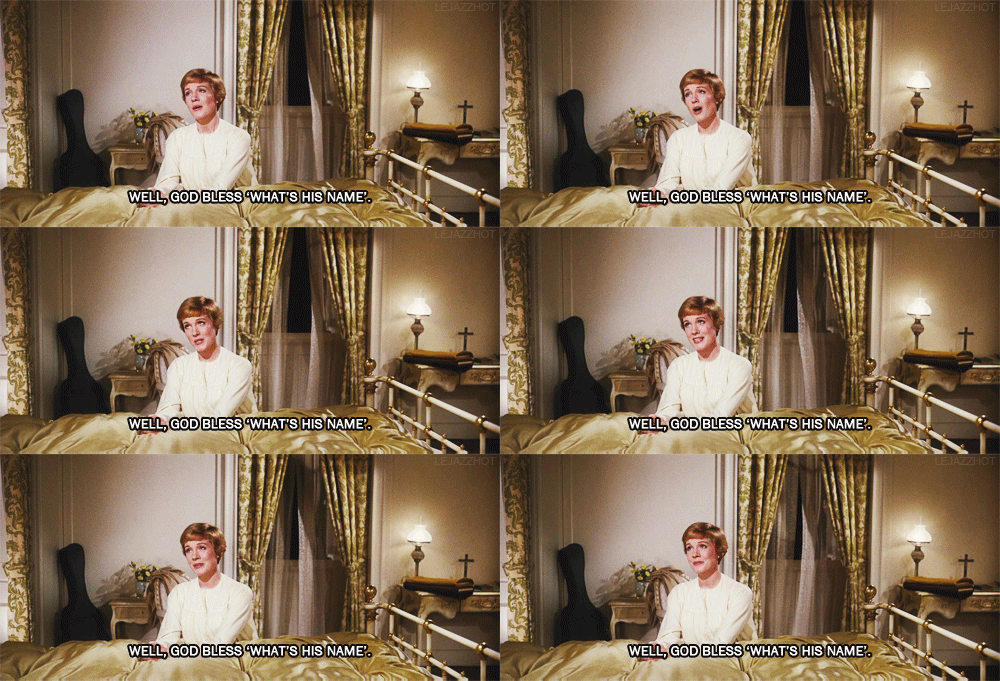
Jenn: I grew up on The Sound of Music, and in spite of the fact that none of the von Trapp children were biologically Maria’s, I love how quickly and naturally she embraced them as if they were. The children didn’t need someone pretending to be their mother — they needed a woman who would love them and treat them kindly. As the relationship grew, Maria truly became a mother to all of the children. And the reason that Maria is such a great mother is simply because of her patience, kindness, and love for the children. She never wanted to replace their birth mother. She simply wanted to be there for these children, no matter if their struggle was related to a relationship or tying their shoes. Her absolutely wonderful demeanor (and the fact that she’s played by queen and hero Julie Andrews) and love for music is what adds to her likability as a person and a mother. A mother is one who constantly supports, loves, and teaches, and this is Maria von Trapp in a nutshell.


ELEANOR WALDORF
(Gossip Girl)

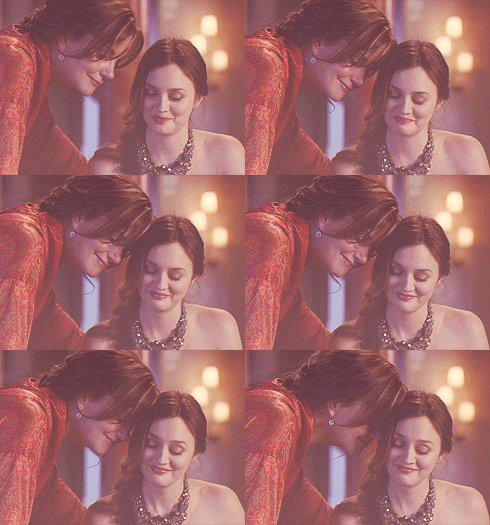
Megan: Blair Waldorf was a very multidimensional character who was both fragile and fiercely strong. She was, after all, Queen B. But it was her mother that we should appreciate. Where Lily van der Woodsen was almost careless in a way and made rash decisions, Eleanor Waldorf was smart. She was business-savvy with her respected fashion house, she was steadfast, she was supportive but she also didn’t always put up with Blair’s nonsense. When Lily would lay down and put up with Serena’s tantrums, Eleanor would call Blair out on them and know when to walk away from an argument. She believed in Blair and what she was capable of — of who she was destined to be. She was willing to do whatever it took to make sure Blair, even in the midst of her royal matrimony scandal, was okay. If it wasn’t for the example Eleanor set, we wouldn’t have been blessed with our Queen Blair Waldorf.


FRANE FINE
(The Nanny)

Maddie: The theme song of this show kind of explains it all. Fran Fine was “just exactly what the doctor prescribed” for the Sheffield family. Long before she became the children’s mother officially, Fran was exactly what each of the three Sheffield children needed. Over the course of the series, we see Maggie, Brighton, and Gracie grow from children still deeply hurting from the loss of their mother to confident young adults who knew they were truly loved. Furthermore, the love between her and the kids is just as important as the romantic love between Fran and Maxwell. Fran brought love and laughter back into the Sheffields’ life, and prompted Maxwell to be a better father to the kids. Her vibrant personality and ways so different from their own helped make the house a home. It was her loving and caring nature, even though it was often conveyed in unconventional forms, that made the Sheffield family whole again.


MOLLY WEASLEY
(Harry Potter)

Jenn: Oh gosh, when it comes to great mothers, how can I not mention Molly Weasley? Not only did she successfully raise her own children, but she also took Harry in as one of her own. When I read Harry Potter, all I could think was: “Molly is the ultimate in mothers.” And the best part about the book series was that J.K. Rowling showcased how strong Molly was, simply because of the fact that she is a mother. She was caring, supportive, and the traditional “mother hen” figure — checking up on her children and praising them whenever they did something great... then sending them Howlers when it was necessary. The thing is, Molly and Arthur never had much. And so it would have been easy for Molly to overcompensate and be ashamed of her modest lifestyle. But she embraced her circumstances and constantly made the best with the modest that she had. Not only did Molly create a life for her family, but she also raised amazing children. She passed on her strength to every child, constantly reminding them of what was important in life and reinforcing their moral codes. She is the reason her children are heroes. And Molly became like a mother to Harry, too, which I think is fantastic. She had so many children to deal with already that it’s incredible she didn’t brush past Harry. She embraced him in every single way that she would have her own flesh and blood.

And if anyone ever threatened the lives of her children, Molly went from completely unassuming housewife and mother to terrifying monster. (I mean, just ask Bellatrix.) I absolutely love Mrs. Weasley and am so grateful that she existed in literature for me as a child.


MARIE BARONE
(Everybody Loves Raymond

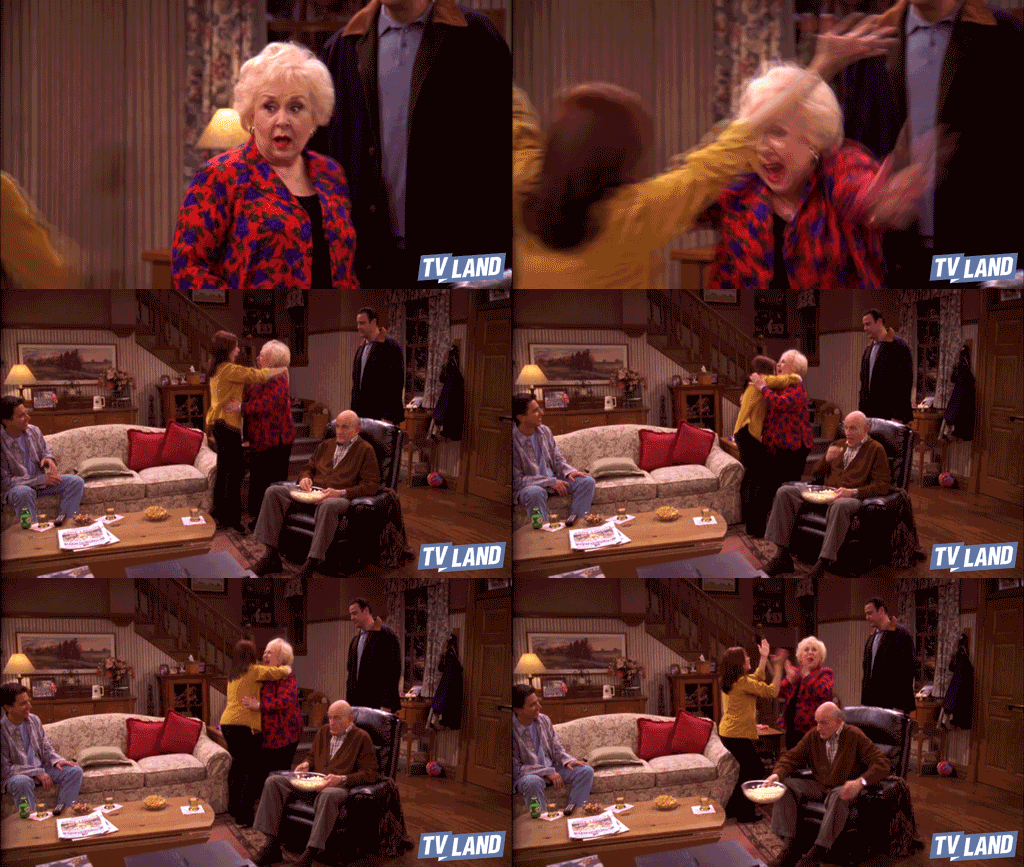
Jon: Seeing as how this week’s TV MVP is focusing heavily on mothers, I figured that I would go back in time to the show that first really impacted me as a young child: Everybody Loves Raymond, which is still one of my favorite sitcoms of all time.

Growing up, I vividly remember the shows I watched with my family on weeknights. A lot of shows came from CBS, which was a staple in my household. The big standouts for us were Survivor, (which my mother still watches to this day), Early Edition (a.k.a., the most underrated show of all time), and Everybody Loves Raymond. The portrayal of your average, everyday suburban American family, featuring some of the zaniest relatives of all time, really struck a chord with me, as it influenced the way I looked at sitcoms and how comedy in sitcoms could truly work.

The best parts of the show, at least to me, were never Ray, Debra, and the kids. Instead, the comedy really shone when it focused on Robert, Frank, and Marie. Out of those three, I connected to Marie the most. She reminded me a lot of my own grandmother, who passed away at the beginning of this year. Marie was always so loving and devoted to her family — always making sure they were okay and fed, and just generally checking on their well-being.

My grandmother was essentially the embodiment of Marie Barone. She was always the kindest, most caring woman, always checking in on her family, making sure we were well taken care of (she always said if we didn’t finish the food, she’d just give it to our dog). My grandmother also loved Everybody Loves Raymond and loved Marie, seeing a lot of herself in the character. With the recent passing of Doris Roberts, paying tribute to both wonderful women seems like a fitting gift for Mother’s Day.


LESLIE KNOPE
(Parks and Recreation)

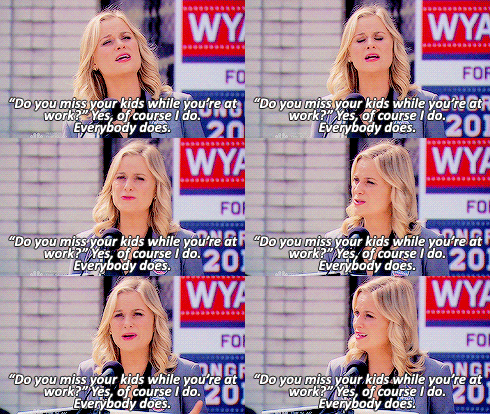
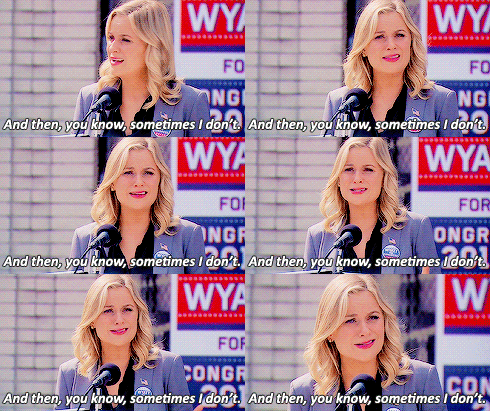
Jenn: Though we don’t get the chance to see a lot of her in action as a mother in Parks and Recreation, Leslie is such a role model and inspiration. A feminist who believes in women taking charge of their own destinies, Leslie is a wonderful mother because she cares deeply about her children. She loves them and is committed to them, just like she is committed to her marriage and her career. Leslie is everything a mother should be — caring, considerate, supportive (you just know that she’ll be the embarrassing mom at every one of those debate tournaments or chorus concerts), and invested. I think this is one of the best words to describe Leslie Knope, really. She is wholeheartedly invested in the people she loves. Nothing is too silly to celebrate, no circumstance too small to be recognized. This is a woman who makes a plethora of scrapbooks of her children (proof, again, of how invested she is) and who will be their biggest support and cheerleader. I love Leslie so much, and I’m grateful that Parks and Recreation was able to give us a glimpse into motherhood for her.

https://45.media.tumblr.com/37d72df502b5cd41db803df778bdadb6/tumblr_o0fy6p3riQ1v38qvqo4_r2_500.gif

DONNA ROSEWOOD
(Rosewood)

Alisa: Rosewood entered the television scene this season like a ray of sunshine. It’s the show I didn’t realize I was missing, but now don’t want to live without. There are so many great characters on this show, but the one that holds everyone together is the Rosewood matriarch, Donna Rosewood, played by the mesmerizing Lorraine Toussaint. Donna Rosewood is everything you hope for in a mother — fierce, loyal, loving, protective mama bear, and deliverer of hard truths. She is by no means perfect, and her relationship with her two adult children reflects all of the nuances and complexities of real life. She is overprotective of her son, Beaumont (Rosie) Rosewood, who suffers from a wealth of health issues due to his premature birth. She did not react well when her daughter, Pippy, came out as gay, and though she fully accepts her now, it took them years to rebuild their relationship.

The best thing about Donna is that despite the real flaws her character is infused with, she is her children’s biggest supporter and advocate. She will defend them on any issue and she backs them 100% (though she’s not afraid to tell them privately when she thinks they’re making a mistake).

Donna also serves as surrogate mother for Pippy’s partner, Tara Milly Izikoff, known affectionately as TMI. TMI was disowned by her own family after she came out as gay, and Donna has made it her mission to shower TMI with all the love and support she should have received from her own mother.

Donna is truly the foundation that underlies not only the Rosewood family, but the entire show. If one day I am even half the mother Donna Rosewood is, I’ll know I’m doing something right. I’m so thankful to have found this show, and that characters like Donna Rosewood, and actors like Lorraine Toussaint, are there to inspire week after week.


MOLLY WEASLEY
(Harry Potter)

Megan: When I was in elementary school, a phenomenon took over the literary world. Harry Potter burst into my life and has been a major part since. While everyone was finding characters to identify with (I’m part Hermione, part Neville and a dash of Fred and George, with the appetite of Ron), I found myself gravitating more and more towards Molly Weasley as the series went on. She was the type of mother that I wanted, and that was perfect for the seven strong brood that she had charge over. (Later nine if you counted how often Harry and Hermione were with them.) She was sweet and caring, but also stern and commanded respect.

When we first meet her, she’s ushering four of her children off to Hogwarts and has one in tow. Instead of shrugging him off, she assists Harry in getting through the barrier to the train. She could have been annoyed that he had no idea how to get on the platform, but she wasn’t. She helped him in a warm, maternal way. And she only got better from there. Molly was angry that her sons had gone to rescue Harry, but understood that he needed the rescuing and was keen on doing so herself in the second book. In the third book, she made sure that Harry had everything he needed. Even when she wasn’t sure how she was going to afford to send all of her children to school with all of the right requirements, she never let on that she was worried and always made sure that Ron’s best friends had what they needed.

As the series continued, Molly was the mother that we all had wanted. She made sure her children ate, and also that they knew she was proud of them. She kept up tradition (knitted jumpers, anyone?) too. Even in the face of impending doom, Molly made sure that Fred and George appreciated their success, that Ron and Harry had wonderful 17th birthdays, and that Bill and Fleur had a magical wedding to remember.

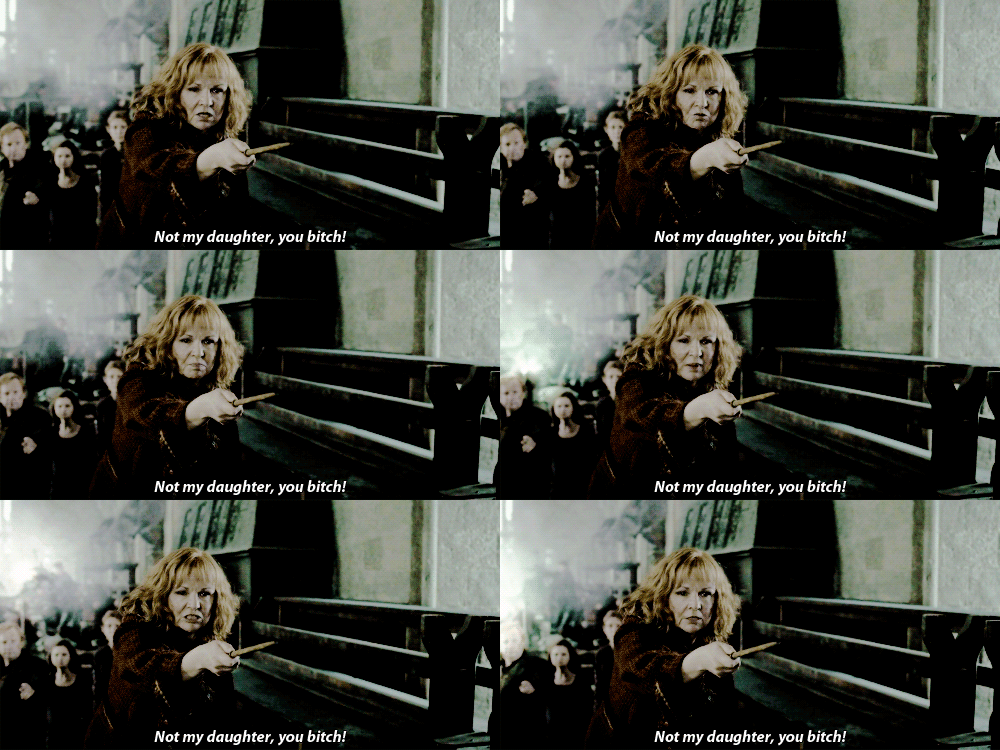
Not only that, but Molly Weasley didn’t hesitate to participate in the Battle of Hogwarts and fight to protect her family, screaming the single greatest line that had me jumping out of my bed through my tears — “Not my daughter, you bitch!” as she struck Bellatrix down. It was amazing, it was perfect, and in a world where love needed to triumph, she was the true heart of the Weasley family.

Who are some of your favorite fictional mothers? Hit up the comments below and let us know! And a very happy Mother's Day to all of you mamas out there. :)

Sunday, April 17, 2016

Series: This Week's TV MVPs - Week 35


Much like Taylor Swift in the GIF above, around here, we are dancing too — because the TV MVP Series is back at it again this week! And many thanks to Rae for filling in while I was at the beach last weekend. As we begin to approach sweeps and finale dates and descriptions are being released, performers are bringing their A-games to their shows, whether comedy or drama. And this week, we have some fantastic performers to highlight. Let's kick it off, then!

Joining me are: