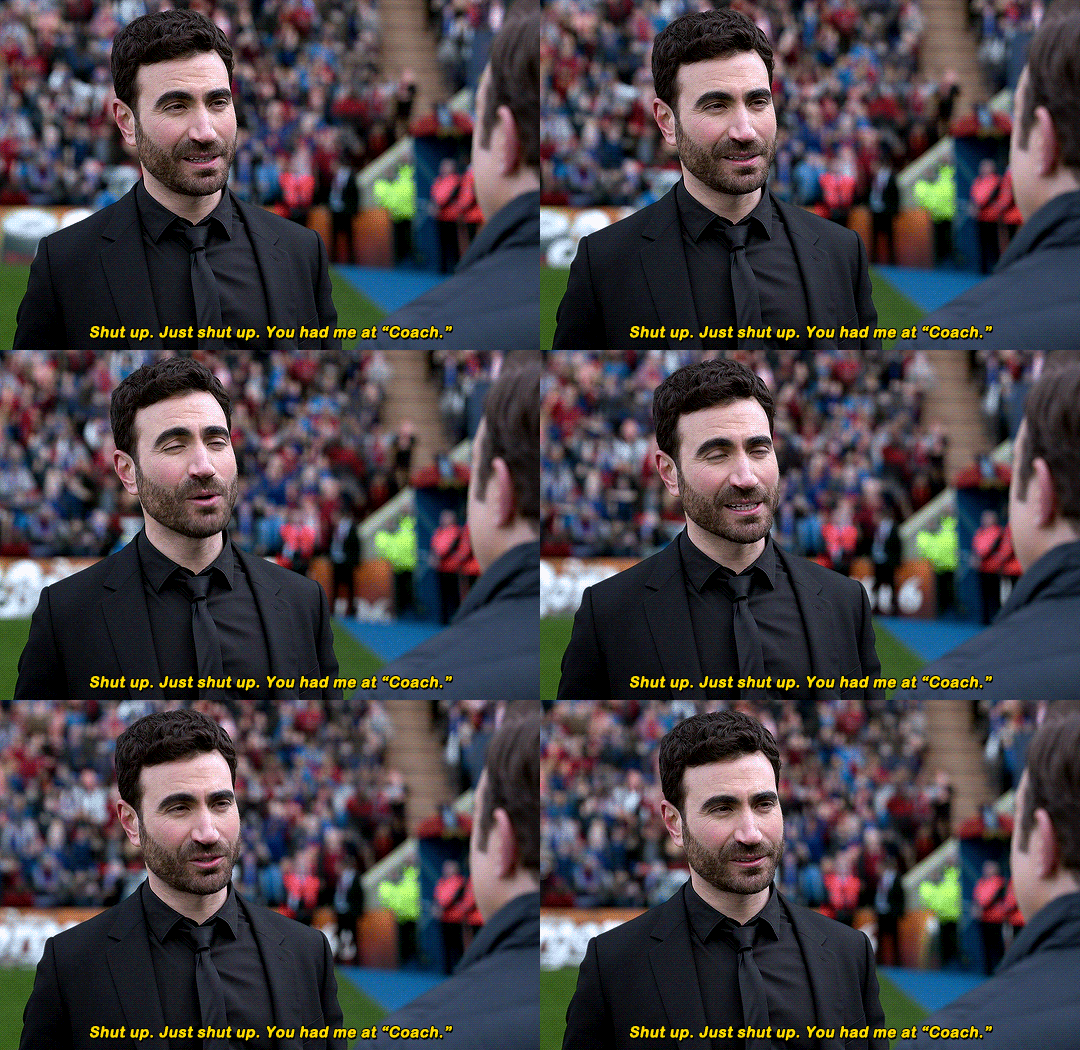
Ted Lasso, Rom-Coms, and Emotional Vulnerability

Why is it important that a show about men who play soccer did a rom-com homage?

Dickinson Behind-the-Scenes: An Interview With the Artisans

Meet the artists who brought the Apple TV+ series to life!

If You Like This, Watch That

Looking for a new TV series to watch? We recommend them based on your preference for musicals, ensemble shows, mysteries, and more!

Showing posts with label the office. Show all posts

Thursday, April 10, 2014

Will-They-Won't-They: A Study in the Success & Dangers Of This Trope


My darling friend Julieta tweeted something recently that really made me think. She wrote: “I don’t understand why TV writers in general are so scared of having their characters fall in love and then be in long-term, committed relationships.” Rather than, as Julieta noted, have characters fall in love and be in committed relationships, most comedies fall into the largest pothole in the world (reminiscent of this one): the hole of the “will-they-won’t-they” relationship.

Now, these relationships have both merits and drawbacks. A good television series won’t drag out the “will-they-won’t-they” for seasons upon seasons without any seeming conclusion, be it good or bad. A good television series will recognize the fact that this relationship is a tool and a powerful one at that: it provides the show with an added layer of tension that lures audience members in and promises them romance and intrigue. A good television show will use this relationship to its advantage by having it GO somewhere. A good television show will realize that there is a precise and delicately balanced window of time in which their characters need to act on their romantic tension, lest the audience feel deceived at best and downright infuriated at worst at a lack of development. A good television show cannot draw out a “will-they-won’t-they” forever, because if they do, they won’t be a good television show anymore.

Relationships are the hinge on which all of humanity swings, so it makes sense that it is the hinge on which television sitcoms seem to swing as well. There are friendships and families and romantic relationships on television just as there are in real life. The problem, however, is that television writers often find it so difficult to mimic real-life relationships. Why is this? Because writers are afraid that their audiences are restless and fickle and if they commit to one thing for too long – one character or one romantic pairing or one plot – that their fans will lose interest. “Will-they-won’t-they” relationships are the obvious (quick) remedy to this fear of audience boredom and subsequent abandonment if, and only if, they are executed correctly.

What I thought I might do is take a look at some of the “will-they-won’t-they” relationships that have piqued my interest over the years and discuss the merits and drawbacks of each as they affect the television comedy series as a whole.

Saturday, April 5, 2014

It's A Man's, Man's, Man's World (But It Would Be Nothing Without A Woman)


I feel like the majority of the stories that I post here begin with "I was talking to my friend Kim." But I was talking to my friend Kim recently about Community and some qualms we have been having with the writing. I told her that what the show truly needs is to return to a balanced writing staff a la season one with an equal number of both males and females. That led me down an interesting rabbit hole in attempting to discover exactly HOW many episodes per season of Community were written or co-written by female writers. After I made a rather startling discovery, I decided to apply this investigative work to more of my favorite network television comedies and made some more pretty starling discoveries, as well as developed a hypothesis based on my raw data. (Look at me sounding all science-y and stuff! You'd hardly know this was a writing blog.)

So, before I break down each show and its seasons, let me explain what you'll be reading and how I recovered the data/what it means:

The shows: I studied Community, New Girl, Parks and Recreation, The Office, and (to a lesser extent) The Mindy Project.

How I came up with the data: I researched the episodes in each season that have aired. (*Now updated since the seasons are over, to reflect the final percentages!) If a single episode was written solely by a woman or by a pair of women, I counted it as 1 point. My reasoning, of course, is that I am mostly focusing on the number of episodes penned by women. It doesn't matter if one or two or a hundred women write an episode: it counts as one episode. If a single episode was written by a writing team consisting of a male and female, I counted it as 1/2 of a point. I gave women like Annie Mebane and Amy Poehler credit if they wrote with a partner because, duh, they still wrote something!

What it all means: This data is obviously a baseline, not an end-all-be-all set of numbers. A variety of factors played into the percentages -- the number of episodes per season is, of course, a major factor. The larger number of episodes in a season, the less likely that there is a large percentage of episodes written by females (as sad as that is to type). Additionally, the size of the writing staff and the diversity among the staff plays a factor in the number of episodes written by women. Shows with a high turnover rate among the writing staff will also factor into this number. Again: it's not a conclusive set of data, but it's definitely interesting to watch the trend among certain shows rise and fall.

And now, without further adieu, let's take a look at some of the shows on my list!