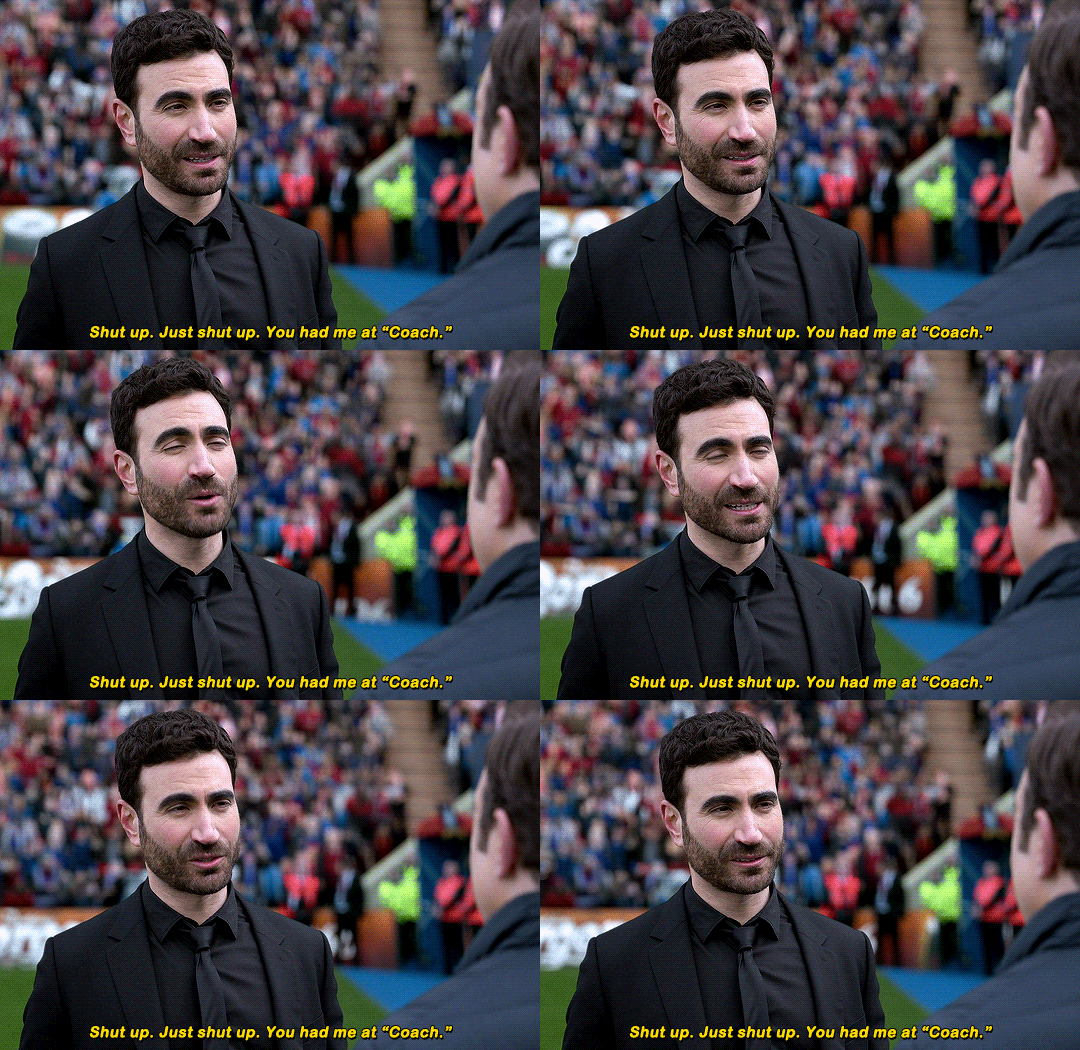
Ted Lasso, Rom-Coms, and Emotional Vulnerability

Why is it important that a show about men who play soccer did a rom-com homage?

Dickinson Behind-the-Scenes: An Interview With the Artisans

Meet the artists who brought the Apple TV+ series to life!

If You Like This, Watch That

Looking for a new TV series to watch? We recommend them based on your preference for musicals, ensemble shows, mysteries, and more!

Showing posts with label dickinson. Show all posts

Sunday, May 9, 2021

Dickinson Behind-the-Scenes: An Interview With the Artisans [Contributor: Jenn]

(Image courtesy of Apple TV+)

Recently we had the opportunity to hop onto a Zoom call and interview some of the people who make Apple TV+’s series, Dickinson, such a success. We heard how much everyone loved their respective crafts, got behind-the-scenes information on how some of our favorite moments came to be (looking at you, “Split the Lark”), and had not-so-subtle hints that season three was going to break some more boxes!

BEHIND THE MUSIC

One of the most impressive things about Dickinson is the incorporation of modern music with the 19th century story. Don’t believe Billie Eilish has a place in the life of Emily Dickinson? Think again! Ian Hultquist and Drum & Lace talked about the decision to integrate contemporary music into a period piece — something the show desired from the beginning.

“I think the trick was exactly figuring out how to implement that [juxtaposition],” Ian said. “At one point I think someone was suggesting having classical instruments, but playing hip hop. Or some people were saying it should be an all rap score.” He continued: “I think the trick for us was finding that fine medium.”

Drum & Lace noted that the choices that DeVoe Yates made as a music supervisor and the choices showrunner Alena Smith made as showrunner informed their decisions as composers. “We wanted to create something that sounded contemporary and fresh but also adds nods to bigger artists — something that sounded familiar,” she said. 

“We were given a lot of room to experiment,” Drum & Lace noted. “We’re really excited for how season two turned out and what season three holds for us.”

One of the biggest achievements in season two musically was “Split the Lark,” and the composers discussed how proud they were that everything came together the way that it did. “I think the most amazing part was knowing that it was going to be such a big plot point,” Drum & Lace noted. 

She noted that the first version of the song was relatively simple and scaled back — just a guitar and a voice. But then, Drum & Lace said: “We imagined it really like a Bond song. What is this sexy, beautiful ode to Emily’s poetry.” The composers noted that it was a really fun process to put the song and scene itself together. 

“It was so fun because it felt like a real collaboration between all parties,” Ian noted, “even [the] cast which we don’t get to do really often so that was exciting.”

As far as looking back on season one, the two composers noted that the Death scene was the most fun for them to work on, and Ian said: “That was one of the earliest things that we wrote.” The two also loved composing for the opening credits because they were left to their own devices and creativity.

Similarly, DeVoe noted that prior to Dickinson, he’d been working on a lot of projects with older music so the task to bring contemporary music into the 19th century was “exciting and daunting to be fresh with it but also be different from current shows. So it’s exciting.”

AESTHETICALLY PLEASING AND PERIOD SPECIFIC

Even though Dickinson musically departs from the 19th century vibe, aesthetically everything — from costumes to hair and makeup and production design — stays relatively within the confines of what’s expected from a period genre. But that doesn’t mean these artists can’t push the boundaries and limitations in order to experiment and also pay homage to what’s happening in the characters’ lives.

“I always start with the period and what’s true to the period,” Jennifer Moeller, the show’s costume designer said. “And then I do sort of filter it through a contemporary lens. I sort of pick and choose the details that I feel will set well with the modern eye. … One of the greatest challenges, truly, is the resources.” 

Jennifer admitted that she gets a lot of questions about where she gets the clothes for the show. “People don’t always realize that we make the bulk of them. … All of Emily and Lavinia and the menswear? They’re all made. Finding material … is a real challenge. We go all over the world to find that stuff.” 

Ande Yung, the show’s makeup department head, talked about how collaboration is key between the departments and the actors, and that they always start out with a blank canvas in terms of makeup. “We think, ‘What’s appropriate for the situation they’d be in? … Sometimes Emily has a little more of a flush to her cheek to represent [that she’s a free spirit].”

Ande loved doing the makeup looks for “Split the Lark” because it involved collaboration with the Metropolitan Opera to research what kinds of looks would have been common for the time period on stage at an opera, and how they could do stage makeup based on that. “Being able to have some creativity was such a joy. I loved it,” she said. 

Neil Patel, the production designer for the show, also talked about his ability to play with modern elements of period pieces: “I made choices [for the Evergreens] that gave a kind of luxury and beauty for the set. … We avoid anachronisms but hopefully it feels fresh and appealing to the audience.”

LOOKING AHEAD

When asked what they’re looking forward to doing that they haven’t done yet whether aligning with the period piece elements of the show or breaking the boxes, the artisans got quiet and then laughed, not wanting to reveal anything about season three of Dickinson. 

“We’re doing all those things that you’re talking about!” Jennifer said with a laugh.

It sounds like whatever is in store allows for the chance for hair, makeup, music, and production design in the next season of Dickinson will be amazing and so much fun.

Many thanks to the artisans for taking time for a Zoom call! Be sure to catch up on the first two seasons of Dickinson which are available on Apple TV+ now.

Tuesday, November 5, 2019

Dickinson Proves to Be an Insane Ride and a Hot Mess [Contributor: Jenn]

(Image credit: Apple)

In 2018, I got my first tattoo. It’d been something I’d contemplated for a few years and finally decided to get. The tattoo is an anchor breaking apart into birds, and I felt it represented two elements of the word “hope,” a word that I leaned into throughout 2017. One part of the tattoo is representative of a quote saying hope is an anchor for our souls, and the other is representative of my favorite Emily Dickinson poem about how “hope is the thing with feathers that perches in the soul.”

When I saw that Apple TV+ was making a show about Emily Dickinson I was intrigued. And I was even more interested when Hailee Steinfeld, of Pitch Perfect and Transformers recent fame, would be playing the lead. And then the first trailer for the series dropped and I immediately felt a simultaneous sense of confusion and disappointment. Emily Dickinson was using the word “dude,” the characters were implementing 2019 slang, and it all seemed to be representative of the kind of show that happens in a world where Glee and Riverdale also proudly exist. Was I signing up for a period comedy/drama or a soapy teen series where people wear period clothes but also dance around to Lizzo?

I’ll readily admit that for the first half (or perhaps a bit more) of Dickinson, I hate-watched the series. Like I did with Glee. Like I did with Smash. And like I’ll undoubtedly do many more times. I texted two of my best friends, former English majors like me, and told them that it was a trainwreck but I also couldn’t stop watching it. Isn’t that just like modern television though? TV doesn’t always have to be particularly award-worthy to keep us invested, especially these days — it just has to be more interesting and bizarre than anything else rivaling our attention.

And I won’t lie to you: Dickinson is certainly bizarre.

I think what could have made this show immediately genius is if Emily Dickinson, poet ahead of her time, was the only one to speak in modern slang. If everyone else in the series seemed stoic and stuck and a little rigid, Emily Dickinson would’ve stood out. She’d be imagining Death as Wiz Khalifa, and slipping into fantasies and challenging the status quo, and she would’ve been misunderstood and genius. The audience would have clearly seen that.

But that’s not what happens in Dickinson. Emily’s sister Lavinia says “woke.” The young adults dance like they’re in a 2019 club. And even Emily’s parents seem to slip in and out of modernity. That’s what’s so jarring about the series: everyone feels like they were told they’re on a different show. Some were instructed to act only as if they were in a BBC period drama (Toby Huss, who plays Emily’s father, is one such example), while others were not. It’s... incredibly jarring and off-putting to watch the characters slip in and out of modernity.

And honestly, it’s what makes the show hard to connect with. Is Emily Dickinson supposed to be a poet ahead of her time or just Hailee Steinfeld in a teen drama on the CW? The constant shift between Emily Dickinson’s deeply 19th century voice in her writing (the episodes open and generally close with her reading a poem aloud while the text is also floating across the screen) and her modern-day slang keep me unable to understand what the show’s trying to accomplish by it’s seemingly random use of modernity. Nothing else about the show focuses on 2019: the costumes, sets, and technology are all distinctly period elements. So for the dialogue and musical decisions to be a jumbled mess of current and past rhetoric feels... well, less than ideal. It takes the viewer out of the story, and leaves us questioning why we should believe any character would be saying the things they are in the 19th century.

That doesn’t, however, mean Dickinson is without redemption. While the plot of Emily Dickinson’s life lends itself to some scandalous soapy drama (she’s pretty much explicitly depicted to have romantic, reciprocal feelings for her best female friend in the show), the highlight of Dickinson comes in the form of Hailee Steinfeld’s dramatic acting.

The show excels when it leans into the things that made Emily Dickinson compelling, not just scandalous. The series seemed to jump out of the gate trying to be edgy, fun, and relatable (hence the dialogue and incorporation of pop music), but that didn’t work for me as I noted above because it was haphazard and lifeless. The true highlight of the series was found in the exploration of Dickinson’s emotional complexities.

There’s a scene later in the series where Dickinson pleads with Death, and it proves that Hailee Steinfeld can really elevate whatever she’s acting in. She’s the emotional heart of the series and when she’s allowed to be a poet who feels like she’s alone — in her head, heart, and world around her — you palpably feel that pain and tension between where Dickinson is living and where she wants to be. We hear her inner critics and people beyond her own head, like her brother, tell her that she’s ordinary. They tell her that there’s nothing special about her.

It’s heartbreaking, but it works because it allows us to see cracks in Emily Dickinson’s exuberant, larger-than-life character. Tonally, the final three or four episodes of the show began to prove to me what the series should have been from the beginning. Dickinson works when I’m compelled by its characters, not distracted by their dialogue. The problem is that it takes most of the first season to get to that point.

I pretty much only stuck around with the show because I wanted to watch it implode on itself (which it does throughout the first six or so episodes), and because I needed to see John Mulaney play Henry David Thoreau. But then I found myself genuinely struck by the ending of “Faith Is a Fine Invention” and wondered why it had waited so long to try and hook me, emotionally. I still don’t know where I land on Dickinson — it’s a trainwreck and a hot mess and, because of that, genuinely compelling for (probably) not-so-great reasons. But it also has something right there, beneath its surface: a genuine possibility to be something great if it’s willing to shed its need to be shocking or subversive. The mish-mashed dialogue doesn’t work; Steinfeld’s performance does.

Emily Dickinson was interesting on her own, and I wonder if the creators were worried she wouldn’t be compelling or interesting or fun enough without trying to turn her into some soapy heroine. Episodes in the latter half of the first season strip those parts away gently. While the modern dialogue still exists, we see characters subvert expectations in other, far more organic ways (there’s an absolutely wonderful moment where Lavinia decides to stand up for herself at the end of episode nine, and some touching moments with Austin in the seventh episode).

I hope that Dickinson allows more people to discover Emily Dickinson’s poetry for exactly what it was: complex, deeply emotional, rooted in questions about faith and life and hope and death. And far, far ahead of its time. If the show manages to do that, at least, maybe I can forgive its transgressions.

Maybe.