Ted Lasso, Rom-Coms, and Emotional Vulnerability

Why is it important that a show about men who play soccer did a rom-com homage?

Dickinson Behind-the-Scenes: An Interview With the Artisans

Meet the artists who brought the Apple TV+ series to life!

If You Like This, Watch That

Looking for a new TV series to watch? We recommend them based on your preference for musicals, ensemble shows, mysteries, and more!

Showing posts with label american gods review. Show all posts

Sunday, June 18, 2017

American Gods 1x08 Review: "Come to Jesus" (A Storm Breaks) [Contributor: Deborah MacArthur]


"Come to Jesus"
Original Airdate: June 18, 2017

[Warning: The following review contains spoilers.]

It’s finale time for American Gods! I usually judge finales by how well they tie up all the loose ends, but I went into this show knowing that the first season was only going to cover roughly the first hundred pages of the book so I suspected the finale would just be littered with cliffhangers. To my pleasant surprise, American Gods manages to structure its first season finale in a way that provides closure on some key ideas and character arcs, even as it clears the storytelling path for future seasons.

A STOLEN QUEEN


We didn’t see how they arrived since last week’s episode was all about Mad Sweeney and Laura Moon, but “Come to Jesus” opens with Wednesday and Shadow sitting in a house while Mr. Nancy sews them some fancy suits. Old Anansi is more than just a tailor, though — his primary role is as a weaver of tales, not of cloth. Mr. Nancy entertains the impatient Wednesday and angry, confused Shadow with the story of a queen in ancient times, who was worshipped by many and was slowly forgotten.

It’s the story of Bilquis, the goddess of love who has spent this season longingly gazing at museum artifacts even though she seems to be getting all the prayers she should need from the people she takes to her bed. Bilquis’s arc — her journey from real belief when she was a queen, to the empty connections she makes through meeting up with people via dating apps — shows us a goddess’s fall from power and rise to a different, less satisfying power. Bilquis is worshipped, but not in the same way she was worshipped before. She has power, but it’s a parasitic power; it relies on the aid of the New Gods, which means the belief of her followers is siphoned off by another deity and she faces starvation despite constant consumption.

There’s an interesting thread of the fall of female power in Bilquis’s story, representative of the ancient worship of the feminine that was transformed into worship of the masculine over time. Bilquis wasn’t forgotten because people stopped knowing her, but because people were stopped from knowing her, stopped from worshipping queens like Bilquis and turned toward worshipping kings. She was a goddess of love, reduced and laid low by gods of war and conquest. And with femininity being such a crucial part of Bilquis’s existence, it’s really no wonder that the male Technical Boy providing her “lifeline” results in unfulfilling, empty worship that leaves her still wandering museums and thinking back on what used to be.

Mr. Nancy wraps up his story in a little bow for Shadow, who still doesn’t get it, by telling the two men to go get themselves a queen. The New Gods recruited a forgotten queen to their side, so it’s time for the Old Gods to do the same.

A STOLEN QUEEN: PART II


In his Bilquis story Mr. Nancy says, from the perspective of Bilquis, “So long as I’m still alive, I can adapt. I still know what I am.” The declaration is a core idea within all the Old Gods, who struggle to find the balance between adapting (which means survival) and changing (which means self-destruction). Vulcan adapted then changed, and was beheaded for it. Bilquis adapted then changed, and was forgotten for it. And then there is Easter, the goddess Ostara of springtime, rebirth, renewal, and the dawn, who seems to have brightly adapted to the fact that she now shares her day with Jesus in the modern era. It’s kinda easy for her, though, since Jesus — all the Jesuses, of which there are at least a dozen walking around Easter’s mansion in Kentucky — is a super nice guy. He even feels a little bad about stealing some of Easter’s thunder.

The suits Mr. Nancy made for Shadow and Wednesday are because the two of them needed to be adequately dressed for Easter’s stellar Easter celebration. Just when I don’t think I can love Shadow any more than I already do, he meets Easter and is instantly smitten with the effervescent Ostara (played by the effervescent Kristin Chenoweth) to the point where he’s all smiles and blushes whenever he talks to her. Easter and I both agree that it’s darling and Shadow is the actual best.


Wednesday’s goal is to recruit Easter to the side of the Old Gods, because even though she’s not exactly on the side of the New Gods (since her existence relies more on Christianity adopting her day than anything the New Gods have done for her, regardless of what Media says about it) she still denies needing anything more than what she already has. To get Easter on their side, Wednesday claims that Vulcan was killed by the New Gods after pledging his allegiance and forging a sword for him. She’s troubled, but she still isn’t ready to sign up for a war. Furthermore, she has a party to host and people keep showing up uninvited — people like Media and Technical Boy, and Laura and Mad Sweeney.

I originally thought that one of the Jesuses walking around the mansion was going to be the one Mad Sweeney wanted to resurrect Laura, but it turns out that Easter was the target all along. Unfortunately for Laura, Easter says that she can’t do anything to bring her back to life because she was killed by a god. After some severe intimidation from Laura, Mad Sweeney confirms that it was Wednesday who had Laura killed because Wednesday needed Shadow. Why did Wednesday need Shadow? No one seems to know except Wednesday, and I have a feeling he isn’t going to be upfront about that motivation any time soon.

An interesting aspect of American Gods is the lack of a clear-cut line between the “good” and “bad” gods. We’re introduced to the story on the side of the Old Gods and, even though most of us viewers are more likely to worship our smartphones than we are to worship Odin, we see the New Gods as the villains. Of course, it doesn’t help that Technical Boy is hideously unlikable and Mr. World is just odd — but Wednesday isn’t exactly the most upstanding or endearing individual either, since he recruits Easter under false pretenses and manipulates her from the second he sees her.

Wednesday is using Easter, just as he’s using Shadow, just as he used Mad Sweeney and he used Laura Moon. The New Gods stole their queen and Wednesday is stealing his, but the show uses Wednesday to add a veneer of custom, tradition, and glory to the Old Gods that makes them seem more genuine than the flashy New Gods. Wednesday is manipulating us, the viewers, the same as he’s manipulating the characters around him: by presenting us with a narrative that makes us rather believe in him over them. If anything, Wednesday’s recruitment of Shadow is just a way for him to further this long con because Shadow is, more than anyone else in this brewing battle, good. By aligning Shadow with himself, Wednesday reinforces the illusion of being on the honorable side of the fight, and we believe it.

On this show, ancient gods are as mercurial and shifting as they need to be to survive and keep their power, and this episode underlines their need to adapt without destroying themselves. If the Old Gods don’t want to adapt to the world, like Bilquis and Vulcan and Easter have tried to do, they must follow Wednesday’s path and force the world to adapt to them. Things happen, as Wednesday says, because gods make them happen — and gods happen because people want to know why things happen. The Old Gods just need to give humanity questions to ask and inspire wonder, then they can return humanity to the simpler worship they followed before, when Old Gods thrived.

The episode ends with Wednesday telling Shadow who he actually is: “I am called Glad-of-War, Grim, Raider, and Third. I am One-Eyed, I am also called Highest and True-Guesser. I am Grimnir and the Hooded One. I am All-Father, Gondlir, Wand-bearer. I have as many names as there are winds, as many titles as there are ways to die. My ravens are Huginn and Muninn, Thought and Memory, my wolves are Freki and Geri. My horse is the gallows. I am Odin.”

Wednesday — Odin — kills some faceless New God henchmen in the name of Ostara and, bolstered by the dramatic speech and the deaths in her name, Easter shows her own power by going old-school and taking Spring from the world around her. The people can have it back, says Wednesday, when they pray for it. After such a fantastic show of ability, Wednesday asks Shadow if he finally believes. Shadow says that he does. He believes everything.

The war between the gods has officially begun.

Afterthoughts:
  • “More Mr. Nancy” is at the top of my list of things I want next season. “More Ricky Whittle being the best Shadow Moon that could ever be” is in second place, only because it’s pretty much a given.
  • Wednesday’s utter inability to understand the human perspective is still one of my favorite things about the character. Shadow is angry that he watched the guy cut off Vulcan’s head then dragged him off to get a suit and Wednesday’s response is “You’re getting one too!”
  • The Believe Buffalo returns to Shadow in this episode! Fitting, since this is the episode in which Shadow finally learns to believe.
  • For a second I thought a song and dance number was about to start when the faceless henchmen began marching around Easter. I wouldn’t put it past this show.

Sunday, June 11, 2017

American Gods 1x07 Review: "A Prayer for Mad Sweeney" (Tall Tales and Fallen Kings) [Contributor: Deborah MacArthur]


"A Prayer for Mad Sweeney"
Original Airdate: June 11, 2017

[Warning: The following review contains spoilers.]

“A Prayer for Mad Sweeney” works as an elegant way to further flesh out the American Gods universe. It reinforces how gods or the godlike get to America via the stories and belief of the human beings who travel to America, and the importance of the Old Gods in the lives of their believers. Through some plain wonderful storytelling and great acting work by Emily Browning (who plays the double role of Essie MacGowan and Laura Moon) and Pablo Schreiber (as Mad Sweeney) American Gods somehow manages to enhance its world and characters with an episode that, with any other show, would have probably been dismissed as filler.


COMING TO AMERICA


We get a brief look at the daily lives of Mr. Ibis and Mr. Jacquel as they work in their funeral home. Mr. Jacquel foretells who their future customers will be as Mr. Ibis (kinda adorably, to be honest) talks about the historical pedigree of his home-brewed beer and lectures his partner on working too late. In turn, Mr. Ibis gets some prompting from Mr. Jacquel to write one of his Coming to America stories, which he sits down at his desk to do — after a second’s hesitation, since he had no idea that the story was in him to write until Mr. Jacquel told him it was there.

Mr. Ibis’s story starts in 1721 and stars Essie MacGowan, an Irish girl who drinks up tales of faerie folk and leprechauns and believes them whole-heartedly. When Essie grows older, she gets a job working in the kitchen of a rich family and seems to spend just as much time spreading tales of the fae as she does doing actual work. The end to Essie’s employment and the beginning of her troubles comes when she has a dalliance with the family’s son. He gives her an heirloom necklace then turns her in as a thief when she’s caught with it. Essie gets sentenced to “seven years transportation,” which is just a fancy way of saying that she’s sent on a ship to America to work as an indentured servant for seven years and then, maybe, carve out a new life for herself in the New World.

Essie convinces the captain of the ship she’s on to release her from her servitude and take her to London with him as his wife instead. As soon as Essie’s left alone after the captain goes on another voyage, she fills a bag with as much of his silver as she can manage and begins a new life alone as a shoplifter in London. Essie had been branded a thief when she hadn’t been one, so it seems she’s just living up to the label.

Throughout Essie MacGowan’s complicated life — including getting charged with stealing again, sentenced to hang, and getting pregnant by the prison guard so that the sentence would be demoted to transportation — she almost consistently keeps her faerie folk in mind. She takes the stories with her when she’s sent back to America as a maid and a wet nurse and tells them to the children in her charge, and the child she eventually has as the wife of the man to whom she was indentured. Essie’s belief in the stories of her youth pulls those figures into America, where they must stay — even when people stop believing the charms against faerie wrath or how a bowl of milk on the windowsill or a loaf of bread at harvest might turn one’s luck from ill to good.

When Essie is an old woman in Virginia, after her children have grown and her grandchildren are more frightened by her stories than enthralled by them, a leprechaun steps out of the darkness to thank her for her devotion. We know him as Mad Sweeney, but Essie only knows him as one of the figures of her beloved tales, a reminder of her happy days as a little girl waiting for her father’s ship to return to shore. When Essie’s long, complicated, good-and-bad life comes to an end, it’s Mad Sweeney — the leprechaun she’d dragged from Ireland through heartfelt belief, probably to his detriment, though he would never resent her for it — who takes her hand and leads her into the afterlife.

This story of Essie is what Mr. Wednesday was talking about during “Lemon Scented You” when he told the New Gods that the Old Gods offered more than a way to occupy people’s time. The Old Gods aren’t simply there to use humans as belief batteries, to take and take and take and give nothing in return. They offer meaning, a connection to the past, and comfort born of tradition and deep faith.

ECHOES FROM THE PAST


Back in the present, Mad Sweeney and Laura are travelling in a stolen ice cream truck after Laura sets Salim free to go find his jinn at the House on the Rock in Wisconsin, where all the gods and demi-gods will be meeting for Mr. Wednesday’s plans. Mad Sweeney and Laura still need to get to Kentucky, where Laura can be resurrected and Mad Sweeney can get his coin back and be free of her. The ice cream truck seems like a great fit for Laura, since she can use the freezer and air conditioner combo to keep the meat on her bones long enough to get to where they need to go.

We get scenes of these two on their travels cut between scenes of Essie’s life story, and they’re not just connected because of Mad Sweeney. Beyond the simple fact that they’re played by the same actress, both Essie and Laura share certain specific traits. Both are ambitious women who don’t shy away from the idea of doing immoral things so long as it gets them what they want in life, and both slowly learn to make peace with the hands they’ve been dealt.

Laura is still working on the latter aspect, but the fact that she performed a selfless act in letting Salim leave, and that she clearly began to appreciate his outlook on life and learned to respect his faith, means she’s making progress. She’s still driven, still acerbic, and still difficult to like as a person — but she’s evolving and changing for the better. The way that American Gods frames the characters of Essie and Laura as kindred souls through time not only gives us a way to relate the past to the present, but also hints at what’s to come for Laura’s personal journey.

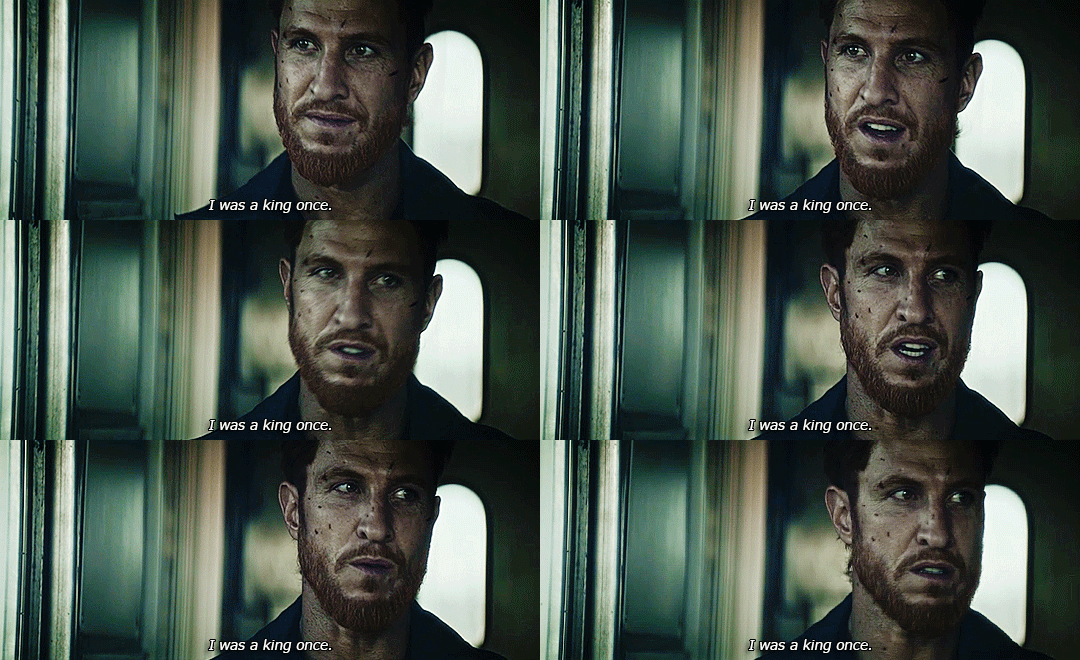
And then there’s the personal journey of Mad Sweeney. We get a vague timeframe for how long Mad Sweeney’s been around and how the ever-changing beliefs of mankind have shaped him, echoing the trajectory Irish mythology’s Tuatha Dé Danann broadly and the story of Buile Shuibhne more specifically. He was a king who left a battle when he saw that he would die, and now he owes a battle to Wednesday for his act of self-preservation. More than that, it seems Sweeney’s debt indentures him to do Wednesday’s bidding — a long fall from his early life not only as a king, but as a being that people like Essie both feared and respected, a creature of fair but mercurial power.

After Sweeney tells Laura his story — I’m not sure if she totally believes her verbal (and sometimes physical) sparring opponent was ever actually a king — they seem to have a flicker of connection. She tells him that dying isn’t so bad and it worked out fine for her, so after hundreds of years, Mad Sweeney might be due to die. Then a rabbit darts out in front of the ice cream truck and Laura swerves to avoid it, flipping the truck and launching herself out the window. Upon impact, the morgue stitches that were holding Laura together rip apart and the golden coin flies out of her body, taking the life it granted with it.

Sweeney wakes up from the crash, sees Laura’s body, and we’re taken to a flashback to the crash where Laura and Robbie died. Mad Sweeney is there, too, ordering a raven to “tell him it’s done,” the implication being that Sweeney killed Laura Moon on Wednesday’s orders. In the present, he’s looking at Laura’s dead body for a second time and he has a choice to make: either pick up his lucky coin, which is finally free from her, and keep walking, or put it back in her and fulfill the promise he made to get her resurrected.

It’s not clear why Sweeney returns the coin to Laura. It could be out of guilt over being the one who originally killed her, or it could be an act of stubborn autonomy — something he could do as Sweeney, a leprechaun who was once a king, and not an act forced upon him by Wednesday’s orders. Maybe Laura really does remind him of the woman hundreds of years ago who had pulled him and his kind from Ireland via well-loved myths. Heck, maybe he’s just secretly nice. Whatever the reasoning, he does return the coin. It magically sinks into her sternum and Laura is undead once more, utterly ignorant of the gift Sweeney had just granted her.

Afterthoughts:
  • I loved how the off-genre music played throughout the Coming to America scenes, along with voiceover and shots of Mr. Ibis’s writing, reminded us that we were seeing the past through Mr. Ibis’s mind. It was easy to think that music was filtering in from Mr. Ibis’s record player as he wrote.
  • All the terrible stuff Sweeney’s said to Salim, and the harshest words Salim can muster for him are “You are an unpleasant creature.” Oh, Salim.
  • When they’re both in prison, Mad Sweeney sarcastically asks Essie what he’d do in the Americas and Essie answers, “Deliver gold to their king.” Hey, remember how Mad Sweeney said his lucky gold coin was meant for the “King of America”?

Monday, June 5, 2017

American Gods 1x06 Review: "A Murder of Gods" (Sacrifices Must Be Made) [Contributor: Deborah MacArthur]


"A Murder of Gods"
Original Airdate: June 4, 2017

[Warning: The following review contains spoilers.]

After the previous episode’s meeting of Old and New Gods, things are heating up this week, and yes that is an intentional Vulcan-based pun. You can’t blame me for punnery. The episode title does it too, as “A Murder of Gods” is not only referencing the Mad Sweeney-approved collective noun for gods, but also the fact that gods are getting murdered this week. Or, more accurately, sacrificed.

Sacrifice is a theme throughout the episode, perhaps more so than American Gods’ usual theme of belief. Sacrifice of self, sacrifice of others, emotional sacrifice, ritualistic sacrifice, and the sacrifice of the past to provide a new future — it all plays a part.

COMING TO AMERICA


In the dead of night, a group of people hope to enter America from Mexico via a section of the Rio Grande. They cross themselves and pray, then their guide warns that anyone unable to swim should stay behind. One man does, separating from his family, but as the rest of the group begins to swim across, the man’s caution is undone and he enters the water — a mistake, as he is eventually overwhelmed and falls beneath the surface.

A hand reaches out and pulls the man to safety as prayers of thanks are given by those already on American soil. When asked for his name, the rescuer tells the man, “You already know my name.” A halo of light appears around his head, but it’s not just a hint at holiness — it’s the light cast by several trucks of armed men patrolling the river.

Generally, these Coming to America vignettes represent how gods traveled to America in the past and, whether it’s 14,000 B.C. or 1697, they’re always a window into the history of American faiths. This story is not only different in its modernity, but also in its representation. Christianity — the faith of those crossing — already exists in America, as we see glimpses of the border patrol’s faith in the words etched on the barrels of their guns (“Thy Kingdom Come”) and a rosary, wrapped around a hand that reloads, fires, and kills those on the riverbank. The list of their victims includes the Mexican manifestation of Jesus, who tries to stop the violence but is shot along with the others.

Actually, I say “the others,” but we don’t see what happens to the man saved from the river, or his family. I suppose it’s possible that Jesus’s sacrifice — complete with the Christian/Catholic symbolism of a mimicked crucifixion, a tumbleweed that sheds a crown of thorns, and a chest wound that glows and bleeds into the shape of the Sacred Heart — gave the man and his family a chance to escape. I’d certainly like to believe so.

SHADOW’S JOURNEY


Shadow and Wednesday are running from the New Gods they met in the previous episode. Still reeling from his encounter with Media as a floating Marilyn Monroe and his brush with an angry tree at the police station, Shadow is back to having trouble with the weird stuff going on in his life. It’s a real pity, too, because he was making so much progress! Maybe if things had continued to come to him more slowly, Shadow wouldn’t have been so derailed — but rather than just glimpsing through the peripheral window of the world’s strangeness (to paraphrase Wednesday), the last couple hours have like, shoved Shadow’s head through that window and now he’s freaking out again. Also, he’s bleeding a lot from that tree wound. Blood loss doesn’t help one cope with severe disruptions in reality.

Wednesday is quite interested to learn that Shadow received a visit from his dead ex-wife and they go back to the Starbrite Motel to see if Laura’s still there. They find the aftermath of the fight between Laura and Mad Sweeney, but no Laura. The only thing Wednesday says about it is that Laura must have a purpose (and a temper), and that purpose was to “let [Shadow] go.” So, they go.

It turns out that Shadow’s tree wound is more than just a tree wound — it’s the “infection” of a semi-sentient cluster of roots inside that wound. It was given to him by Mr. Wood, a god who started as a manifestation of early man’s worship of trees but sacrificed himself to the encroachment of industrialization in his forested domain. Significantly, Mr. Wood shifted his method of receiving worship into something new and thus changed himself from an Old God to a New God to stay relevant, which is the offer that Wednesday rejected in the previous episode. Wednesday rips the root from Shadow and tosses it on the ground.

With Shadow’s gross root-wound hopefully dealt with, the two of them drive to Vulcan, Virginia to meet with an old friend: Vulcan himself. Much like Mr. Wood, Vulcan has adapted to a more modern age. Instead of being a god of the forge, he’s the god of a factory making bullets. Instead of being a god of volcano fire, he’s the god of firearms. Instead of throwing sacrifices into a volcano, he allows the occasional worker to fall into a vat of molten metal and be made into bullets. Vulcan’s not much on OSHA guidelines, apparently. And yes, the bullets made in Vulcan, VA are indeed the same ones used by the armed border patrol in the opening sequence.

The meeting between Vulcan and Wednesday seems amiable at first. Wednesday brings him soma and asks him how he got such a sweet gig as the god of a whole town (“Sacrifice,” says Vulcan). They share a drink without drinking while Vulcan creepily creeps out Shadow and the audience with references to hanging trees, the franchising of faith, and how safe the bullets he prints with his name make his “believers” feel.

Things turn sour after Wednesday gets Vulcan’s agreement to join the fray and forge Wednesday a sword. As Vulcan is putting the final touches on the sword in the bullet factory, he reveals that he’s switched sides. Like Mr. Wood before him, Vulcan has bought into the New Gods’ sales pitch and won’t be fighting alongside Wednesday when the battle comes. Unfortunately for Vulcan, Wednesday has already received his verbal alliance and his sword — which means that, when Wednesday cuts off Vulcan’s head and throws him into the same vat of molten metal his sacrifices fall into, he can spin the death into a martyrdom and blame it on the New Gods. Also, Wednesday pees into the molten metal to “curse” it, and I have no idea what it’s going to mean for the bullets made from that metal but it’ll probably mean something.

LAURA’S JOURNEY


Back at the beginning of the episode, Laura also returns to the Starbrite Motel, but she’s too late to talk to Shadow. She’s also too late to get into her car and follow him, since her car was towed by the police (it was, after all, the car of a murder victim and the police had no reason to believe she’d be needing it again). That last bit of news is delivered by Mad Sweeney, who still wants his coin back and has arrived at the conclusion that the only way to get what he wants is to make it so Laura no longer needs the coin. After name-dropping Jesus, Mad Sweeney tells Laura he knows a guy who does resurrections. He’ll get Laura resurrected, she won’t need the coin to keep moving around, she’ll cough it up, and he’ll be on his merry leprechaun way. As far as American Gods plans go, it’s straightforward.

Our favorite supernatural jerks decide to steal a car to get them where they need to go, but end up stealing the cab of Salim (you may remember him from “Head Full of Snow”). He is very much not a supernatural jerk and is probably too nice to be hanging out with Laura and Sweeney. Still, Salim thinks the dead woman and the leprechaun might help him find the jinn he’s looking for, so he offers to drive them where they need to go.

I don’t know if it’s friendship exactly, since Laura still seems unlikely to make friends, but Laura and Salim develop a sort of comradery that I greatly enjoy throughout their storyline. They seem to pair off against the ruder Mad Sweeney as two people sharing in the sacrificial shedding of their past lives and welcoming a new life on the horizon. Salim is a man of faith while Laura remains faithless and untethered to anything or anyone who isn’t Shadow, but there seems to be a genuine connection between the two of them. Salim sympathizes with Laura and engages her in conversation about family, prayer, and faith. Laura takes Salim’s earnestness to heart and directs his cab to Indiana instead of Kentucky, where Sweeney told them to go.

We see — through Shadow’s mind in a pseudo-hypnotism sequence initiated by Wednesday — Laura visit her family’s house and peer inside through the window. As Wednesday described the existence of Old and New Gods as something on the periphery, viewable through metaphorical windows should one only look, Laura is looking through a window from her place in that otherworldly, peripheral space, into a normalcy in which she no longer exists. She shrugs off the idea of never seeing her family again, but if she isn’t affected by the sacrifices she’s making for a second chance at a new life, there was no reason for her to divert the car to Indiana in the first place.

At the end of the episode, Salim participates in morning prayer as the sun rises and Mad Sweeney and Laura watch. After prayer, Salim turns to Laura and, if they agree on nothing else, at least they agree that “Life is good.” Living is good. New lives are good, whatever the sacrifice.

Afterthoughts:
  • Poor, poor Salim does not deserve to be trapped on a road trip with Mad Sweeney.
  • Cleverly, the show has Corbin Bernsen play Vulcan with a limp — in mythology, Vulcan was thrown from the heavens and broke his leg when he landed.
  • I do love the music choice of “I Put a Spell on You” on top of the gun-fanatic town of Vulcan.
  • “Neutral in the face of injustice is on the side of the oppressor.” Wednesday Wisdom indeed.
  • I know I say it a lot, but just... Ricky Whittle is the absolute best. His reaction after Wednesday cuts off Vulcan’s head is magnificent.

Sunday, May 28, 2017

American Gods 1x05 Review: "Lemon Scented You" (I Demand A Better Future) [Contributor: Deborah MacArthur]


"Lemon Scented You"
Original Airdate: May 28, 2017

[Warning: The following review contains spoilers.]

This supernatural road trip show took an appreciated detour last week to explore the character of Laura Moon, Shadow’s dead and very complicated ex-wife, but we’re back on the main thoroughfare with this week’s “Lemon Scented You.” Back to Old Gods and New Gods, super-zombie wives, angry leprechauns, and Mr. Wednesday’s cryptic knowledge about what’s happening to poor Shadow’s life.

COMING TO AMERICA


The Coming to America story this episode is a 3D animation, perhaps because it’s the oldest story we’ve gotten so far and it needed that storybook touch. It’s dated at about 14,000 B.C., a tale of ancient Siberians crossing a land bridge to escape deadly cold and, as this story generally goes, discovering that the food and riches promised to them are absent. The shaman of the tribe seeks advice about finding food from their god, Nunyunnini, but the price is too high to pay and the tribe chooses to abandon their god rather than heed it.

Unlike previous Coming to America vignettes, where gods are pulled from their lands in the hearts of the people traveling to the New World and kept there with storytelling or prayers, the tale of Nunyunnini is one of a god forgotten who, once forgotten, dies. It highlights the necessity of humans in the life cycle of gods — the main idea of American Gods’ mythology — and proves that gods can die just as well as they can live.

SHADOW AND LAURA


Shadow arrives in his hotel room to find his dead wife sitting on his bed and honestly, bless Ricky Whittle because the way he plays Shadow’s shocked, subtle freak-out is so, so brilliant. The writing is pretty brilliant, too, but Whittle just sells every micro-expression. Like, I don’t actually know how the average person going through a crisis of reality would react to finding their dead spouse looking lively, well-dressed, and waiting for them in a hotel room, but throwing a pillow at the face of the undead manifestation to make sure it’s real seems like the right move to me.

The Moons have some things to discuss. Shadow’s first topic: Laura cheating on him. While Laura seems more focused on the fact that she’s having a posthumous chat with her husband, wives rising from their graves is old news to Shadow (“Don’t think that anything you got to say or do, including dying, is going to distract from the subject at hand.”) and he’s more interested in her activities while alive. As Laura begins to explain herself, it’s even more clear now than it was in “Git Gone” that death hasn’t changed her much. She has the same no-nonsense, objective way of looking at life as she did when she sat Shadow down and told him she wanted him to rob a bank for her.

When she’s done talking apathetically about cheating on Shadow and then dying (she was “very blah about the whole thing”) Laura asks Shadow to get her some cigarettes. Somehow, this show manages to make a trip to the cigarette machine look beautiful and emotive, helped along by the lights around the “Starbrite Hotel” — another hotel with a significant name, this time reflecting on the golden glow that surrounds Shadow every time we see him from Laura’s perspective.

While Laura soaks her dead flesh in a warm bath to keep herself warm to the touch, Shadow finally recognizes that his wife coming back from the dead is weird. He tells Laura that he had a feeling she was going to die when they spoke while he was in prison, and Laura tells Shadow that she doesn’t really feel anything. Until she kisses him, and then we get a glowy image of her dead heart beating once in her chest.

The scenes between Laura and Shadow are strange and sometimes strangely sweet, especially when Laura says that she’s looking out for Shadow and thanks him for the “present” of the lucky leprechaun coin he “gave” her. Laura is more animated and smiles more frequently while dead than she did over the entire course of “Git Gone,” thanks to the glow that surrounds Shadow whenever she looks at him. Sense comes to Shadow quickly, though, and he makes it clear that he’s not her “Puppy” anymore. He can’t be, ever again.

Mr. Wednesday interrupts the Moons’ conversation with a knock on the door, inviting Shadow out for “five, six drinks” to help them forget the trials of the day. Shadow rejects the offer, but interruptions abound! The police show up to arrest them both for the bank robbery they pulled off a couple episodes ago. Laura, back in her warm bath, notices Shadow’s golden light fading as he’s driven away.


THE NEW GODS


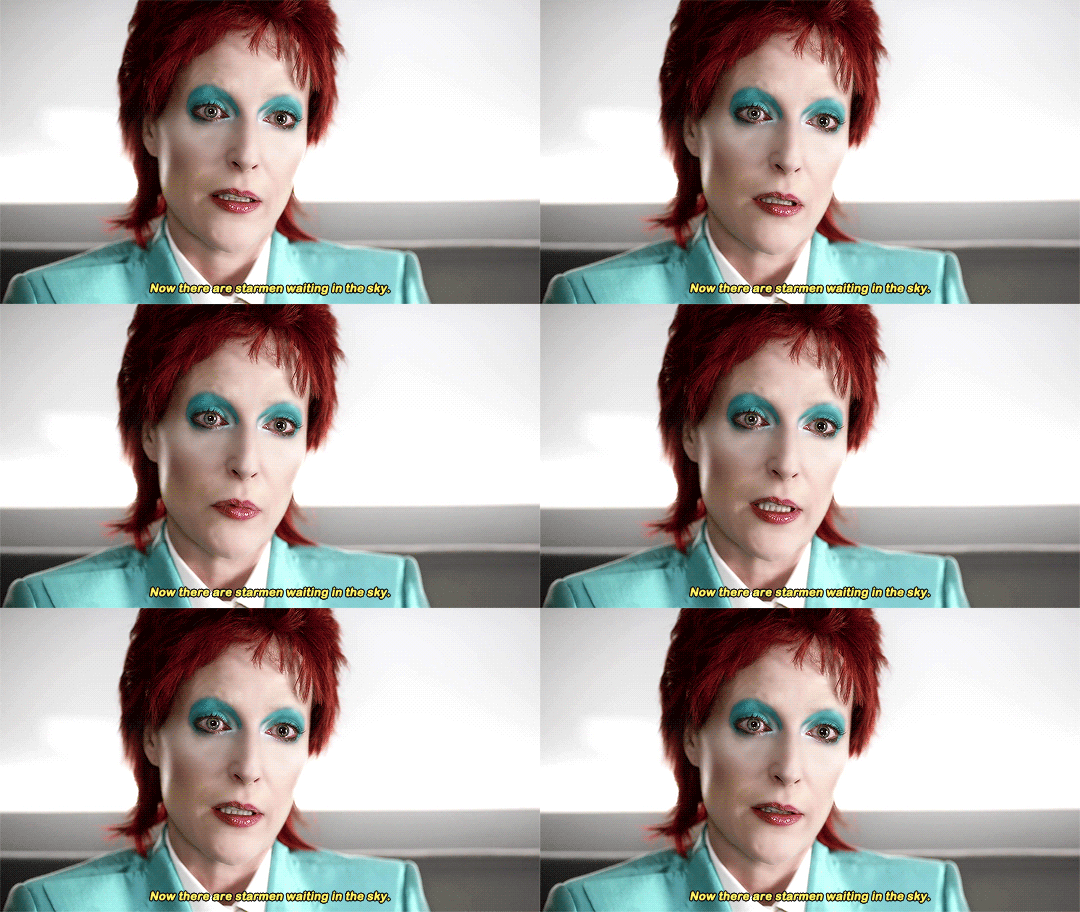
We see Technical Boy, the douchiest of the New Gods, getting snatched up by the same weird device that transported Shadow to his limo in episode one. Waiting for him in the limousine is Media, wonderfully dressed as David Bowie from his 1973 “Life On Mars?” promotional video, right down to Bowie’s iconic mismatched eyes. She has some advice to give Technical Boy on his brand and image, how the world — and Mr. World — sees him, and criticizing how he dealt with Shadow. She does most of her talking in David Bowie song lyrics, which I absolutely adore, quoting, in order: “Oh! You Pretty Things,” “Rebel Rebel,” “Space Oddity,” “Life on Mars?,” “Under Pressure,” “Cat People (Putting Out Fire),” and “Starman.” This is the quality TV content I live for.

On behalf of Mr. World, Media orders Technical Boy to apologize to Shadow and Wednesday. We don’t yet know who this Mr. World is, but it’s evident that the New Gods see him as a leader — and one not to be messed with or ignored. Media explains that keeping Wednesday calm is critical, because all he needs is “just enough” belief to take them down.

TROUBLE


After being apprehended by the police, Shadow and Wednesday are separated and interrogated. Shadow won’t say much more than “lawyer,” but Wednesday has adopted the confused old man persona that got him a seat in first class in the premiere. Whether intentionally or not, Wednesday has pinned the whole thing on Shadow, saying that the Shadow stole him from a retirement home.

The officer interviewing Shadow theorizes something close to the truth, but lines up a more realistic sequence of events: Shadow meets an old grifter and signs on to learn the trade. The officer interviewing Wednesday gets the actual truth but doesn’t believe it because, honestly, who would? However, Shadow’s officer can tell that there’s something bigger going on than a simple grifting partnership — the tip they got on their whereabouts was specific and high tech, which means Shadow and Wednesday must have some powerful enemies and it’d be interesting to know who those enemies are.

When the officer allows Shadow into the same room as Wednesday, Shadow confronts his employer about who’s after them. Meanwhile, a spider (Hi, Mr. Nancy!) unlocks their cuffs and they hear a ruckus going on in the police station. Before they can escape, Media shows up wearing the guise of Marilyn Monroe and, once again, Ricky Whittle’s reaction to stuff as Shadow is just the best. When he realizes that Media is floating down the hall, he’s more shocked by that than he was about his undead wife.

Before Shadow can have another breakdown, they hear footsteps in the hall. Enter: Mr. World. Probably the most enigmatic of the New Gods, Mr. World doesn’t have an obvious association with anything like Media or Technical Boy do. The closest I can get to pinning him down is as a representation of knowledge, specifically “secret knowledge” in the vein of conspiracy theories and ominous world enterprises that manipulate society.

Mr. World calls Technical Boy in to deliver an apology. Technical Boy does, but his wide-eyed stare and cavalier way of describing how in “poor taste” lynching Shadow had been, what with America’s current state of racial tension, makes him seem insincere. Mr. World senses the insincerity and offers Technical Boy up for Shadow to punch a bit as compensation. Shadow rejects the offer, and Mr. World absolves Technical Boy of his sins. Mr. World is really odd, and I can’t tell if that’s the character or if it’s because he’s played by Crispin Glover.

The New Gods have a deal for Wednesday and his kind: a merger. An upgrade to, as Media puts it in her most commercial way, “a brand-new, lemon-scented you.” Media presents Wednesday with a shiny possible future that includes a rocket named after him hitting North Korea, so everyone would know his name — something that is, of course, critical to a god’s survival. Also, there are rainbows and unicorns.

Wednesday rejects the plan on principle or pride. He states that the New Gods distract and simply occupy people’s time — the Old Gods gave people meaning. “Then give it to them again,” says Mr. World. Then he leaves, but Technical Boy ruins his departure “on a good line” by questioning him about letting Wednesday go. To shut him up, Media knocks Technical Boy’s two front teeth out by blowing him a kiss. The New Gods are bizarre.

THE ESCAPE


Earlier in the episode, just after Shadow left his hotel in a police car, Laura was paid a visit by Mad Sweeney. Sweeney still wants his lucky coin back, but Laura has a feeling that the coin is the reason why she can currently walk, talk, and knock a leprechaun into the wall with a flick of her finger. So she’s not giving it back, and Mad Sweeney can’t take it — but he can wait. Laura Moon is still dead, no matter how much her afterlife makes her feel alive, and she will rot like any other dead body. Especially if she keeps trying to mimic living flesh by soaking in warm water.

Mad Sweeney shoves Laura under the water of her bath just as police arrive and they arrest him for killing her. Laura is sent to the morgue while Mad Sweeney is carted off to jail, where his officers encounter the bloodbath the New Gods left behind in the police station. The police are dead, the whole place is a lights-flickering mess, and Shadow is nearly killed by the grasping branches that haunt and antagonize him in his dream of the bone orchard.

Wednesday and Shadow run away. Mad Sweeney runs away. Laura wakes in a morgue and keeps on not living.

Afterthoughts:

  • Ian McShane talking to a raven is a scene I didn’t know I wanted to see on a TV show until American Gods delivered it to me.
  • “I got a fax. On a machine that hasn’t been turned on in — I don’t know, since fax machines.”
  • Wednesday is officially named as Odin in this episode! I’ll still be calling him Wednesday, though.

Sunday, May 21, 2017

American Gods 1x04 Review: "Git Gone" (She’s Not There) [Contributor: Deborah MacArthur]


"Git Gone"
Original Airdate: May 21, 2017

[Warning: The following review contains spoilers.]

This week, we take a break from Shadow’s journey toward understanding his new reality. “Git Gone” is the story of Laura Moon before she met Shadow, before she married Shadow, and before and after the events that sent Shadow to prison and resulted in her death. It’s the story of a fundamentally unhappy person who tries her best — in some harmful ways — to stop herself from being unhappy, and how she affects the lives of the people around her in her quest to find something to believe in.

LAURA


We get none of the usual vignettes to start the episode. Instead, it opens on a flashback of Laura before she was Laura Moon, back when she was working as a dealer in an Egyptian-themed casino. She’s living alone and working a job she doesn’t like, and it’s only getting worse — represented by the casino’s introduction of a shuffling machine that means Laura doesn’t have to shuffle cards anymore, even though she likes shuffling cards.

Laura’s life after work is boring routine: she drops her keys in a dish, turns off the television she’d left on for some reason, pushes her cat out the door, and eats a small dinner. The first time we see her, she also kills a fly with an insecticide called Git Gone — which seems like overkill for a fly, but Laura is apparently feeling destructive, since she also takes the Git Gone with her into a covered hot tub and nearly chokes to death on the fumes.

The next time we see her at work, Shadow Moon sits down at Laura’s card table. It’s fun to see what Shadow was like before he went to jail and Laura died. He is, as Laura labels him, cocky: he’s talkative, flirty, and charming. He has thoughts on how to order drinks and has good-natured reactions to his bad card game. He also proves that those sleight-of-hand coin tricks he’s interested in aren’t just for entertainment or idle fingers when he uses his skills to cheat some casino chips off a waitress. Laura — because she’s charmed by him, or because she just doesn’t like her job enough to protect her employers at Shadow’s expense — warns that the casino is heavily monitored and he will get caught if he tries anything bigger than switching out a couple chips.

After Laura’s shift, she’s walking to her car and Shadow stops her to flirt a little more. Hey, Shadow? I know you’re a nice person, but maybe don’t walk up to lone women in dark parking lots? You’re lucky Laura wasn’t wielding some Git Gone to spray in your face. Instead, she sorta flirts back and smirks when Shadow tells her she would make a good thief, hinting that she could be his “inside man” to rob the casino. Instead of establishing a crime partnership, Laura invites Shadow back to her place for what I assume was meant to be a one-night stand. However, Shadow is still there in the morning, and he’s still rather charming while he teaches Laura card tricks.

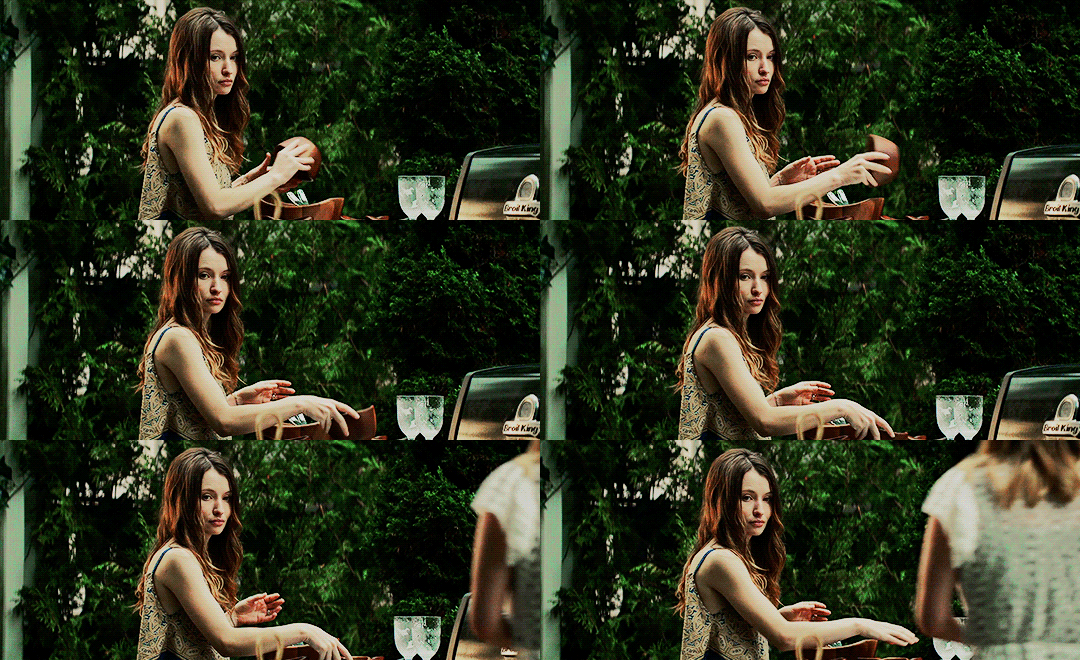
Their relationship grows to the point where Laura and Shadow are going on double-dates to barbecues with friends and Audrey, Laura’s best friend, notices the googly-eyes Shadow sends in Laura’s direction. Of course, we know that Laura and Shadow eventually get married. Scenes of their wedding are intercut with a past conversation between them, in which Laura tells Shadow that she doesn’t believe in anything, and all that happens after death is rotting. As Laura puts it, she wants to believe in everything, but “life is just not that interesting.”


After they get married, Shadow is happy — but for Laura, Shadow is just another part of her routine. She’s not alone in her house anymore, but she’s still alone in her head and in the universe, so Shadow’s presence changes nothing. From the tale of how she lost her belief, I gather that the character of Laura represents how belief doesn’t just power the gods, but also people. For human beings to truly live, they must believe in something, even if it’s just vague beliefs like the agnostic assertion that there may be “more” out there, or belief in love, as Shadow’s primary belief seems to be. There is nothing for Laura to believe in, which means that, even though her marriage to Shadow is a happy one on the surface, she still gazes out at the covered hot tub and asks Shadow to buy more Git Gone bug spray when he goes to the store.

Desperate to find a way to make herself happy, Laura sits Shadow down and tells him that she wants to rob the casino like they talked about the night they met. At this point, Shadow and Laura have been together for years, Shadow thinking all the while that he was in a great marriage where both he and Laura were happy. But Laura tells him that she is not happy. In fact, she resents that Shadow is happy. Her life is in a rut — she lives in a house she inherited, in a town she inherited, and works a crappy job that she hates — and she thinks her happiness can be found in piles of stolen casino money.

We don’t get to see Laura’s “perfect” plan play out. We only see the aftermath: Shadow in jail, telling Laura that it was all just bad luck and that he’ll be fine if she can wait for him on the other side. Laura’s life becomes a different routine, but still a routine. She gets calls from Shadow in prison, hangs out with Audrey and Robbie, and occasionally visits Shadow. She’s still not happy.

Laura arrives home one night to find her cat dead on her kitchen floor and asks Robbie over to deal with it. He buries the cat while Laura drinks wine and mourns a pet she claims she didn’t even like. Robbie offers a hug, and the hug turns into more, and Robbie comes back for more again the next day. Laura turns him down at first, because she doesn’t want to start anything with Robbie while Shadow’s in prison for something she asked him to do, but — as we all know — that rejection doesn’t last.

Something so bewildering about Laura in the book (why she would continue her affair with Robbie when she’s so close to being reunited with Shadow) makes perfect sense in the show, where they carefully flesh out Laura’s character and the unhappiness that defines her. Laura doesn’t see Shadow’s release from prison as a return to wedded bliss, and she doesn’t even see the affair with Robbie as a distracting bit of fun while her husband is away. They’re both the same to her. She’s unhappy no matter what, so what does it matter if she cheats on Shadow? What does it matter if Shadow even returns? Everything is the same to Laura Moon. There is nothing to believe in, the world is not that interesting, and all we do after we die is rot.

We know what happens next: Laura and Robbie die in a car accident. Laura learns she was wrong about the afterlife, as she is confronted by Anubis — introduced to us in the previous episode as the bearer of bad news and weigher of hearts. Perhaps indicative of Laura’s lack of belief, the cosmic desert she finds herself on is not the bright, glorious landscape that Mrs. Fadil traveled to in last week’s episode. It’s dark and foreboding, and Anubis is decked out in black instead of white.

Laura questions Anubis about her destination. He tells her, “In life you believed in nothing. You will go to nothing. You will be done. There will be darkness.” Laura asks if there will be peace, but Anubis repeats that there will be darkness. There is no peace in nothing, no peace in a lack of belief, and no peace for Laura Moon — in life, or in death. There is only darkness. For Laura, the path to her darkness is represented by a covered hot tub and a can of Git Gone bug spray, the tools she used in life when she was tempted by death.

When Laura resists, Anubis has some strong words for her and orders her into the darkness, but before she can do more than swear at him, she’s torn away from Anubis’s world and back into her buried coffin by the power of a leprechaun’s lucky gold coin.

After crawling out of her grave, Laura looks out and sees a glowing gold light. She follows it, and finds that the light is centered around Shadow, who has just been hanged by Technical Boy’s henchmen. It turns out that Laura was the preternatural power that had saved Shadow from certain death in the first episode. She tears through the faceless henchmen with inhuman strength and speed, then cuts Shadow down from the tree and disappears before he can see her.

Since she’s covered in mud and gore, Laura trudges back to her house to clean up. Since her arm got injured in the fight, she’s carrying it around with her like, no big deal. Just a severed arm, y’know? Laura is clean and re-dressed when Shadow arrives to pack up her house, and she spends that entire sequence of episode two hiding out in — of course — the covered hot tub. Shadow, by the way, is the only thing Laura sees in glorious, glowing golden color now. Everything else in her world is hazy and muted.

To get her arm sewn back on, Laura visits Audrey’s house, which is stocked with craft supplies. When Audrey arrives home and sees her dead ex-best friend — sans one arm — standing there, she understandably freaks out and runs into the bathroom to scream obscenities through the door. Laura follows her and she and Audrey have a disturbingly normal chat about how Audrey’s handling the death and betrayal of both her husband and her best friend. I would say that Laura’s inability to recognize how strange things are or feel any strong emotions about her life is like how she can no longer see colors, but it would be inaccurate. Laura is just as numb while dead as she was alive — the difference is that, while dead, she finally has something to follow and believe in, and that something is the gold-glowing Shadow.

Laura manages to persuade Audrey to drive her in the direction of Shadow’s light, but they’re stopped on the road by Mr. Ibis and Mr. Jacquel — the latter of which Laura recognizes as Anubis. Mr. Jacquel/Anubis also recognizes Laura. Hard to forget a spirit who up and disappears from your cosmic deathscape right after you went on a rant about her insignificance.

Mr. Ibis and Mr. Jacquel are proprietors of a funeral home, which is convenient for Laura because Audrey’s job at stitching her arm on with common thread probably wasn’t the best. They re-assemble Laura and paint her up, and Mr. Jacquel tells her that when she’s done with her mission, she will be delivered into darkness.

Meanwhile, Laura is drawn to the light. She dresses up nicely and hangs flypaper in Shadow’s hotel room to catch the flies that have been buzzing around her ever since she died (and, significantly, before her death as well). Then we see her waiting patiently, until the door opens and glowing Shadow is there, and we’re back where we ended in the last episode.

Afterthoughts:
  • I think Laura’s experience with technology ruining something she enjoys might be a mini-parallel with her future husband’s problems with the New Gods of technology, especially since her casino takes its inspiration from one of the Old God religions.
  • “My grandma always had cats. She said that they could see ghosts when we can’t, and warn you of thieves.” “Yeah?” [Shadow, a thief, pokes at Laura’s cat.] “I think your cat’s broken.”
  • I love the ravens that follow Laura around. For people who know what they mean, it implies some interesting things.

Sunday, May 14, 2017

American Gods 1x03 Review: "Head Full of Snow" (From Nothing to Everything) [Contributor: Deborah MacArthur]


"Head Full of Snow"
Original Airdate: May 14, 2017

[Warning: The following review contains spoilers.]

This week on American Gods: jinn drive taxis and gods weigh hearts, Shadow Moon is still struggling with his hold on reality, Mr. Wednesday still doesn’t understand why anything should be a struggle, and someone takes the moon. We learn how stories can be a way of believing, and how belief can change the world, or just make it snow. Also: there is a storm, a bank robbery, and a visitor.


SOMEWHERE IN AMERICA


We don’t get a story of gods coming to America to open the episode this week, but we do get two stories of gods (or the godlike) already here. The Somewhere in America tales of the previous episodes have centered around Bilquis, the unhappy goddess of love and lust whose particular form of worship gets all the buzz online. Like Bilquis’s scenes, those during this week’s episode serve to remind us that the adventure of Wednesday and Shadow isn’t the center of everything. The gods living in America have been living in America — have been making their living in America — for years already. They come here, and here they wait to be worshipped, or to be believed, or to come to life in the stories mortals tell.

If I had to pick some connecting thread between the two Somewhere in America segments of this episode, I think it might be the power of stories. Just as the Vikings tied their god to the land with sacrifice and war, some gods or beings of myth are tied to the land and its people with stories. Stories, like prayers and sacrifices, hold power — perhaps because someone must believe in them to tell them correctly, even if that belief only lasts for the time of telling.

Somewhere in America a woman named Mrs. Fadil is making dinner for her family when she gets a knock at the door. The man on her doorstep tells her that he is of Death, and she has died. Upon realizing the truth of what the man says, Mrs. Fadil is confused: she is a Muslim woman, but the scene playing out is not one that follows the faith she believes. He tells her that her grandmother used to share stories of Egyptian gods, and Mrs. Fadil believed those stories when she was young, then remembered them throughout life. For that, she gets to go with Anubis, the Egyptian god of the Afterlife, and have her heart weighed against a feather.

Anubis takes Mrs. Fadil to an absolutely breathtaking landscape of desert and colorful, starry sky. They sit down next to a set of scales and he reaches into her chest to rip out her heart so that her life can be measured in the Egyptian way. As soon as her heart is on the scales, Mrs. Fadil begins worrying about all the bad things she’s done in her life, but the scales even out and prove that she lived well. She’s allowed to choose her next world. Unable to decide between five doors to different afterlifes, she turns to Anubis to decide for her, and then, when she hesitates, the cat that had followed them both just pushes her through the door he opens. Cats: kinda jerks, even in the place between life and death.

Somewhere in America, a man named Salim is living an unhappy life selling junk, or trying to — no one will see him or listen to him, and they certainly won’t give him their money. He tries smiling his way through it, but it’s clear that unhappiness is dragging him down. Then he meets a man driving a taxi, who speaks his language and of ancient cities long gone, and who hides eyes made of burning flame behind a pair of cheap plastic sunglasses. Salim’s grandmother used to say that she saw an ifrit (a kind of jinn) on the edge of the desert, and clearly something about that tale had stuck with Salim because he doesn’t seem too shocked to find a jinn driving a taxi.

After commiserating over life in America — Salim’s miserable experience as a salesman and the Jinn’s miserable experience driving a cab in a country he’d been dragged into through stories — Salim invites him into his hotel room and his bed. When Salim wakes up the next morning, all that’s left of the Jinn is his wallet and ID, the keys to his cab, and his black sunglasses. Salim, I suppose, will try a new life driving a cab — and though the Jinn hadn’t exactly made that occupation sound glamorous, Salim seems happier on his new path.

I guess both these Somewhere in America asides had an idea of comfort at the core of them. Mrs. Fadil finds comfort in the terrifying afterlife by allowing Anubis to choose her path for her, while Salim and the Jinn find comfort in each other.

SHADOW’S JOURNEY


Shadow wakes up when he senses someone go through the living room, where he’s sleeping on the couch, and climb out the window of Czernobog and the Sisters’ apartment. Probably mimicking Mrs. Fadil’s climb out her fire escape, up her building, and into Anubis’s world of desert and starry sky, Shadow climbs up the ladder of the building and onto the roof, where a sky full of unearthly bright stars and looming storm clouds are overhead. Also there on the roof is Zorya Polunochnaya, the sister who had been sleeping since Shadow and Mr. Wednesday had arrived.

Zorya Polunochnaya tells Shadow the story of the bear in the stars, and how it will devour everything if it escapes its chains, so the sisters watch the sky to make sure that doesn’t happen. Then she reads Shadow’s fortune: “You believe in nothing, so you have nothing,” she tells him. “You are on a path from nothing to everything.” When questioned about his cavalier disregard for his own life, Shadow again brings up how bizarre his world has become ever since Laura’s death. Zorya Polunochnaya concludes that Shadow would “rather die than live in a world with bears in the sky.”

To help Shadow, Zorya Polunochnaya trades a kiss for the moon — a silver coin that she pulls from the sky, then tells him not to lose or give away, like he had given away the sun before. Shadow has no idea what she’s talking about, of course, and wakes up on the couch in the house, where there is no ladder to the roof from the living room window but there is a silver coin in his pocket. Shadow goes to Czernobog’s room and makes another bet over a game of checkers: if Shadow wins, Czernobog meets Wednesday in Wisconsin; if he loses, Czernobog gets two hammer swings in case the first swing doesn’t kill Shadow outright.

Meanwhile, Wednesday himself is wooing Zorya Vechernyaya in the rain and talking about old times. “I can taste you on the rain,” she tells him as thunder rumbles and the storm starts. “What else can I taste?” To which Wednesday answers: “War.”

Gods must be creatures of habit, because Czernobog tries playing the exact same game he played against Shadow before. Shadow is able to beat him this time around. He will still get his head smashed by Czernobog’s hammer, but Czernobog must wait until after Wednesday’s scheme is complete to do it.

The next morning, Wednesday tells shadow that they’re going to rob a bank. They check out the bank (and are checked out by the bank’s security system, which also features some shadows and an eye that looks curiously like Media’s). Wednesday tells Shadow that they need snow to help them rob the bank, then asks that Shadow think of snow.

While waiting for some business cards and signs to be printed up, Shadow thinks of snow — and lo and behold, it snows. He questions this later at lunch with Wednesday, telling him that it was never supposed to snow, but he thought of snow and it started to snow. Once again, Shadow finds himself torn between believing in the world he’s always known and the world that Wednesday is showing him exists.

Shadow’s day isn’t exactly improved by the appearance of Mad Sweeney, looking for that gold coin he gave Shadow after their fight in Jack’s Crocodile Bar. That was his lucky coin, he tells Shadow, and Shadow informs him that he threw the coin away. According to Shadow, it’s now on Laura Moon’s grave in Eagle Point, Indiana. Mad Sweeney storms off to get his coin back, and Shadow goes back to contemplating the difference between reality and delusion, and which one he might be experiencing.

The bank robbery isn’t so much a bank robbery as it is a bank misdirection, as Wednesday tapes up a few Out of Order signs and puts on a security guard uniform and pretends that the bank’s deposit slot is closed. People just hand the money over to him, and though police do show up, they’re just worried about a single man handling so much cash. Shadow pretends to be Wednesday’s supervisor, getting into the character Wednesday provided him. Everything turns out fine.

“This is the only country in the world that wonders what it is,” Wednesday says to Shadow later. Shadow protests that Americans know who they are, but Wednesday tells him that Americans only pretend to know who they are, just like Shadow pretends. “You are pretending that you cannot believe in impossible things.”

Shadow still protests the idea that he made it snow, but can’t help admitting that nothing about his life feels like a delusion. Instead, it feels like a dream (“What a beautiful thing to be able to dream when you’re not asleep,” says Wednesday).

Wednesday switches tactics by asking if Shadow believes in love. Shadow does believe in love, but he didn’t before Laura — which means that Shadow didn’t believe until he did, “and then the world changed because [he] believed.” Belief, it seems, has the power to change everything.

In Eagle Point, Indiana, Mad Sweeney is digging up Laura Moon’s grave, only to find an empty casket with a perfectly circular, coin-sized hole burned through it.

When Shadow returns to his hotel room, his dead wife is sitting on his bed. She says hello.

Afterthoughts:

  • Not that I like thinking about his death, but if all you need to get into a different faith’s afterlife is to tell some stories about their gods, I guess Neil Gaiman’s going to be spoiled for choice.
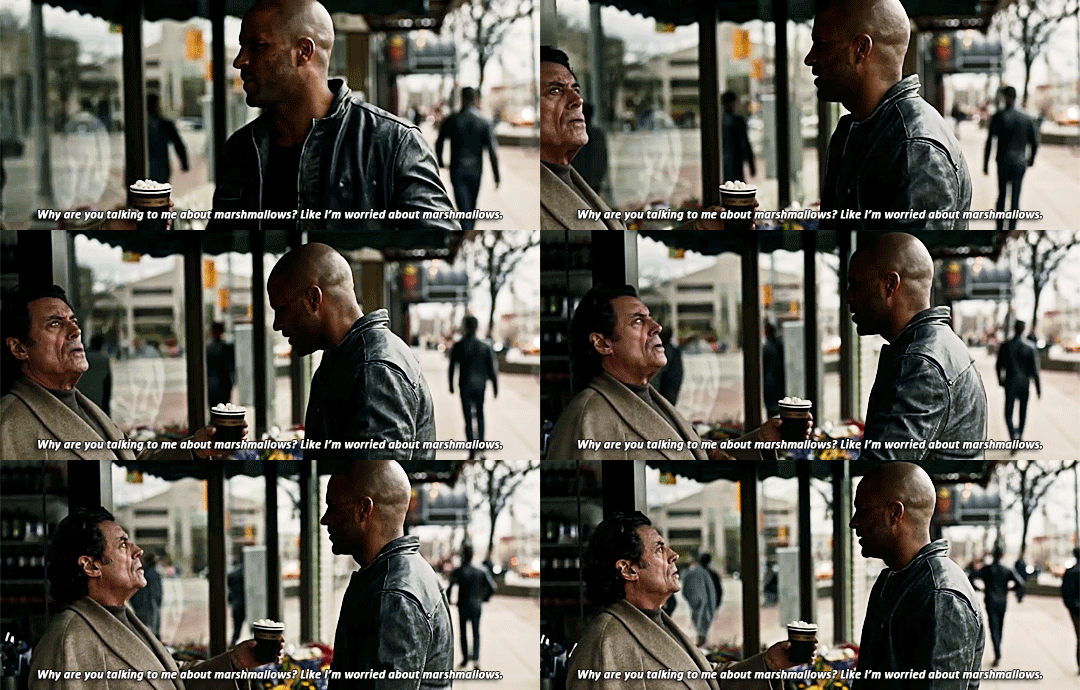
  • “Got you marshmallows in your cocoa, you like marshmallows?” “Why are you talking to me about marshmallows? Like I’m worried about marshmallows! ... Yeah, I like marshmallows.” The petulant child tone just sells that line.
  • “So you’re perfectly okay believing that tiny people on television can predict the weather, but you crinkle with consternation at the mere suggestion that you could make it snow.” My favorite thing about Wednesday is how he manages to make nonsense sound sensible.

Sunday, May 7, 2017

American Gods 1x02 Review: "The Secret of Spoons" (A Hard Rain's A-Gonna Fall) [Contributor: Deborah MacArthur]


"The Secret of Spoons"
Original Airdate: May 7, 2017

[Warning: The following review contains spoilers.]

If last week’s premiere of American Gods wasn’t enough to prove that this show isn’t like your usual show in terms of episodic plots, character, pacing, or arcing story, then welcome to episode two! “The Secret of Spoons” brings to us: several character introductions, a protagonist who thinks he’s losing it, and checkers as a big finale. It’s clear that American Gods is playing for the long term and isn’t shy about it — in fact, this episode seems to revel in the epic, meandering pace it has set for itself even more than the previous one.

Sequences without dialogue, seemingly pointless dialogue, or things that only raise more questions — all of it works to set a mood. For some, that mood is probably simple confusion. But that’s pretty fitting when one considers the current mental state of our protagonist, Shadow, who is likely just as confused about everything happening around him as we are. At least we occasionally get flashbacks courtesy of Mr. Ibis to tell us that gods are real and powered by belief. Poor Shadow Moon just gets abstruse instruction from Mr. Wednesday, assaulted and almost hanged, and threatened by a hammer-wielding chainsmoker over a game of checkers.


COMING TO AMERICA


Our first introduction of many in this episode is to Anansi, the spider god of storytelling and knowledge who originates in West African folklore. Anansi is often depicted as a playfully clever trickster, but not so much here — and for good reason. His introductory manifestation for American Gods occurs in a Dutch slave ship heading for America in 1697. After one of the chained men on the ship prays to him, promising lifelong worship in exchange for freedom, Anansi appears, wearing a colorful modern suit and bearing bad news. As a god, Anansi evidently has knowledge of the future, and explains to the men in the belly of the ship the fate that awaits them for being black in “the land of opportunity, milk and honey.”

Though Anansi fulfills his role as a storyteller, the story he tells is not one of the clever tales he spins in legend that allow him to slip harmlessly out of danger, but one of three hundred years of tragedy, horror, and inequality. I can’t actually quote most of the speech Orlando Jones gives as Anansi in this “Coming to America” scene because the highlights include words that I’m not allowed to use here on Just About Write, but know that the entire thing is absolutely incredible in both content and delivery.

Anansi is justifiably angry about the future of the people who worship him in America and he stokes the anger in those around him. He tells them that they can “die a sacrifice for something worthwhile” by setting the ship they — and the slavers — are on ablaze, destroying it before it ever reaches land. Anansi breaks their chains and they are suddenly free to do just that. The ship burns at sea and, presumably, leaves no survivors.

Except for a curiously colorful spider, which crawls ashore in America.


SHADOW’S JOURNEY


Shadow’s story starts right after it left off, post-lynch mob and the utter annihilation of that lynch mob by some unknown, unseen, unearthly-strong protector. Since the kid in the limo mentioned Mr. Wednesday in his over-the-top speech about deletion and reprogramming reality, Shadow figures Wednesday must have something to do with him almost getting murdered — or, at the very least, being employed by Wednesday has exposed Shadow to people who want Shadow murdered for associating with him. Regardless, Shadow is extremely upset and wants an explanation from Mr. Wednesday.

Mr. Wednesday, as ever, uses twice the number of words to impart half the requested knowledge. All Shadow knows for sure is that he’s now involved in something huge and dangerous, and that attacking Shadow to get to Wednesday is a great way to make the old one-eyed con artist angry. Also, his salary has been doubled. That’s nice?

The next day, Shadow goes to the house he shared with Laura before being sent to prison to clean out her effects and gather what he wants to keep. As soon as he steps through the door he sees the decorations that are still up for his welcome home party. He imagines Laura standing in the kitchen and sleeping on the bed, before the reality of her absence returns to him. Shadow gets to work boxing up all Laura’s things, cleaning the house, packing his own clothes — all while the box full of the personal items that had been on Laura’s body when she’d died seems to loom at him from its spot on the bed.

Eventually, Shadow gives in and opens the box. He takes Laura’s wedding ring out of the plastic evidence bag, then removes her phone and goes to the last messages she exchanged with Robbie. Maybe Shadow was feeling self-destructive, or maybe he hoped there’d be no evidence of the affair Audrey had spoken of — either way, he sees exactly what he didn’t need to see. As he finishes cleaning the house, Shadow is so distracted by his hurt and anger that he scrapes his fingers raw while scrubbing the bathroom floor and doesn’t notice until he’s bleeding.

The entire sequence of Shadow in the house imagining, packing, and cleaning is done entirely without dialogue and with abrupt close-ups to things like bloody soap suds and taped boxes. The silence adds to Shadow’s contemplative emotions and allows Ricky Whittle’s acting abilities to shine through spectacularly, while the editing of the scenes makes things feel as surreal and disjointed as Shadow must feel.

When everything is packed and Shadow’s life as he knew it is truly over, Mr. Wednesday announces that they’re going shopping and then stopping in Chicago on the way to “one of the most important places in the entire country.” On the journey to Chicago, there’s more driving footage (which I still love) and some of the coin trickery that I haven’t discussed in a review yet but basically, Shadow has a habit of doing magic tricks with coins. As do a few others, like Mad Sweeney in the previous episode and Mr. Wednesday in this one. Both Sweeney and Wednesday have done a trick where they flip the coin into the air and it disappears before coming down again. Both times, Shadow is amusingly bewildered and frustrated.


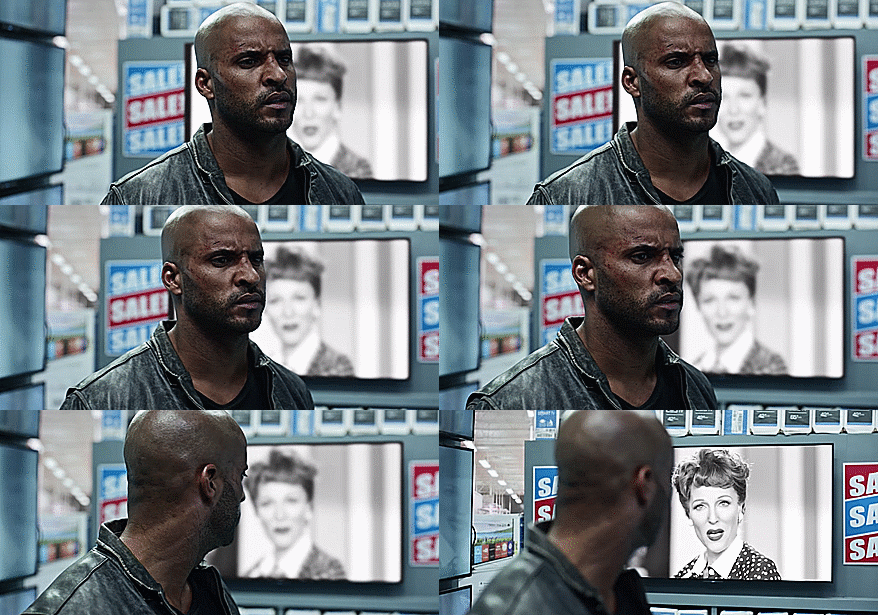
While shopping for all the things on Wednesday’s list, Shadow ends up in the TV aisle of a store and, to his surprise, Lucille Ball as Lucy Ricardo is speaking to him through one of the televisions. Lucy — or Media, our second introduction of the episode — apologizes to Shadow for the actions of Technical Boy, a.k.a. the kid in the limo who almost had Shadow killed. Media wants very much for Shadow to be “in [their] camp” but Shadow gets no clarification on what this means, or why camps exist, or why he’s wanted at all.

Asking Wednesday what’s going on only yields more unhelpful advice for Shadow, who is panicking at the thought of going post-prison crazy. Flying out of a limo and seeing digitized people can be explained away as hallucination. Disappearing coins are just magic tricks. But Lucy talking to him through a TV? That’s, as Shadow puts it, “weirder by several orders of magnitude than anything that’s ever happened to [him].” Wednesday’s response? “So far.” He does arrive at a specific decision that Shadow must make, though: choosing to believe that he’s crazy, or choosing to believe that the world is.

I love the way Ian McShane and Ricky Whittle play their characters individually, but the magic is really in how they play them together. Shadow is equal parts mystified, angry, and exasperated by Wednesday’s cryptic words and seemingly random behavior; Wednesday seems both genuinely concerned about Shadow’s well-being and perfectly capable of pushing him into mortal danger without hesitation. It’s an interesting dynamic that’s greatly enhanced by the actors.

Wednesday’s shopping list is for his friends(?) in Chicago, a family of three sisters and an ambiguously related man named Czernobog. The sisters — we’re introduced to two of three, but mostly to Zorya Vechernyaya — tell fortunes and Czernobog slaughters cows for the meat industry. Both Shadow and Wednesday are invited to dinner, though Czernobog seems furious at spending an evening in their presence. Mostly because of whatever Wednesday wants him to participate in, which isn’t clarified exactly but does involve a lot of death. Whatever interest Czernobog has in the death (and it’s a lot, if the way he talks about smashing cows’ skulls in with hammers is anything to go by) is outweighed by his concern for himself and his wish to stay out of Wednesday’s scheming.

Czernobog asks Shadow if he knows how to play checkers, which he does (“I was in prison for three years.”) and then challenges him to a game. After a few turns, Czernobog gets up to show off the hammer he used to use to kill cows. Shadow is clearly uneasy, even before he starts imagining blood dripping down the hammer’s handle. Czernobog seems to be having fun talking to Shadow about how great it is to kill things at sunrise and laughs before offering a wager: if he loses, he agrees to participate in whatever Wednesday is planning. If Czernobog wins, then he gets to smash Shadow’s head in with his hammer.

A brief discussion ensues, with Wednesday telling Shadow that the choice — like the choice to be mad or accept the world’s madness — is completely up to Shadow, and no one else. Shadow, although he doesn’t know what Wednesday is planning, knows that Czernobog is somehow important and that it might be time to choose a mad, mad world. He agrees to the terms. We get another sequence without dialogue as the two play their game.

Unfortunately, Shadow loses.

Afterthoughts:
  • Not sure if it’s intentional, but I think Laura’s phone says a lot about her: a generic background wallpaper and a series of generic starter apps, like a notes app and a clock. Basically, the apps most people either delete from their home screen or add to a different page of it. No games, no personality, no indication that she used the phone as an extension of her life, the way most people with smartphones end up doing.
  • “At times the universe does seem to have singled you out for unique abuse. In these moments, you gotta ask yourself: Would I rather be ignored?” “...Yes!”
  • Wednesday flirting with Zorya Vechernyaya, though.
  • I hope Bilquis gets to be a bigger part of the story soon so I can actually talk about her, since they’re clearly doing something interesting with her character but even I don’t know what’s going on yet, beyond the obvious: Bilquis, even while regularly participating in her personal form of worship, is not a happy goddess.

Sunday, April 30, 2017

American Gods 1x01 Review: "The Bone Orchard" (A Storm is Coming) [Contributor: Deborah MacArthur]


"The Bone Orchard"
Original Airdate: April 30, 2017

[Warning: The following review contains all the spoilers. All of them.]

While reflecting on the process of writing American Gods in the foreword of the 10th Anniversary Edition, Neil Gaiman tells us, “I wanted to write a book that was big and odd and meandering, and I did and it was.”

The trickiest thing about American Gods, the novel, is that it is not a straightforward novel with a straightforward plot. It is a big, odd, meandering novel that trips through time and viewpoints and dream sequences. It’s a novel that’s one part mystery, one part horror, one part romance (in several strange ways), one part fantasy, one part mythology, and I have no idea how many parts actually make up the recipe of this book, but I know that it’s delicious and that this metaphor got really weird.

I don’t eat books, by the way.

American Gods is a confusing, magical reflection on the confusing, sometimes magical country of America, which is all mixed up with a tangle of cultures and mythologies and opposing viewpoints that create something oddly precarious — and that precariousness, too, is reflected in the novel. This book was never an action-packed page-turner full of twists and gunfights and explosions. It’s a story that creeps along the edges, rolling out slowly like a fog and — if you allow it to do so — seeps into your mind and takes root. The word I always use to describe it is “atmospheric,” which is both accurate and inaccurate, since the book might be a slowly rolling fog, but it also has murderous gods, and the undead. So yeah,  it’s not just some plotless thinkpiece, either.

That atmosphere thing is critical to me, though. I know that the television show American Gods can’t be identical to the book American Gods (side note: no show can be identical to the book, no show will ever be identical to the book, and setting your hopes for a show to be “identical to the book” is just setting yourself up for disappointment). But to me, as a devoted fan of this big, odd, meandering story, the most important thing for the show to capture and replicate is not exact details of the big, odd, meandering story itself — but the atmosphere that boils up when all those big, odd, meandering ingredients get together and create something fantastic.


IF YOU ARE TO SURVIVE, YOU MUST BELIEVE


The story of American Gods begins with a tale of Vikings arriving in the Americas, as narrated by Mr. Ibis (who, I assume, will probably be narrating all the flashbacks we see in the series). The travelers left their homes to seek out riches in a new land, but find only hostility, starvation, and misery as soon as they step foot on foreign soil. Desperate to return home but lacking the wind to sail away, they maim themselves in the name of their god by each stabbing out an eye, then they sacrifice one of their number in the name of their god by burning the man alive. And, finally, they realize that the one they worship is a war god. So they start a war.

Their methods of worship are bloody and brutal, but effective — the god they were praying to evidently grants them a sailing wind that will send them back home. But when they leave, they leave the god tied to the land, waiting. Mr. Ibis’s narrative establishes the main premise of the series, which is that the manifestation and power of the gods rests solely on whether or not people believe in them, remember them, and worship them.

Now in the story of present-day America, a man named Shadow Moon is in the last days of a three-year prison sentence. In his waking hours, Shadow has a feeling that something big and menacing is coming for him — something he can’t see, but can’t help believing in. When he sleeps, he dreams of an orchard of bones beneath a starry sky and a noose hanging from bone-white branches. It’s evident that Shadow’s life is teetering on a precipice of change, and when he gets news that he’s to be released early because his wife, Laura, has died in a car accident — well, there is really no way that whatever’s coming is going to be good for him.

After a brief flashback while Shadow’s standing in the airport, waiting to get on a plane and go back to his hometown for his wife’s funeral, we get the introduction of Mr. Wednesday. Everything about Mr. Wednesday screams “con-artist,” from the smooth way he finagles a seat in first class to the cryptic references he makes to Shadow, to his bizarre theory that the plane he and Shadow are sitting in owes its flight not so much to physics, but to people’s belief in the plane’s ability to fly. So when Mr. Wednesday offers Shadow a job, I’m sure everything within Shadow is screaming at him to reject it. Which he does. Unfortunately for Shadow, he’s the protagonist of this show and he doesn’t really have a choice in whether or not he participates.

Shadow falls asleep on the plane and dreams again, but not just of the Bone Orchard from before. In a captivating and incredibly surreal scene, Shadow dreams of a massive buffalo with flaming eyes. “Believe,” says the Buffalo.

When Shadow wakes, Mr. Wednesday is gone — but not gone for good. After getting a car, Shadow drives, alone, to his next destination. He pauses for a moment to scream at the sky, which I don’t begrudge him. His life just turned very rough and, sadly, it’s only going to get rougher. After this moment of anger at the (ha!) gods, Shadow stops at a truly ridiculous place called “Jack’s Crocodile Bar” (the bar is literally in the mouth of a giant fiberglass crocodile) for food. While there, Shadow runs into mysterious Mr. Wednesday and gets the job offer again. After informing Shadow that the job waiting for him back home no longer exists — Shadow’s wife and his best friend (Robbie), who had lined the job up for him, are both quite dead — Shadow is tricked into working for Mr. Wednesday via a coin toss.

The scenes in Jack’s Crocodile Bar are absolutely wonderful, from the set of the bar itself to the introduction of Mad Sweeney the Seven-Foot-Tall Leprechaun to the character and story elements it establishes. Mr. Wednesday fast-talks his way through a lot of expectations for Shadow Moon before Shadow signs on as his “aide-de-camp [and] castellan” through the ritualistic drinking of mead.
Not only is Shadow to be Mr. Wednesday’s all-around assistant, but also essentially his bodyguard. Shadow is also the one who, in the event of Mr. Wednesday’s death, is expected to hold his vigil. Ricky Whittle plays Shadow as impatient, angry, and skeptical enough — not to mention distracted by Mad Sweeney’s perfect darts game going on in the background — that it’s unclear whether Shadow is even listening to what Wednesday is saying. This depiction, as well as the other bursts of anger and emotion throughout the episode, is a departure from the almost preternaturally cool and collected Shadow of the novel, but it still manages to be perfect.

Mad Sweeney challenges Shadow to a fight out of nowhere and, reluctantly, Shadows fights him. Sweeney promises gold that he pulls from who-knows-where and basically just lives up to his name, madly ranting about fighting for the joy of fighting and laughing when Shadow pummels him bloody.

The fight ends with a cut to black for the audience, but Shadow wakes in the back of a Cadillac, with Mr. Wednesday driving, and seems to have won — though he can’t remember doing so. Mad Sweeney had even taught him the coin trick that involved pulling gold from nowhere and gave Shadow a shiny gold coin as a prize.

At Laura’s funeral, Shadow learns from Robbie’s widow, Audrey, that Robbie and Laura dying on the same day wasn’t just some weird coincidence. The two were having an affair, and died in the car accident together. When the funeral is over, Shadow throws the gold coin he received from Mad Sweeney on Laura’s grave and spends a few moments shouting at her, telling her that he read books in prison and he wanted to surprise her with what he’d learned. It’s genuinely such a good performance by Ricky Whittle, and another example of how show-Shadow’s emotional turmoil is much more clear than book-Shadow’s. The performance of a half-mourning, half-furious, all-drunk Audrey (played by Betty Gilpin) that follows Shadow’s rant to his dead wife is also pretty great — great enough to distract Shadow from seeing the coin he’d dropped on Laura’s grave getting sucked into the soil.

There’s just one more meeting Shadow must suffer through before he’s allowed to return to... whatever life he’s about to have as Mr. Wednesday’s employee, and that meeting is with a boy in a limo. As the scrawny, strange hipster across from Shadow vapes on toad skins (what?) and occasionally tells his faceless robot henchmen to punch Shadow in the face, he rants about how Wednesday is old and Shadow will be deleted. It’s a visually trippy scene, full of smoke and the implication that Shadow probably thinks he’s hallucinating when the world around him digitizes, then he goes flying up into the sky.

He lands in the mud and rain, the faceless henchmen beating him and eventually stringing him up to a tree with the noose that had haunted his Bone Orchard dreams. Before Shadow chokes to death, the rope around his neck is cut and the rain and mud has mixed with the blood of his attackers, who have been very, very killed by some unknown and unseen force.

And that’s it for the pilot of American Gods! Personally speaking, I think “The Bone Orchard” delivers the atmospheric requirements I was hoping for in an American Gods adaptation, while also sprinkling in some of its own flavor and character interpretations. It’s visually captivating, superbly acted, and I am so looking forward to more.

Afterthoughts:
  • I think the only iffy aesthetics of the show might be the non-scenery CGI, like the trees and the noose in the Bone Orchard in Shadow’s dream. Everything else looks amazing.
  • “I’ve got an eye for these things. Just the one.” Hee.
  • “What should I call you, if I were so inclined?” “Shadow Moon.” “Oh, my boy, that is one outstandingly improbable name.”
  • I love that the show recognizes the “road trip novel” aspects of the story by giving us a few very nice driving scenes, with large vista shots of the American landscape.
  • Yes, I skipped talking about The Scene with Bilquis in the main review. I try to keep something of a narrative flow with my reviews, and the Bilquis cut-away didn’t quite fit. All I really have to say is this: The “holy moly, what?!” factor does not diminish in the book-to-screen translation.