Ted Lasso, Rom-Coms, and Emotional Vulnerability

Why is it important that a show about men who play soccer did a rom-com homage?

Dickinson Behind-the-Scenes: An Interview With the Artisans

Meet the artists who brought the Apple TV+ series to life!

If You Like This, Watch That

Looking for a new TV series to watch? We recommend them based on your preference for musicals, ensemble shows, mysteries, and more!

Showing posts with label ya fiction. Show all posts

Thursday, October 25, 2018

Ask an Author: Rabbit & Robot's Andrew Smith [Contributor: Megan Mann]


When it comes to dystopia, readers have a pretty concrete idea of what the genre means. The world has experienced some cataclysmic event that has lead to society become the worst version of itself. There's usually a purge of human life and if there isn't, society works completely differently than the reader is used to. (Like how America turned into Panem, or how zombies have taken over the world, or how girls are given the chance to win the prince's love on a Bachelor-type show, how radiation has poisoned the world and the outlawed children on a space station are sent back to earth, or how the country has been divided based on personality traits.)

But what about if America is just constantly at war — both civil and global — and kids are encouraged to basically be either a never-ending soldier, or a coder in this great technically advanced future? What if space is no longer the final frontier and is easily accessible to anyone with the money? What if A.I. is as commonplace as a gallon of milk, and the futuristic version of Adderrall is passed out like candy?

Enter Andrew Smith's newest YA novel, Rabbit & Robot. With the dystopian sub-genre of YA fiction so saturated these days, this novel was a refresher. It was interesting and different, but never shied away from grounding itself in reality. The character, Cager, is trapped in space, but worried that he'll never use a can opener or kiss a girl. It's easy to see and understand the reality within the unknown.

How does Andrew Smith describe his newest book? I asked him about that and much more. Here are some of the greatest answers I've ever received in an interview.

Congratulations! Rabbit & Robot is finally out! How does it feel? Does the feeling ever change with each publication? 


Andrew: To be honest, it feels a little scary and strange. I took three years off between my last book and Rabbit & Robot, so I felt more than a bit nervous and apprehensive about getting back into the THING. But I always feel nervous and apprehensive whenever a book comes out.

When I read the description, it reminded me slightly of Grasshopper Jungle. Then when I started reading it, I realized the two could not be more different. Could you explain where the idea for this story came from? 


Back in 2015, one day I found myself trapped inside this massive machine hurtling through space, surrounded by thousands of insane robots that were eating each other. Then I realized I wasn't inside a machine with cannibalistic insane robots — it was only Twitter. So I decided to write a book about it.

(Megan's note: Best answer ever?)

When did you start writing this? It almost feels as if the election in 2016 was an influence on the 30 wars. 


I actually started writing the book in early 2015, well before the election and associated campaigns lost their bearings. But geez! who knew I would create robots that pretty much acted exactly like Brett Kavanaugh during his hearings?

Do you see the story as somewhat prophetic? It doesn’t seem that unlikely that technology is heading in the way of artificial intelligence — or, as you call them, "cogs" — and that this sort of technology has the ability to completely backfire?


I'm more concerned about the likelihood of public education being conquered by corporate interests, and then programming kids into predetermined (and very narrow) pathways to the JOBS OF THE FUTURE! Kids, you don't have to be Rabbits or Robots, just in case you were wondering.

Speaking of cogs, was it fun to write the cog dialogue? Their emotions are all over the place. 


I had fun writing the cogs. There was lots of material out there for me to draw from by just looking for the archetype manifestations on social media.

What about Dr. Geneva? How much research went into his soliloquies? It almost feels like you found the most random stuff to Google and thought, "Yeah, this will work!"


Dr. Geneva was a labor of love, and he's also one of my characters whom I would most like to punch in the face. He is a tribute to every never-shutting-up mansplainer I have ever encountered.

And yeah, mansplaining is exhausting, research-wise.

Not only is technology moving in the way of artificial intelligence, but there’s a new version of the space race on our hands. Was the Tennessee a reflection of that? 


The Tennessee is a combination of several things. First, it's a tribute to "Anecdote of the Jar," a poem by Wallace Stevens. Furthermore, it serves as a big heaping plate of my disgust for imperialism, and the wastefulness of obscene wealth. Like many people, I'm pretty much over Elon Musk. And anyone who shoots a sports car into space just because he CAN... well, how does that move us forward as a species at all?

The book almost feels like it takes place in two parts: pre- and post blue people. As a reader, they show up and you realize you have so much of the story left to go! Was that your intention? 


The blue people — Queen Dot, King Carlos, and their teenage sons — are really like the creators of the universe: God, in effect. I didn't want to write an entire book about "God," since I understand it's already been done. But I did want them to pop in just to mess with the few human beings left in the universe, and to let them know how woefully wrong we've been about everything since the dawn of time.

It almost feels like you’re saying, “Look, the theory that we’re all just a simulation and they want to see how long it takes us to totally destroy each other” is true. Would you agree or disagree? 


I think we're progressing much more slowly than any "intelligent" species has a right to, but I don't believe we're observable entertainment for anyone out there. And Queen Dot does lament what human beings have done to her favorite place in the universe, which is a beach in Mexico.

I think one of the most surprising aspects of the story is by the end, Cager says “Love and hope are what make us who we are.” While that’s clear in retrospect, — as he realizes that he has a version of love with Rowan and Billy and a potential greater love with Meg — it’s not what sticks out when you’re reading the story. Why the layering? 


Cager is a kid who was basically raised in a petri dish. He has no clue at all what it really means to be a human until he gets trapped in this hopeless situation on the Tennessee, and then all the opportunities (missed and otherwise) that come with being a human are entirely overwhelming to him. But yeah, love and hope. They all have hope at the end, don't they?

Okay, now to the fun stuff! It was recently Banned Books Week. What are some of your favorite banned books? 


I was on tour for Banned Books Week, and I even went to the city in Oregon where my book Stick was banned in a school district earlier in 2018. So let me start off with these: The Chocolate War (I wrote about this book being banned in Grasshopper Jungle), The Satanic Verses, and Slaughterhouse Five.

(Megan's note: Stick is one of Andrew Smith's best works specifically because of why it's banned. It's an incredible, and difficult, read.)

What’s your writing process like? 


I sit down at my messy desk, turn on my computer, and press little keys with letters on them. I don't think I have a "process." I don't draft or outline. I think about an idea for a long time (maybe six months to a year) until that idea becomes so concrete in my head, and then I just write it. I've been thinking about a thing for a while now, and I am just about to let it come out.

Could you see any of your work ever becoming a movie? What would a Rabbit & Robot movie look like? 


There are a few things that are in various stages of development. But I have also said NO to some of my stories being made into films. I would love to see Rabbit & Robot turned into a film, but it would have to have the right people behind it, and I have no desire whatsoever to write a script. I don't think I could ever turn one of my novels into a script.

And finally, what are you reading right now? 


I just finished reading Less, by Andrew Sean Greer. I loved it so very much!

Rabbit & Robot, an A.I. infested dystopian that will have you constantly thinking, questioning and laughing out loud, is out now through Simon & Schuster. And just read all of Andrew Smith's work, okay?

Sunday, October 9, 2016

An Interview with Author A.S. King [Contributor: Megan Mann]

(Photo credit: bookfans.net)

Several years ago in a college course that I took on a whim, I was introduced to a genre I generally scoffed at and a collection of authors that I was utterly unfamiliar with. It was a course dedicated to YA and middle grade literature, covering topics ranging from private schools to eating disorders to dystopian futures and everything in between. Of all the books I read, one truly stood out: Please Ignore Vera Dietz by A.S. King.

It was a book about a girl whose best friend had recently passed away. She drinks heavily, pretends she’s fine, but she’s seeing him. She’s seeing him in the front seat of her car or in multiples in the bathroom. Throughout the book -- and multiple perspectives including a talking pagoda -- we learn of all the secrets Vera is holding about his death and all of the secrets she was holding before it. The book was addicting, and I was sad when it ended.

It wasn’t long before I needed to read everything that King had put out up to that point and then impatiently await the next book’s release. I devoured Ask the Passengers and wouldn’t rest until all of my friends had read it. I was terrified through most of Reality Boy, was riveted by Everybody Sees the Ants, contemplative during Glory O’Brien’s History of the Future and utterly transfixed while reading last year’s I Crawl Through It.

I loved those books because they were different. They took something universal and added something special, something magical that added another layer to the story. And I wasn’t alone. Whenever I would discuss her work with someone else, I discovered that they, too, were as obsessed as I was and would talk with such sincere reverence.

That’s why I totally lost my mind when I discovered her newest title, Still Life with Tornado, was coming out on October 11th. Thankfully, I was lucky enough to get the opportunity to ask A.S. King a few questions about her work last week, get a little bit of insight into what the book is about, why she chooses to write YA, and more!

Your new book Still Life Tornado is coming out on October 11th. Can you tell me a little bit about it?

A.S. King: My books can be hard to explain in short, so I’ll say that Still Life with Tornado is an exploration of the effect domestic abuse can have on the children of those abusive partnerships. But it’s also about art and existential crises. And the inner child.

Why is writing young adult literature important to you? What is it about the genre that you're drawn to?

King: Young adults are intelligent, savvy about a lot more than we give them credit for, and they tend to like things that are different or weird. I’d been writing odd books for 15 years before I got published and I learned in that time that adult publishers are a bit more reticent to publish weird books -- especially when it comes to Surrealism, as the genre is pretty dominated by men.

So with a book like I Crawl Through It I feel very fortunate to be in an area of publishing that allowed me to write and publish a pure Surrealist novel. I don’t think that would have happened had I been in adult publishing. Really, young adult literature allows me to write what I want to write while exploring characters during the core of their self-discovery. We like to think that adults have already achieved self-discovery, but the reality is that self-discovery never stops. That’s why I write a lot of adult characters into my books about young adults -- so they see we aren’t perfect either.

Image result for ask king books

What I really gravitate toward in your work is your elements of magical realism. Talk about why magical realism is important in your writing.

King: I love reading Surrealist literature and books that use magical realism. I think my work is a strange mix of the two. I think it’s important to approach hard or heavy topics with a touch of humor or Surrealism because otherwise, all you’re left with is the stuff that happens to you and not the magical internal workings of the human brain while those things are happening. I’ve experienced several out-of-body experiences for example, and those happened because my brain was trying to deal with what was happening in the moment. Those moments hold much more than just the pain of surviving something life-threatening; those moments hold bizarre and life-saving techniques our brains automatically do in order to help us. It’s very like dreaming. Dreaming also saves us from our daily lives by giving our brains an outlet. So in order to properly explore the human condition, I can’t leave out the dreamy, life-saving brainwork that comes with our baggage.

Related to that question, something I really love about your work is that you always manage to ground your work in something relatable (i.e. someone's confusion of their sexuality, a friend's death, an identity crisis or even someone dealing with the preconceived notions people have of us). Are you conscious of that when you're writing? And if so, how difficult is it to balance the fantastical elements with the more human elements of story?

King: I’m not conscious of much when I’m writing fiction. The character arrives and starts talking to me. I write it down. I trust them. They guide me completely. They bring that relatable material to me but they also bring their coping mechanisms. In so doing, they hand me the magic they use to overcome, and I simply follow orders. Believe me, when this started happening, I wasn’t so sure my characters were sane. When a pagoda starts talking to you, it’s a moment of, “okay, I’ll write this down but I’m not sure it will fit into the book.” But then it talks to you again, and then it clearly belongs, so you keep it. The balance is achieved for me by trusting my characters and their journey.

Banned Books Week just happened. Although none of your titles seem to pop up on these lists (I researched extensively to make sure), how would you react if one of them did?

King: I’ve been soft censored and uninvited from pre-arranged school visits. It’s never a nice feeling. I suppose if one of my books got officially challenged, I’d do what most others do: I’d write a letter to the board who has to make the decision. I’d offer to come to the area to talk about why I write what I do. I’ve dealt with book banners as a library board member and I know how their brains work. I suppose I’d ask them why they find me so dangerous. Hmm. Good question. I really don’t know what I’d do.

Image result for books gif

With Hollywood looking to bookstores for inspiration, which of your books would you like to see made into a movie? 

King: I get this question a lot. I never know how to answer it. I’d love to see what a kickass screenwriter and director could do with my books. Any of my books, really. I wonder how difficult it is to take those layers in a novel and transfer them into script.

What do you want readers to take away from reading one of your books?

King: Fiction is art. That’s how I see it anyway. So I feel like it’s none of my business what readers take away from art because art does many different things to a person. But my favorite kind of art — visual, musical, or written word — is the kind that makes me think. So I hope my books make my readers think. Outside the box. Outside of themselves. Thinking is the goal. Putting the puzzle of an artist’s ideas into your own form and allowing it to change you is a wonderful feeling. That’s what I hope I can give to those thinkers.

And think you will. The work of A.S. King will have you wrapped up in a thick blanket of words that you won’t want to come out of until everything is said and done. You want to read and read and read to know how it ends, to see how the characters fare. You see yourself somewhere in the binding and hope to find some sort of truth and hope splattered on the pages.

To find something like that at a time when there are always so many new titles coming out every month has been truly special to me. Very seldom do I find an author that I gravitate toward in this way and who puts out stunning work each and every time.

Getting the chance to talk to A.S. King was a really amazing experience for me and one that I hope will encourage many of you to pick up one of her books. As a person who will always recommend her work, I highly recommend that you get to the store this week and pick up Still Life with Tornado or any other titles (I was serious about Ask the Passengers) with her name on the cover. I promise you will not regret it.

Tuesday, April 5, 2016

Bells, Brides, and Books: A YA Guide to True Love This Wedding Season [Contributor: Megan Mann]


It’s happening. It’s started to fill your Instagram, your Twitter ,and your Facebook is littered with changing relationship statuses. You’re in a world of pun-filled hashtags, airbrushed, over-the-shoulder laughter shots during sunset or on the beach, and so many texts saying, “Oh my god, did you see?” that you don’t even know what to do with yourself.

Yes, my friends. It’s officially wedding season! Since Christmas, you’ve started to see the pictures of the rings and read the stories of the proposals, but now that spring is here and summer is on its way, wedding season is in full swing. So, to get you in the spirit of this season of that butterflies-in-the-stomach, heart-bursting true love, I did a little bit of work for you.

One of my life’s greatest loves has been and always will be the written word. I ran out of room long ago and have since created many end tables out of stacks of Steinbeck and Hemingway, tales of heroism and also evil, far-fetched fantasy and dark reality, fiction and YA, memoir to middle grade. So, it’s safe to say that I have read my fair share of romance in all its variations. As someone who is in love with love, I have created a list full of stories that are sure to melt your heart this wedding season.

Whether you’re single or taken, reeling from a breakup or deeply in love, this list of books will surely have you swept up and heart-eyed.


Aristotle and Dante Discover the Secrets of the Universe by Benjamin Alire Saenz

Aristotle is shocked when he meets the over the top, secure-in-himself Dante. Aristotle is closed off when it comes to his feelings, he struggles with his relationship with his family and he’s not sure he’s ever going to really know who he is. Dante is flamboyant, proud of his sexual orientation and has a great relationship with his family. When the two become inseparable over a summer, the two grow in different ways — ways Aristotle doesn’t yet understand.

I truly wept in this book. Rarely do I ever cry like this, but this was so stunning in its delivery and its message that you couldn’t help but be moved to tears. This is a rare love story that will have you hugging the book as you close the last page.


Flipped by Wendelin Van Draanen

Julie Baker has loved Bryce Loski since the first time she laid eyes on him when they were just five years old. Bryce has hated her for just as long. By the time they’re in eighth grade, she starts to realize that what she loves is superficial and maybe he’s not the sum of his parts. At the same time, Bryce is realizing that maybe he was wrong about Julie — maybe she’s more than he could ever have imagined. Thanks to a Sycamore tree, they’ll figure out how to see someone for more than they are.

Sure, a book that is about eighth-graders may not necessarily appeal to you, but this is a truly beautiful story. I’ve never not cried watching the near-flawless movie adaptation, and it has some of the sweetest love quotes you’ll find. It’s a quick read that will make your heart swell and make you believe in all the magic that love possesses. 


To All the Boys I’ve Loved Before by Jenny Han

Lara Jean has been in love before. It’s just that the boys she loves don’t know it. Instead of telling them, she would write them letters explaining, in detail, everything she’s ever felt and the way she loves them. She keeps all five letters in an antique hatbox so that she can keep her love to herself. Only one day, the letters are gone and the boys confront her about each of their letters. This makes Lara Jean’s life a little complicated since one of the boys is her older sister’s boyfriend. This then leads to a fake relationship with Peter, one of the receivers, that confuses Lara Jean even more.

If you loved her previous The Summer I Turned Pretty trilogy, you’ll love this and its sequel. There are so many sweet and tender moments that you wonder how, exactly, Han nailed everything you ever felt in high school so well. I wouldn’t read this if you’re on a diet though. This book is full of sweet treats.


Anna and the French Kiss by Stephanie Perkins

Anna’s senior year is flipped upside down when her pretentious romance novelist father takes her out of her Atlanta high school and sends her to a Parisian boarding school. But it’s not so bad when she meets Etienne St. Clair, a force of nature who — very sadly — has a girlfriend. As she tries to hide her feelings for him and swears to just be friends, it’s clear that she can’t contain them and neither can he. The feeling between them is palpable and nearly flies off the page. In the city of love, will they find it?

If you’ve never wanted to date a book, it’s because you haven’t yet read this one. It pulsates with energy from the moment they meet and the back and forth between the two characters keeps you on the edge of your seat. It hammers your heart against your ribcage and makes you want to fall in love.


Eleanor and Park by Rainbow Rowell

Park is sitting on the bus listening to music and reading his comics when the new girl walks on — to jeers from the other passengers. Her wild red hair, thicker frame, and patchy clothes leave her open to ridicule and closed off to any of the open seats. When she sits next to Park, it’s obvious that they won’t be talking. But soon, they start to. The conversation begins with comics and then transitions to music and then... to everything. Everything except what Eleanor doesn’t want anyone to know. When Park finds out, there’s nothing more he wants to do than protect her.

An unconventional love story, the love of Eleanor and Park is sweet and subtle. It’s not all-consuming, nor is it immediate. It’s gradual and satisfying and heartbreaking all at once. Hurry up and read this before it becomes a movie!


The Geography of You and Me by Jennifer E. Smith

A rolling blackout strikes the northeast, halting the elevator Lucy and Owen find themselves in. After getting out, they have nothing else to do but roam the darkened streets and see New York City in a different light — or lack thereof. But this is their last night in the city. Lucy’s family is on their way to London and, after losing his maintenance job, Owen and his father are making a cross-country trip toward California. But this night still stays with them. They find ways to keep in touch, but until they meet again, how will they ever know what will work?

If you have a serious case of wanderlust, this is the book for you. It crosses the U.S., crosses an ocean, and crosses many different time zones. It makes you want to pick up and go — to find that sense of wonderment and love. And it depicts the power of love during a confusing time.


Sloppy Firsts by Megan McCafferty

Jessica Darling is sixteen and upset about her best friend moving away. What is she supposed to do now? How is she supposed to deal with her dad’s serious obsession with her track meets and her annoying older sister’s over-the-top wedding plans? How is she going to deal with her ex-best friends at school and her mom’s hopes that she will become more like her older sister? In swoops Marcus Flutie, a boy Jessica met in middle school and who is so not her type. But if that's true, why does she find herself swooning at his ironic Backstreet Boys shirt and the origami notes she finds slipped into her pockets?

Buckle up, because this is a love story that spans five books and will tear at every single one of your heart strings all the way from butterflies to heartbreak and back again. You’ll want to slow down and enjoy every last word of Marcus Flutie’s and only hope to have that feeling one day.


The Selection by Kiera Cass

In a distant United States, now named Illea, the royal family’s only son will embark on his selection: a competition featuring girls from the castes vying for the heart of the prince. This year is different. In an attempt to win favor over the unruly lower castes, the palace opens this year’s selection to girls from all the castes. America Singer has no desire to enter, but her mother is insistent. What if she was picked? What if the prince fell in love with her? That wouldn’t matter to America as she’s in love with Aspen, a boy from a lower caste — a boy her parents would never let her marry. When America is chosen from the thousands of entries, she’s heartbroken. But once she reaches the castle and forms a bond with the prince, would staying be so bad?

If you love The Bachelor, I would take yourself to the store right now to get your hands on this series. It’s like that show, but in a dystopian America and the winner becomes the next queen. I mean, talk about a step up. You will devour this series and fall madly in love with America and Maxon. Hurry up! This one is getting the movie treatment too!


Dash & Lily’s Book of Dares by David Levithan and Rachel Cohn

Dash is roaming through one of the world’s most iconic bookstores, Strand Books in New York City, when he stumbles upon a red notebook among the stacks. When he opens it, he sees it’s full of dares just waiting to be taken. When he’s done and he’s written in it, he places it back on the shelf and waits. Lily is shocked to discover that someone has accepted her challenges and written back. As the book goes back and forth across the city, the two are curious about each other. But what if when they meet and the other isn’t as great in person as they are on paper? What if they, themselves, aren’t as great off the page?

David Levithan knows romance. He writes it so well that the other two books he’s written with Rachel Cohn — Nick & Norah’s Infinite Playlist and Naomi & Ely’s No Kiss List — have both been made into movies. This one is for the nerdy guys and gals out there who dream of a literary romance of their own. It’ll sweep you up and keep you wondering what’s coming next.

Wedding season can make a cynic out of anyone, so I encourage you to indulge in a tender story that will make your life all the sweeter. Revel in the magic of love and the honesty in writing it. Remember that true love comes in many different forms, that a happy ending is just a page turn away, and yours is waiting to be written.

Tuesday, August 25, 2015

Getting Rid of the Stigma: Mental Illness in Young Adult Fiction [Contributor: Megan Mann]


As I have said before and will probably say a hundred more times within the next month: books are powerful. Books are important. They aren’t just there to provide us with an escape from reality, entertain us, or give us something to do on a cold or rainy day. More important than all of that, books are there to give us a new perspective on a familiar topic, teach us something, or erase a stigma.


That is what is so important about Neal Shusterman’s latest title: Challenger Deep.

Caden Bosch is a high school student who is convinced that another guy at school is trying to kill him. He explains this to his parents but they feel he’s simply overreacting. He can feel pressure all around him and his brain never stops. Questions and scenarios fill his head, causing him to do things he never imagined. He lies about being on the track team. To make his downward spiral stop, he walks until his feet bleed. He thinks the dolphins on his sister’s wall are watching him. He gets so far out that he thinks he’s on a sea voyage he’ll never get off, believing so deeply that he’s on the great vessel.

Challenger Deep is the first time, probably, since I read Fight Club that mental illness (specifically of schizophrenia or manic psychosis) was discussed thoroughly and was at the very foundation and core of the book. We see Caden reacting to his troublesome mental state with both fear and a sense of irrationality. We see how common it is to lead a normal life one day, and then have these sort of feelings the next day. For most people who don’t suffer from a mental illness, it can be easy to question the validity of the disease when “you were fine just yesterday.”

The problem with mental health is that it is that easy for it to just... appear. No warning. I was fine one day and then the next my mind was a little bit out of control. Boom. Now I have really bad anxiety and panic attacks. Mental illness often happens just like that. And what’s so great about Challenger Deep is that it shows how easy it is, how quickly the disease can evolve and twist in shape. Neal Shusterman doesn’t skimp on any details and details or sugarcoat how hard it is to deal with mental illness. Not only that, but Shusterman also conveys how difficult it is to treat mental health. Caden goes into a treatment center and observes other patients suffering with their issues. What he sees while there is how easy it is to get better and then get worse again. Caden also goes through changes in his medication, as some medications help and others don’t. What Shusterman conveys is that the fact that there is no "cure all" for mental illness: it is a matter of discovering what treatment works best for an individual.


And treating a mental illness that has consumed your life is a large part of Corey Ann Haydu’s OCD Love Story. Bea is at a school dance when the power goes out. She listens closely and hears someone showing signs of a panic attack and goes over to help the person. The two flirt and kiss but when the power comes back on, the mysterious boy is nowhere to be seen. Until Bea's therapist recommends OCD group therapy to her... and the mysterious boy from the school dance is sitting there. He’s what you think of when you think of OCD: he counts and recounts, he’s a germaphobe, etc.. But Bea isn’t like the rest of the stereotypical OCD patients. She doesn’t pull her hair out or count to eight over and over again. In fact, it almost seems like she doesn’t need OCD therapy.

But she does.

Bea listens in on the couple seeing the therapist before her and she takes notes. She fills up an ugly notebook with a shooting star on the cover with the intimate details that she shouldn’t have and starts to drive by the couple's lavish apartment complex in order to look in on their lives. Except that it takes her forever to get there, because she can’t drive the speed limit or she remains convinced that she hit a dog in the street and didn’t know, or killed a child playing with a ball. So Bea has to turn around and check once, twice, before she feels that she can move on. She’s even taken to pinching her thigh when things in life get out of hand, a pinch that has painted a deep black, blue and purple bruise on her skin.


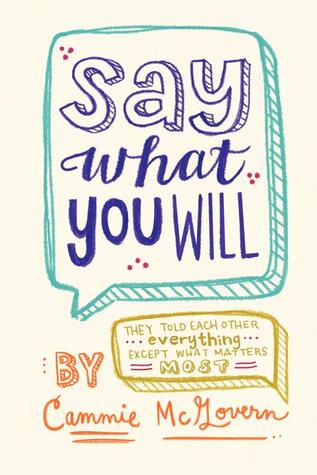
(It’s very similar to what happens in Cammie McGovern’s Say What You Will. Only instead of seeing it totally from only one side, we actually see it from the another side as well, which is equally as important.)

In Say What You Will, Amy suffers from cerebral palsy and, during her senior year, seeks out a group of peer helpers in order to make friends. She wants a boy named Matthew specifically to apply, so he does. As the two grow to become friends, Amy discovers that Matthew suffers from crippling OCD. He believes, much like Bea does in OCD Love Story, that if he doesn’t check in on someone or something, bad things will happen and it will be his fault. He has panic attacks as his thoughts repeat themselves and can’t see straight. He sweats through his clothing but doesn’t want anyone to know.

Amy does what she can to help him. She challenges him to do a small task every day and see how he fares. She reminds him that the panic attack is only temporary and that what he’s worried about isn’t reality. Amy has him repeat back what she says to him and reminds him of his challenges. Matthew slowly gets better and almost looks forward to her challenges. Through her help, they both explore what it means to love someone's faults but also help them and others heal.

Like I said: it’s important to note the other side that is displayed in Say What You Will. For most people struggling with mental illness, it’s easy and common for those around them to not understand what it is like. They’re not in your head, after all, so how could they? And it’s not like it’s exactly all that easy to explain what you’re going through either when you're suffering from mental illness. Most of the time, your description is inadequate or it doesn’t quite sound right. It’s important to note in the novel that Amy does her homework about OCD and finds out how to help Matthew little by little. She talks him through his panic attacks and reminds him that the panic is only temporary. She has him do realistic, manageable tasks instead of requiring him to accomplish tasks that someone with OCD would see as requiring a Herculean effort to accomplish. She may not fully understand what he’s going through, but she’s doing her best to help him and to empower him.

I knew very little about OCD before reading those books. I mean, I knew what True Life: I Have OCD told me back in the day, but that was about the extent of my knowledge. I knew of the hand-washing and the counting. I didn’t know about the troubles with driving or the belief that something bad was going to happen if a ritual of some sort wasn’t performed. These were very informative novels for me, while still being works of fiction. They brought to light how difficult OCD is and how consuming mental illness can be even while a person is still seeming “normal” on the outside. Some issues can be eating away at a person  while they appear fine.

You may have read this article thus far and thought, “But, Megan. You have yet to discuss how easy it is to appear fine when suffering from something like depression!” You’re right. I haven’t mentioned depression yet, though I've touched on anxiety and OCD. There are plenty of books that have depression as plot factor that didn’t quite capture -- in my opinion -- the depth of the disease. It felt like these books were missing some facet of depression as a disease or were just diminishing it entirely.


The only title that captured depression well for me was Ned Vizzini’s It’s Kind of a Funny Story. In it, Craig feels the pressure of his fancy school’s workload and the future he’s not sure he’s capable of achieving anymore. He stops eating and sleeping and finally... he becomes overwhelmed by his disease and all of the expectations placed upon him. So he takes himself out on the Brooklyn Bridge, prepared to end it all. Instead of jumping, however, he calls the suicide hotline and -- as a result -- is checked into the hospital for a 72-hour psychiatric hold. His friends don’t visit and he wonders if they were even good friends to begin with. Without all of the distractions of his daily life, though, Craig is finally able to confront his issues head-on.

The reason this novel worked so well for me was that the author suffered from depression and suicidal thoughts himself. That sounds awful to say, but I am glad that, while he was alive, he understood what it was like to suffer from these things. I think he did an excellent job of wanting to share the mindset with others. This story's purpose was to remind those suffering from mental illness that they’re not alone, that the pressures of life can sometimes be extremely overwhelming and can often cause you to lose control. He knew that firsthand and though his story ended tragically, hopefully his novel will provide hope and healing for others.

What makes these books I've listed above so special is the fact that they’re aimed at younger readers -- readers who may not know or be able to fully identify what they’re going through or how to deal with it. No book will ever portray mental illness flawlessly or provide an easy solution for every person, but these few books tackle the topic with grace and with class.

When it comes to young adult fiction, it’s important for this demographic of readers to understand that they’re not weird or abnormal because their brains function a bit differently from others'. They need to know that it’s okay -- more than okay, actually -- to discuss how they’re feeling with someone. It's important that these books conveyed the fact that that they don’t have to keep their struggles to themselves. These stories don’t gloss over the obstacles one may face with mental illness, but they do show that it’s possible to live a happy and full life despite your brain chemistry not exactly playing fair with you.

It’s time to break through the stigma of discussing mental health among all literature -- not just young adult -- and getting those who need it the help they deserve. If these few YA novels represent the future of mental health issues in literature, it’s a future I’m greatly looking forward to.