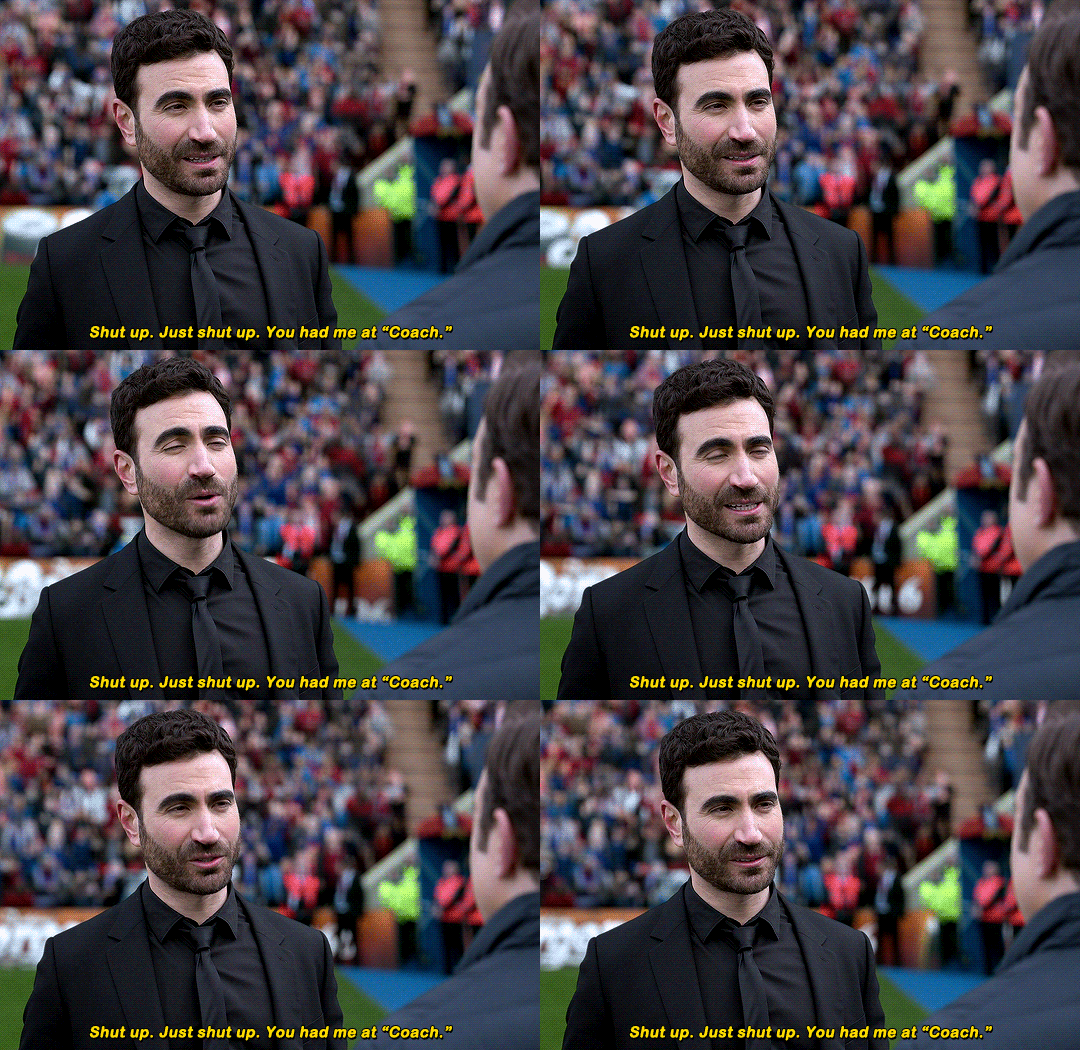
Ted Lasso, Rom-Coms, and Emotional Vulnerability

Why is it important that a show about men who play soccer did a rom-com homage?

Dickinson Behind-the-Scenes: An Interview With the Artisans

Meet the artists who brought the Apple TV+ series to life!

If You Like This, Watch That

Looking for a new TV series to watch? We recommend them based on your preference for musicals, ensemble shows, mysteries, and more!

Showing posts with label izombie review. Show all posts

Friday, April 27, 2018

iZombie 4x08 Review: “Chivalry is Dead” (White Knight) [Guest Poster: Chloe]


“Chivalry is Dead” 
Original Airdate: April 23, 2018

Like with many of the recent episodes of season four, “Chivalry is Dead” is a comparatively quieter one. Especially when looking ahead to next week’s episode description and promo, this one definitely feels like a slow build toward something far more intense and jarring. I appreciate that the show has given both the narrative and its audience a chance to breathe before giving us anything else new to engage with. While last week’s episode struggled a bit with its narrative progression, “Chivalry is Dead” manages to progress the most vital plot threads forward in a way that feels organic and substantial.

The case of the week centers on a live-action role player (LARP) who is murdered during a duel with someone else from his team. When Liv eats his brains, she takes on the mannerisms and persona of a “chivalrous knight” in a move that is simultaneously grating and yet also endearing. Seeing Rose McIver in a role like this really speaks to her talents as an actress because she manages to completely embody the character to the point where (at least for this episode) she ceases to be herself. While I wasn’t a huge fan of the brain itself — because medieval culture and lore just aren’t my thing — the case does allow two vital plot lines to better integrate, so I still see value in it.

Whilst on “chivalrous knight” brain, we get to see Liv further cement herself as the new Renegade. It is the ideal brain to be on, because it allows her to act the part of “savior.” Liv has always associated herself as a proponent of justice and “goodness” throughout the series, and so now to be seen both literally and metaphorically as a “white knight” gives her the confidence and conviction to assume her role as Renegade. However, it is evident throughout the episode that Liv still doesn’t have a firm grasp on the responsibilities and consequences of her recent actions. This is made especially apparent at the end of the episode when she loses track of one of the people she is supposed to smuggle into Seattle. When the girl finally does arrive, Liv’s “healing” scratch doesn’t work. I do not know what we are supposed to glean from this interaction (either that Isobel has some type of immunity or that Liv is losing her “spark”) but it will definitely have an impact on how she handles things moving forward.

The inability to help a dying girl is going to psychologically affect Liv more than she is probably willing to admit. Especially since the only reason she is on this crusade in the first place, and the reason she eats brains in order to solve crimes, is to feel like she is helping people. All she ever wanted pre-series was to become a doctor. And when that was no longer a possibility, she found other ways to help. But if she can’t help Isobel or gets imprisoned or killed for her actions, it is going to lead to even more problems both ideologically and emotionally for everyone in Liv’s core group.

I fear that not being able to help Isobel will push Liv to be even more brazen and reckless than usual, and that it will lead to her ultimate downfall. Especially considering everything else that is happening simultaneously throughout Seattle, I worry that Liv is not even aware of the mounting problems that are facing the city and — more importantly — she is not equipped to handle them by herself. Her motivations are seemingly coming from a pure place, but her recent actions have not necessarily been a reflection of that. If she is going to make a meaningful impact for the citizens of Seattle, she is going to need a lot more support and assistance than she currently has at her disposal

The case of the week additionally allows for some more integration of the Clive/Dale relationship storyline. By the end of the episode, we find out that the victim was murdered by a member of his LARP-ing group after he was caught sleeping with the friend's wife. During her interrogation, the wife discusses the difficulties of being in a zombie-human relationship and realizing that the lack of intimacy creates a lot of tension in her marriage. As we are well aware, this is the exact same thing that Clive has been struggling with all season. I appreciate that even in a small way, Clive is able to emotionally connect with another person over their similar relationship woes.

I think Clive will need to continue to reach out to other people for support as he continues to navigate his relationship obstacles with Dale, because navigating it by themselves has not been enough so far. Even though they are trying to communicate better, Clive is clearly crumbling from the pressure of it all. Watching Clive be so despondent this episode was hard to process. I have said it a million times but I will keep saying it until it happens: Clive deserves to be happy! We have seen him struggle in other ways before, but watching him suffer emotionally the way he has this season has been a bit too much for me. He deserves better than the storyline he has been given this season. Some of our other core characters deserve better too, including Peyton.

“Chivalry is Dead” gives Peyton something tangible to do for the first time all season by integrating her into the Renegade plotline. Even though I previously bemoaned the fact that Peyton was not getting adequate development or screen time, I am not sure I like what the writers have decided to do with her storyline. Now that she is more aware of what Major and Liv have been respectively working on, it makes sense for Liv to want to include her in her Renegade plans and take advantage of Peyton’s connections and authority in the Mayor’s office to further her own agenda. That is ultimately my main issue with this storyline: it paints Peyton as reckless even though that has never been a facet of her characterization. Peyton is methodical, hard-working, and sensible. Bribing a prisoner for information and then stealing a duffel bag full of cash is not only a poorly thought-out plan, it is also incredibly dangerous.

Especially with the revelation that Stacy Boss (someone Peyton has always been at odds with) is back in Seattle and the fact that it is technically his money that was stolen does not bode well for Peyton’s future. I do understand that now that circumstances have changed in New Seattle, maybe Peyton is more inclined to break the rules in order to help her friends and “the greater good” but it is evident that this decision will have negative consequences in upcoming episodes. It is not yet clear what will become of Peyton now that she has positioned herself as part of a resistance effort, but that it won’t be anything good.

The plot this week is far less focused on the Fillmore Graves/Major storyline, but there is still some crucial plot development regarding Major. I have discussed this a lot in my previous posts, but much of Major’s development this season has been focused on his moral quandaries. He has made very clear and definitive choices about where his loyalties lie, which is unwaveringly with Chase Graves. It has resulted in choices that characterize Major as a villain, but we have seen glimmers of recognition lately — that he is aware that his behavior is ultimately wrong. We see this presented a lot more clearly in “Chivalry is Dead” when Major buddies up to a corrupt Fillmore Graves soldier in order to then feed information about him to Chase.

It is apparent that once Major sees how far the other soldier is willing to bend the rules to suit his needs (even if this involves terrorizing or even killing people) that Major finally wakes up to the reality of what he has been a part of. He may not technically be as harmful as this other soldier, but he perpetuates many of the same notions and promotes the same culture of fear for the citizens of New Seattle. It is unfortunate that it took seeing this behavior reflected in someone else for Major to have a moment of moral clarity, since Peyton, Ravi, and Liv have long made it apparent how they feel about his Fillmore Graves associations, and what it has meant for his integrity. But it is also unfortunate, because it is increasingly apparent that Major is now too closely embedded as an “enemy” and that finding a way to reconcile his actions is going to be nearly impossible.

Elsewhere, the episode works to fuse the church/cult storyline with Blaine’s narrative arc. This ends up being important for a couple of reasons. It is vital from a narrative standpoint, because it has been clear since the beginning of the season that Angus and his cult will serve as catalysts for a full-blown uprising against Fillmore Graves, and other corrupt forces in New Seattle. Even though Angus and his followers are their own source of destruction, they view themselves as being morally justified in their pursuits. His group is comprised of dangerous but easily corruptible people. When Blaine sees an opportunity to exploit the dumb and hungry zombies in his father’s group, he does. It is apparent that Blaine is playing the long game when it comes to taking down his father. So he decides to play nice for a while.

Blaine honors the standing reservation for the church to eat for free at Romero’s once a week. He holds his tongue to avoid saying regrettable things in front of his father, all in an attempt to lull Angus into a false sense of trust and security. So when Stacy Boss returns to Seattle to collect on a debt owed to him, Blaine — being the manipulative and calculated person that he is — uses it as an opportunity to solve two problems at once. Watching Stacy and Blaine work together should make us all very fearful for our core characters’ futures. Stacy is only acting courteous toward Blaine because he wants his help. He has no other reason to trust Blaine and vice versa. It is a calculated move, but thankfully one the Blaine now knows how to take advantage of. Watching this particular relationship unfold in the next few weeks will be very interesting. And considering that Stacy’s storyline was never fully wrapped up before, I am glad the show is taking the opportunity to do it now.

As is made apparent in the promo for next week’s episode, during the brain “buffet” on the prison transport bus, one of the more dangerous prisoners escapes. It will lead to very negative consequences for the citizens of Seattle if he is not caught, but will also have ramifications for the people ultimately responsible. This plays into exactly what Blaine wants. He wants chaos to erupt in New Seattle — and if the blame gets partly directed at his father, even better. It will be interesting to see how all of the oppressive forces (Fillmore Graves, Blaine, Angus, and now Stacy Boss) will run counter to each other in the coming episodes. It will undoubtedly lead to destruction and carnage, but will also hopefully make for a compelling arc to end the season on. This is really what this season has been building to anyway, and I am now prepared to watch it unfold.

Ultimately, “Chivalry is Dead” serves as a necessary catalyst for very important things to come. On its own, the episode is quieter and more simple in structure but it is used intentionally to give the audience a break before the sensory overload that is promising to unfold starting next week. The episode still manages to develop integral storylines, while also delivering the type of fun (and funny) case of the week that we can expect from this show. Tune in next week for my coverage of “Mac-Liv-Moore,” which — based on the direction I think the show is taking us — will be an intense and exhilarating viewing experience.

Friday, April 20, 2018

iZombie 4x07 Review: “Don’t Hate the Player, Hate the Brain” (Middle of the Road) [Guest Poster: Chloe]


“Don’t Hate the Player, Hate the Brain” 
Original Airdate: April 16, 2018 

This episode, while decent enough, feels really out of place with the rest of the season. After a fast-paced and narratively ambitious first half of season four, “Don’t Hate the Player, Hate the Brain” feels largely inconsequential from both a narrative and tonal perspective. While I do appreciate that these middle of the season episodes have taken the time to slow things down and refocus, this episode feels a little too simplified. With the exception of two important plot elements, everything else about this episode feels like it could have been found as a plot in a previous season. And who knows, maybe it was intentional on the part of the writers to give us something easily digestible before moving on to what is bound to be an intense conclusion to the season. However, in a series that has to cover a lot of material in such a short time frame, this unfortunately feels a little like a waste of space. Despite some of my own misgivings about it, the episode still manages to have some trademark iZombie humor, thanks to the case of the week and our core characters.

The case itself is pretty standard — which is partly why the episode feels like something we have seen before. An egotistical “player” is killed essentially for being a giant tool. Liv eats his brains and takes on the personality of the “sleaze ball,” to the annoyance of everyone around her. While the brain itself lacks dimension beyond being that of a truly repulsive person, Rose McIver manages to play the character with a lot more humor and warmth than just pure sleaze. The case itself is only interesting because it turns out that a newly-turned zombie is the murderer. Before this season, zombies (other than Blaine) weren’t the perpetrators of crime. So to have a murder be the direct result of the fraught relationship between humans and the undead was an interesting perspective for the show to tackle.

Liv eats the brains in order to solve the case as per usual, but more than anything, being on “player” brain allows Liv to cultivate a personality where she feels like she can help Clive with his relationship. Clive’s relationship woes become an integral aspect of this week’s episode, as they take an unfortunately somber turn. I discussed in my previous posts that regardless of what happens with his relationship, I want Clive to be happy. I also expressed concern that Dale was asking too much of him from their current arrangement, and this episode confirms that. Clive is the one who has always been reluctant about the idea of having an open relationship, but he agrees because he loves Dale.

But when he finally puts himself out there (and goes home with someone) Dale immediately has a negative reaction. It doesn’t surprise me that she responds this way, but her comments were still enough to make me want to scream at her. She is hypocritical, passive-aggressive, and unkind in her response to Clive’s actions. She fails to acknowledge how much guilt, pain, and confusion their entire arrangement has caused Clive. Their emotional disconnect, coupled with her anger and resentment, will only lead to further complications in their relationship. It is disheartening to watch because again, I just want to see Clive happy and right now he isn’t. Compared to some of the other plot threads of the season, this one might not seem as vital to the overall plot, but it is still an important element to explore because it serves to further Clive’s characterization. I don’t know what else I hope to see out of this plot line moving forward, but I hope that it results in Clive eventually finding a way to be happy — even if it means his relationship with Dale has to end.

Elsewhere in the episode, the focus is split between Liv, Chase, Major, and Peyton. The Renegade storyline takes a backseat for most of the episode, and the only significant development is that Liv finds a way to make zombie I.D. cards for anyone new who gets smuggled into the city. It does not make for the most exciting of plot developments, but it does allow for important elements to come together. In the search for a supplier of brains, Liv finally has the opportunity to meet Angus at his church. I guess it never occurred to me that Liv and Angus had never met, because she didn’t even make the connection that Blaine was his son. I understand that it is a necessary meeting, so that everyone can now be aware of each other. Understanding who Angus is, and knowing about his connection to Blaine will undoubtedly become important later in the season. But for now, the plot point feels very incomplete and out of place with everything else happening in the episode.

The connection that the show is trying to establish between Liv and Levon feels additionally out of place, and quite frankly a little forced. Every time Liv gets a new love interest, it feels like they are used as a distraction on her road back to Major. While I have genuinely liked some of her boyfriends from past seasons, they either end up dead or caught up in Liv’s hijinks, and it is frustrating to watch. By making Levon part of Renegade’s crew, it is clear that he can keep up with some of Liv’s more elaborate and dangerous plans, but that is not enough to justify putting them together romantically.

We currently do not know enough about Levon to understand his motivations or his personality, so making him a love interest for Liv feels too convenient and contrived. Based on how she has handled her last two relationships, Liv is not in a good position to be dating anyone right now. But more than anything, I am not a fan of the relationship because it feels unnecessary. We know that she is capable of having platonic relationships with her co-workers, so why should this be any different?

As Chase continues to struggle with how to manage the mounting problems in New Seattle, he begins to lean on Major to assist him in his nefarious endeavors — a role that Major unquestionably assumes. It is evident that despite publicly claiming he is satisfied with how things in New Seattle have been running (and that everything he has done so far has been intentional) Chase’s emotional responses continue to indicate the exact opposite. He feels threatened by bad press and is exhibiting symptoms of paranoia. He checks his office for bugs and has Major shut down Seattle’s alt-weekly, citing it as “fake news” because it reports on issues that run in contradiction to the Fillmore Graves agenda. It is a plot line that makes me recoil in disgust because of its real-world connotations.

However, despite season four’s socio-politically charged narrative, I am reluctant to make any further comparisons between in-universe events as they relate to our current political climate. I understand why comparisons might be drawn, but doing so gets us too far away from the shows actual intent, (plus it makes me depressed) so I am not going to use this space for that. The real purpose of this plot line is to show how pressure is affecting Chase and how he is choosing to wield his power. Peyton realizes that through his actions, Chase has established an autocracy in New Seattle — a fact he doesn’t deny. He thinks he understands what is best for the citizens of the city he created, but it is increasingly apparent that it is his limited perspective on how change manifests — and his poorly-masked vulnerabilities — that will lead to his imminent downfall. It will also likely lead to Major’s downfall too.

Major has made it very clear this season where his allegiances are, so if Chase is eventually taken out of power, the responsibility for the destruction of Seattle will become Major’s fault too. It is still difficult to interpret the motivation behind some of Major’s actions, but it is evident that the show will continue to address the moral implications for every decision he has made. The look of simultaneous disbelief and disgust that Peyton gives Major during the episode when she realizes the full extent of his actions should serve as yet another wake-up call that he is making poor choices.

Unfortunately, it might be too late for Major to extract himself from Fillmore Graves, and emotionally and morally reconcile the damage he has caused. The rest of the season will undoubtedly determine what ultimately happens to him as the result of being on the “wrong” side of history.

Ultimately, “Don’t Hate the Player, Hate the Brain” is a decent, but frustrating viewing experience. It skillfully weaves humor with aggression and chaos, but it still fails to move the plot forward in any significant way. However, knowing what the show is capable of, I am not too concerned by one mediocre middle episode. I am confident that next week’s episode will be more plot propelling and exciting. Tune in next week for my coverage of “Chivalry is Dead.”

Saturday, April 14, 2018

iZombie 4x06 Review: “My Really Fair Lady” (Song and Dance) [Guest Poster: Chloe]


“My Really Fair Lady” 
Original Airdate: April 9, 2018 

“My Really Fair Lady” functions a bit differently than most episodes of iZombie, and that is a good thing. Instead of trying to do too much with its plot, it chooses to expand upon just a few of the most important narrative elements from this season. The episode also functions differently because for once, Liv does not eat the brains of a murder victim. As a result, her over-the-top personality changes exist purely for comedic value rather than serving any legitimate purpose. While none of what we see from Liv (or any of our characters) feels strictly necessary, it still makes for a fun and solid midseason episode. Nothing truly groundbreaking happens, but given how narratively intensive the first half of the season was, it is nice to have a comparatively quieter episode.

“My Really Fair Lady” steps outside of iZombie’s traditional procedural formula by doing an episode that does not actually contain a murder or “case of the week.” Instead, it focuses on some of the aftermath of the events of “Goon Struck.” While the episode does not have a murder victim, Liv still eats the brains of an over-the-top theater actress, played perfectly by the incomparable Rachel Bloom. While the first few minutes of her backstory are not necessary from a narrative perspective, it is a wonderful excuse to see Rachel in a role other than Rebecca Bunch.

(Also, as a life-long Rent fan, I thoroughly appreciated that her character attempts to put on an avant-garde zombie version of the musical. It is funny and sweet, and is only made better once Rose McIver adopts the persona too.)

While seeing Liv on “theater diva” brain is mostly done for comedic purposes, it lends itself well to the tone of the episode. Her main purpose in “My Really Fair Lady” is to pick up where Mama Leoni left off when she was executed, and become the new Renegade. Despite her desire to be good, I don’t think that Liv understands exactly what she is getting herself into — which Levon and the rest of Mama’s crew affirm. However, being on “theater diva” brain does have some advantages. It gives her the confidence and acting ability to pull off a dangerous rescue mission at New Seattle’s shipping yard. It also gives Rose McIver not only the opportunity to use her real hair and makeup, but also her real accent. It is so cute to hear her Kiwi accent, and it allows for a level of immersion even beyond what we normally see.

Since the episode does not have its standard “case of the week,” it has to rely on the shipping yard mission as its main source of conflict. Even though the mission is ultimately successful, it is apparent that this is just one facet of a much more challenging undertaking. They were successful this time, but that certainly doesn’t mean that any other facet of being Renegade will be easy for Liv. I honestly don’t know how Liv is going to be able to balance her double life of solving crime and acting as the new Renegade, but it will be interesting to watch. The most important thing for the show to address now is whether or not Liv will see repercussions of any of her recent decisions. Too often the show lets Liv off the hook for her behavior because she is the protagonist. However, this season the writers have been better about making the audience and other characters aware of her flaws, so maybe the show will find ways to hold Liv accountable.

Liv has often aligned herself as a “white knight,” ready to save Seattle from the evil plaguing society. She is both idealistic and overly-simplistic in her notions about how evil manifests, and she also lacks the self-awareness to recognize when she is contributing to the overall problem. Taking on the responsibilities of Renegade is just one recent example of Liv attempting to align herself on the “right” side of history, even if she doesn’t know what that means anymore. I have mentioned it several times before, but I think that it deserves further clarification: that Liv thinking she is a good person — or better than people like Major and Blaine — is a reflection of her own actions and behavior. It is a limited perspective on what it means to be “good” or “evil” and it is a perspective that will likely lead to further conflict for Liv in the future.

When I talk about Liv being “good,” there is a reason I put it in quotation marks. I talk about her goodness in comparison to other characters because it is a vital part of how she views herself, regardless of whether or not I actually consider Liv to be a good person. I feel like making that distinction is particularly necessary to make as we move toward the second half of the season. We will likely see Liv make a lot of morally questionable decisions in the next few episodes, and we as an audience need to be ready to talk about her actions and behavior — separate from what the characters themselves are willing to comment on.

Elsewhere in the episode, the narrative concerns itself with focusing on three key relationships: Clive and Dale, Peyton and Ravi, and Blaine and Angus.

One of the only downsides of not having an actual murder victim this week is that we don’t get to see as much interaction between Liv, Ravi, and Clive in the ways that we usually do. As a result, their individual storylines feel very isolated — and arguably less profound — because they can’t lean on each other for guidance or to reinforce their own (often poor) decision making. Without Ravi or Liv there to support and listen to Clive’s needs, his storyline this episode feels out of place with everything else. While his relationship issues with Dale have been well established this season (and I do want some sort of resolution to their arc), the development that we do get in this episode comes about in a weird way, and ultimately should have been reserved for a different episode. While Liv and Ravi’s advice is not always valued by Clive, it is still important that he listens to their perspectives — which is hopefully what he will get to do in the next episode.

Since Clive doesn’t have anyone to really confide in this week, he is left to his own devices when it comes to dealing with his relationship woes. While Clive seemed initially hesitant about the idea of an open relationship with Dale, he seems less reluctant in this episode because we see him flirt with his new co-worker. However when she finds out that he is already in a relationship with Dale, she is understandably upset by the idea that he would cheat on Dale with her. Despite the whole situation being mishandled, it does lead to an important and honest conversation with the co-worker... that Dale just so happens to overhear. Her expression after hearing Clive’s speech is a little hard to read.  It isn’t clear if her disappointed look is the result of jealousy or because Clive is having an honest conversation about their relationship with a virtual stranger, but is unwilling to communicate those same things to her.

Alternatively, maybe she realizes that what she is asking of Clive is unfair. They love each other, but what they currently have isn’t working for a lot of reasons. Without seeing their interactions with each other, it is hard to say what direction their relationship is ultimately heading. I don’t know if they will be able to make it work as a couple, but as long as Clive feels like he has his friends to confide in (and we actually see it on screen) I will be satisfied regardless of the results. I may not like Dale as a character but I care about Clive and just want him to be happy. If that means that the show spends more screen time trying to further develop their relationship, then I am okay with it. The same can unfortunately not be said for some of the other romantic relationships on the show.

I knew as soon as Peyton wanted Liv to eat the brain of a heroin addict in order to secure a “win” in the bus accident case that Ravi would take advantage of his zombie “time of the month” and eat the brain instead. On the one hand, I appreciate the opportunity for Rahul Kohli to showcase his acting range (and he truly was brilliant on “heroin addict” brain) but from a narrative perspective, it was a little infuriating to watch. I sometimes like the idea of Peyton and Ravi as a couple, but I dislike the fact that it took a truly reckless and dangerous gesture on Ravi’s part for Peyton to consider him again. Their relationship has always felt very one-sided and while I do believe that she cares for him, I don’t appreciate that it took this much on Ravi’s part to get them to that reunion kiss at the end of the episode. I think both of them have made poor choices in response to their relationship; but more than anything, I think it’s Peyton’s general lack of character development that makes it hard to root for Ravi and Peyton as a couple. If she was given more screen time and more opportunities for us to understand her motivations, then I could maybe feel better about shipping these two. As it stands, I will wait to see what the show decides to do with this relationship before I make any more observations on them as a couple.

One of the most significant plot points of “My Really Fair Lady” happens at the very end. I was wondering when the church/cult storyline would finally intersect with Blaine’s, and this episode gives us that answer. When Blaine finally learns that his father has not actually been at the bottom of a well as he had previously thought, he absolutely loses it. Angus shows up to Blaine’s restaurant with his cult in the hopes of securing a standing reservation for them to eat at Romero’s every week. It is a significant plot point for a few reasons. Angus uses it as an opportunity to show Blaine that he is just as dangerous and manipulative as before, but now he also has his own army of followers that he can control and use in a fight against Blaine. This particular storyline was already alarming enough to watch, but is even more so now that Blaine is aware of the problem.

However, the part that is most alarming is seeing how much control Angus still has over Blaine, psychologically. While we see Blaine’s anger during his confrontation with his dad, we also see something even rarer — we see his fear. Blaine has always been characterized as a textbook villain. He is murderous, manipulative, arrogant, angry, and ruthless. Despite all of these characteristics, the show makes it very apparent that these are learned traits and defense mechanisms. They are all characteristics that Blaine has chosen to adopt, but they are still the product of seeing similar behavior expressed when he was growing up. Blaine was abused by his father as a child (something he repeats while screaming at his father in this episode), and it is clearly a trauma that informs his behavior as an adult.

Blaine’s predominant emotions at the end of this episode are anger, fear, and disbelief. As much as he would like to pretend otherwise, the notion that his father has manipulated and coerced an entire group of people into believing that he is some type of zombie savior deeply terrifies Blaine. The whole reason that Blaine kept his father in “zombie jail” and put him down a well in the first place is because killing him would have been too easy. He wanted Angus to suffer the way that Blaine felt he had suffered as a child. So for Blaine to find out that not only is his father out of the well but is more of a threat than ever gives Blaine considerable cause for concern.

It is evident that Blaine and Angus will have to come to some final blow soon. For his sake, I am hoping that Blaine is the one who triumphs over his father. I appreciate that Blaine is a complex villain. I wouldn’t like him as much if he weren’t. It is because of his complexities that I can root for his hopeful triumph over his father — in whatever form that takes. While Blaine’s terrible childhood should not be used as an excuse for his behavior, it is a good explanation for his actions. Having something deeper and more dynamic to cling to makes Blaine a more interesting and important antagonist to — dare I say — root for.

Ultimately, “My Really Fair Lady” showcases that the show still does pretty well when it goes narratively smaller. While not every aspect of the episode felt like it had a legitimate place in the overall plot, it still allowed for some of the most vital narrative threads of the season to further develop. It leaves the rest of the season open for a lot of different possibilities, and I look forward to finding out how the show handles that. Come back next week for my coverage of “Don’t Hate the Player, Hate the Brain.”

Saturday, March 31, 2018

iZombie 4x05 Review: “Goon Struck” (A Step in the Right Direction) [Guest Poster: Chloe]


“Goon Struck” 
Original Airdate: March 26, 2018

The first few episodes of iZombie season four primarily existed to establish the tone and direction that the season would be going in. These episodes were largely frustrating for me to watch because they established a lot in a very short amount of time without taking the time to delve into some of the more complex aspects of the narrative, or providing insight into how anything would be resolved.

However, I should just remind myself every once in a while to be more patient with the creators and writers of the show. These episodes ultimately proved necessary because they have set things up for a more focused middle third of the season. “Goon Struck” exemplifies what iZombie can be when all of its narrative components work well together. It is an episode that works because it is not trying to be overly ambitious with its plot. The episode does still have a lot of moving parts, but they are a lot better integrated so it no longer feels overwhelming to keep up with individual components.

The primary murder victim this week is an aggressive hockey player. Watching Rose McIver immerse herself in this particular role was a lot of fun to watch because she makes the transition between last week's “rom-com” brain to “hockey punk” look seamless. This particular brain gives Ravi, Clive, and Liv an opportunity to have a lot of fun with each other. It showcases why they work so well as a team, and watching them bond over bad hockey puns — and their hatred of haughty French detectives — is a beautiful thing to witness. The show works best when it balances humor with the more dark and sinister elements of the plot, and that balance is displayed so well in “Goon Struck.”

The case of the week is ultimately significant for more than just its humor. It is used as a means of connecting the Renegade/Mama Leoni storyline to everything we have seen so far this season. At the end of last week’s episode, it was unclear what Chase was planning on doing with Renegade — although killing her was the likely outcome. However before we reached that inevitable conclusion, Chase surprised me. He initially decides to put Renegade in “zombie jail” (also known as a deep freezer) in order to preserve her for future use.

While all of this is happening, Liv gets a vision of Blaine killing our hockey player. It then becomes apparent how this plot element fits in with the rest of the story. The murdered hockey player was working with Renegade in pursuit of doing the “right” thing, and got murdered for being in the way. The way that the show integrates these storylines is both logical and effective. Now our characters are more or less aware of each other’s motivations. Blaine is his usual evil self and is more interested in looking out for his own needs than anyone else’s. Major continues to make morally questionable decisions, all while masquerading himself as “just” and “good.” Chase is struggling to maintain order in the complex system he has created in New Seattle. And Liv continues to be most interested in being on the side of justice, which is why she makes a very big decision at the end of the episode.

By the end of the episode, Chase decides to publicly execute Renegade to serve as an example to the citizens of Seattle — her actions were not tolerated and will not be tolerated. So of course Liv decides to team up with our new character, Levon, (who we don’t know that much about yet but sure welcome to the show, Daniel Bonjour) and “pick up where Mama Leoni left off.” It may seem like a more subtle shift in tone than some of the other changes that have happened this season, but it will likely have a much bigger impact. The possible uprising that I theorized about a few weeks ago could be the result of Liv’s decision. Now that she is more aware of what is really happening in her city and the kind of leader Chase Graves has solidified himself as, she is going to be more determined to undermine the whole system. I am really excited to see how this unfolds, and I am just grateful that this season has indeed been building to something special. I hope that the next few episodes continue to develop the ideas that have been fleshed out in this episode and that we slowly build to the most emotionally satisfying finale to date.

The sub-plot with Major and Don E initially seems out of place with the rest of the episode, but ultimately ends up working well when we discover what they are really doing outside of Seattle. At first it appears as if they have kidnapped a woman for no reason, but when she turns out to be the daughter of an influential army general (the same general who wants to bomb Seattle and put everyone out of their misery), the choice makes sense. It then becomes clear that Chase wants to use the woman as a weak attempt at gaining leverage in order to insure that his plans for New Seattle stay intact. Apart from that, the plotline is generally unimportant. It does give us some funny Don E one-liners, but mostly the plotline is used to fully cement where Major’s allegiances are.

Major is Fillmore Graves to the core and is willing to do anything it takes to maintain the notion that he is on the “right” side of history. However as I have mentioned before, Major is a mess of contradictions. He preaches about the importance of creating harmony and safety within New Seattle, but looks the other way when immoral things happen. He can watch someone get publicly executed for turning zombies, but when he scratches someone in the same episode, it is treated differently because he is part of Fillmore Graves. The only time his morality ever gets checked is when he is around Liv. At the end of the episode when Liv gives him a disapproving look, his expression falters for a moment because he knows what he just participated in was wrong. The question now is what is he going to do about it? He has had numerous opportunities recently to make better choices and he still refuses to listen to reason. If Liv ultimately turns her back on Major, I question whether he will be able to morally course-correct on his own, or if he will even want to. It is apparent by the end of the episode, that despite their romantic history and their friendship, Liv and Major are officially on opposing sides as the plot moves forward. 

Elsewhere in the episode, Peyton actually gets something to do! (Sort of.) Even though it is part of the B-plot, it still manages to be well-integrated with the rest of the story. When bus patrons come to the mayor’s office with complaints about their zombie bus driver, Peyton take it upon herself to alleviate their concerns while also attempting to help the malnourished driver. He is one of hundreds of underfed zombies living in New Seattle — which again speaks to the food shortage and “image” problems facing Fillmore Graves and New Seattle in general. The main problem with this is that despite Peyton’s desire to maintain harmony between non-zombies and zombies, she has no actual control over what happens in New Seattle — including the food supply. So promising to take care of one starving bus driver backfires tremendously for her.

When the driver gives his new rations to his family, he is left still starving, passes out at the wheel, crashes and ends up eating the brains of two passengers before getting shot and killed. It is evident that while her job of helping people used to be meaningful, Peyton no longer has the capacity to make a difference for the citizens of New Seattle. She works for a zombie mayor, but when Fillmore Graves controls almost everything, does her job as a staff member mean anything? Ultimately this storyline with Peyton delivers a message about futility and hopelessness. If the mayor’s office cannot help meet the needs of Seattle’s citizens, and Fillmore Graves isn’t meeting needs either, then who is going to? (And no, joining Angus’s church/cult isn’t going to be the solution.)

This storyline again speaks to a much bigger problem for the city as a whole because it shows how little facets of everyday life are being impacted as the result of problems at the top. Fillmore Graves has restructured Seattle to be a military state, but it is becoming increasingly clear that they are losing control over their own citizens. It is mostly the result of neglect, which speaks to poor leadership rather than ill-intent. While I used to think that having the wall, the soldiers, and the minuscule rations were a way for Fillmore Graves to control the citizens of New Seattle (and to an extent that is still partially true), now I see them used as a desperate attempt to maintain order in a city that — from an outsiders perspective — is in ruin. Chase Graves, while once seen as a strong-arm, now seems ill-equipped to oversee the aftermath of his own creation; and he seems scared of what will happen if he cannot fix the mounting problems facing his city.

Perhaps the most satisfying part of “Goon Struck” is getting to see more of Chase Graves and getting a better understanding of his motivations. While Chase is a person who would like to be seen as a ruthless and aggressive leader (and he succeeds in doing that most of the time), he has also always been characterized as a little sheepish and vulnerable. We saw some of that in the finale last season, making it clear that his vision for New Seattle came out of necessity rather than an actual true desire to be evil. I am certainly not saying that he doesn’t possess the ability to be evil; rather it doesn’t come as easily as he would like people to think. That is what makes him an interesting antagonist to pair alongside Blaine. For Blaine, being ruthless and calculating is just who he is. His motivations have always been crystal clear. Chase was thrust into Seattle and forced to make some tough calls in order to push the notion of a “new world order” forward. His behavior is not always a reflection of his true values, but something he has ultimately decided to do out of fear. He is afraid of the world that exists outside the walls of New Seattle, and what the people of that world could do to its citizens if he cannot maintain order. 

He is afraid that if he shows weakness, everyone who is under his control will turn on him, and he will be left in ruin. His motivations and actions in this episode align perfectly with a fear-based mentality. He doesn’t want to have to make an example out of Renegade, but does so because the fear of losing control over the system he has created is much greater than his desire to be good. He publicly executes Renegade not because he truly wants to, but because he needs to convince himself that he is still strong and in control.

However, Chase has not anticipated what the aftermath of his actions will be. He incorrectly assumes that this action, along with kidnapping an army generals daughter, will be provide him with the time and leverage needed to negotiate and “fix” his broken city. Little does he know that it is about to make things a whole lot worse. The rise of Angus’s church and Liv’s decision to carry on Renegade/Mama Leoni’s legacy are just two components of many that will lead to Chase’s downfall. I fully expect that Chase will get thrown out of power or killed before the end of the season.

Ultimately, “Goon Struck” is a simple but good episode that showcases what iZombie can accomplish when it focuses on one thing at a time. The writers have developed such an intricate world, but sometimes it is nice to just explore and develop one facet of it at a time, before building to bigger ideas. The episode exemplifies why all of these characters (even the antagonists) matter, and that sometimes taking the time to explore character rather than plot, works better for the show. It gives us a more compelling reason to empathize with their struggles, so that when things do reach their inevitable breaking point, we will be emotionally ready.

There won’t be a new episode of iZombie next week, but I will be back in two weeks with my coverage of “My Really Fair Lady,” guest-starring Rachel Bloom!

Thursday, March 22, 2018

iZombie 4x04 Review: “Brainless in Seattle, Part 2” (The Second Act) [Guest Poster: Chloe]


“Brainless in Seattle, Part 2” 
Original Airdate: March 19, 2018

Last week I was left feeling frustrated and unfulfilled by “Brainless in Seattle, Part 1” because to me, it existed merely as a placeholder for things to come. Thankfully “Brainless in Seattle, Part 2” does a better job of providing resolution to some of the most significant narrative threads of the season thus far. Even though the episode does not accomplish everything, it does give the audience a clearer idea of what the rest of the season might entail. It also uses its hour to more effectively integrate stories that previously lacked focus.

Since this episode is the conclusion of a two episode arc, my commentary this week is going to be in pretty direct response to the observations I made in my post last week. Essentially, like the episode itself, this post is really just a continuation of my thoughts.

“Brainless in Seattle, Part 2” picks up pretty seamlessly where last week left off and immediately finds ways to integrate the five central plot components of season four. Those central plot threads include: 1) Fillmore Graves being an oppressive and violent force that has set New Seattle up like a prison. 2) Angus and his zombie church/cult growing stronger and more dangerous as they hunt and kill humans “in the name of God.” 3) Investigating Renegade, a coyote who scratches sick people, and helps people escape Seattle, all in the name of “helping.” 4) Blaine running a criminal operation that involves killing people and buying brains on the black market. 5) A serial killer who is murdering wealthy people that are looking to leave or enter Seattle.

And that doesn’t even include all of the more minor narrative components of the season. Does that sound a little narratively ambitious to anyone else but me, considering we got all of this new information in just three episodes? It is ambitious, which is why I have been feeling so frustrated with the season so far. I wasn’t sure how or if any of these components would start to integrate, so I am pleased that this episode starts to do that a little bit.

In this episode, we finally get a better understanding of what Angus and his church have planned for the future. We are reintroduced to this particular plot point when Tucker (the anti-zombie who was scratched and turned into a zombie by a Fillmore Graves soldier in episode two) finds his way into the church. He is depressed with his new condition and none of his friends or family wants anything to do with him, so the extremeness of the church and its rhetoric start to appeal to Tucker. He has nothing left to lose and he sees Fillmore Graves as the enemy — which is why he has no issue with completely giving in to the messages Angus preaches. It is only when Major shows up at the church in search of Tucker that these two narrative threads start to come together.

In a scene that it truly disturbing, Angus both commends Major for his work as a “liberator” when he was The Chaos “Killer” but also threatens him. He makes it explicitly clear that Fillmore Graves is the enemy of the people and that if Major shows up at the church in uniform again, he will “smack [his] head clean off [his] body.” It is a line that is so ominous that it really should serve as a wake-up call for Major. While Angus is just a different kind of evil force, it does not take away from all of the oppression that Major is perpetuating as a Fillmore Graves employee. I still don’t think that he sees his actions as morally wrong, but maybe this will serve as a reminder that there will eventually be consequences for his decisions and actions.

While I was initially skeptical of this particular storyline, I am now very interested to see how this unfolds throughout the rest of the season. It feels just as high stakes as the Max Rager plot from season two, but twice as harrowing because it involves more than one evil force. It has been a relatively slow build to this point because it has been mixed in with so many other narrative components. However, this plot is evident that the show is building to some type of grand conclusion that will undoubtedly alter the structure and course of the series yet again. I don’t currently feel like I am in a good place to speculate on the specifics of that resolution because I am not even sure what I want from this storyline. But the show has always found ways to surprise me with its resolutions before, so I trust the writers to do a good job of surprising me this season too.

The other central component of this episode explores the connection between Renegade and Blaine. In last week’s episode, Chase tasked Blaine with finding Renegade so that she could be eliminated. As a result, we get to see Blaine on “loose lips” brain while he waits for a vision that can help him track her down. This is a particularly great brain for Blaine to be on. Even though he is already very transparent about how evil he is, he becomes so honest to everyone about his motivations (even customers at his restaurant), that it is treated very comically. This is the Blaine content that I am here for! He was so sidelined as a character last season that I am just grateful that the writers decided to return him to his rightful place as one of the central antagonists of the series. 

Before Blaine is able to find Renegade, we get a really important conversation between her and Liv. We find out that like Liv, she is one of Seattle’s original zombies. She was one of many early zombies who were subsisting off of the brains of murdered teens (which if you don’t remember, was part of Blaine’s M.O. in season one).

When she realized that no one cared to listen to her concerns, Renegade decided to start helping people in any way that she could. In New Seattle, that now involves scratching the sick and helping families over the city wall, like we saw in episode two. She is presented as a truly compassionate and honest person, so it devastating when Blaine finally finds and brings her to Chase Graves. I don’t yet know what plans Chase might have for Renegade beyond killing her, but the look he gives her is chilling. She is either going to be used as part of some evil plan or she has been getting in the way of whatever Chase has planned next. It will undoubtedly involve coming to blows with Angus’s church/cult or with Liv, and I am excited to watch it unfold. Again, I feel like a bad fan for not having some of the foresight to be able to predict what is going to happen next, but I am also okay with not knowing.

The last component of “Brainless in Seattle, Part 2” is arguably also the least important. While the revelation that there was a serial killer in Seattle felt important last week, it doesn’t feel as important now. Additionally, we see Liv continue on “rom-com” brain even though there is no compelling reason for her to still be on it other than wanting to find her “soulmate” Tim. It does provide Rose McIver with the opportunity to play someone over-the-top and whimsical (she can truly play any character convincingly) which is funny to watch, but does little else for the narrative. However, I do appreciate that starting with last week’s episode we are getting the return of the introspective voice overs from Liv. It is a vital part of how we see and understand Liv’s perspective and motivations, so I appreciated having it back. It also gave the episode a lighter tone, despite all of the harrowing aspects of the rest of the plot. That combined with Ravi’s undercover persona and seeing Major on “macho wrestler” brain allowed the episode to feel less sinister.

The serial killer storyline ends up feeling a little lackluster in comparison to everything else the episode does well. They catch the bad guy in the same way they would with any other case, and that is it. There is no further exploration of the killer’s motives, and the episode concludes the arc without commenting on its significance at all. It was a nice idea to explore in theory, and maybe it will still be integrated with another element of the story, but for now it feels like wasted space. In a season that has so many other components to it, the show cannot afford to waste time on elements that won’t serve the rest of the story in a significant way.

“Brainless in Seattle, Part 2” manages to address almost every loose thread of the season thus far and while not all elements have been concluded satisfactorily, (at least to me) it does provide satisfying answers for some plot points. In an episode filled with other great moments, the conversation that Liv and Clive have about his relationship with Dale was the most satisfying for me to watch. In last week’s episode, we saw Dale kiss another man, and it raised questions about whether she was cheating on Clive. Instead of communicating her concerns in a mature way, Liv decides to badmouth Dale and attempts to set Clive up with a new co-worker. We see her do this more aggressively in “Part 2” and thankfully Clive is not having any of it. He finally calls Liv out on all of her problematic behavior by arguing that “what makes this worse is that it’s not just coming from the brain you are on; I think it is coming from you.” It is only after this conversation that Liv decides to tell Clive the truth. As I speculated last week, Dale and Clive have indeed agreed to open up their relationship, so technically what Liv saw wasn’t cheating.

But the news is still devastating for Clive because of course it isn’t really something he wants, but rather something he is trying to do because “when you love someone you will do anything to try to make it work.” It is a heartbreaking moment but also one that brings Liv and Clive closer. It is vital that they are both so hard on each other about their various life choices because it holds them more accountable for their actions. This conversation is ultimately so important because it is a rare moment of vulnerability for Clive. As frustrated as he gets with Liv, he still trusts her with the most important aspects of his life which allows their friendship to flourish.

Ultimately “Brainless in Seattle, Part 2” serves as an adequate conclusion to some of the most important developments from last week’s episode. We are now a third of the way through season four, and this episode definitely feels like the conclusion of “Act 1.” If the first act exists to establish all of the important facets of the season, act two will show a more substantial build in the narrative. What it will entail is for us to speculate, but whatever the next part of the season brings, I know that it will be a lot of fun to watch. Join me next week for my coverage of “Goon Struck.”

Wednesday, March 14, 2018

iZombie 4x03 Review: “Brainless in Seattle, Part 1” (An Apt Title) [Guest Poster: Chloe]


“Brainless in Seattle, Part 1” 
Original Airdate: March 12, 2018 

“Brainless in Seattle, Part 1” is a decent episode, but it functions exactly like its title indicates. It is part one of a much more narratively complex story but without part two, the episode falls a little flat. It also makes it more challenging to discuss, because it introduces so many new plot points that have no emotional or narrative pay-off yet. So instead of trying to speculate what is going to happen in part two, I am going to treat this episode like a standalone for now. I will acknowledge that this episode continues to develop some pretty ambitious ideas for the season, but without knowing how any individual narrative thread is going to come together, I am going to try to stick to commenting on what I do know.

While the plot point about the zombie cult/church played a vital role in last week’s episode, “Brainless in Seattle, Part 1” puts that storyline on hold for the week in order to explore yet another sinister threat to the safety of the citizens of Seattle. We discover that anyone who tries to come into/leave Seattle is either scratched (thus making them a zombie) or murdered. This new development is introduced to us in two important ways — and Blaine and Fillmore Graves seem to be at the center of most of the conflict.

The first important plot thread of the episode is that Seattle has a severe shortage of brains. In order to maintain the city the way it is, something has to change. If Fillmore Graves doesn’t find a new way to acquire a steady supply of brains, Seattle will soon run out and the aftermath will be catastrophic. The additional problem related to this is that new people entering the city are being scratched, even though that isn’t supposed to happen. The alleged culprit is Renegade — the human smuggler we met at the end of last week’s episode. It is not yet clear why she is scratching people (especially since she seems so compassionate and thoughtful), but the important thing is that Chase Graves wants her eliminated.

It is not yet clear what Chase Grave’s long-term goals for New Seattle are; he is keeping his plans to himself, since even Major is not privy to the deeper machinations underway by Chase and Fillmore Graves. It is evident that Chase does not trust Major with the more “classified” plans, and in many ways I think that is why he wanted Major to work with and recruit new zombie teens to join the Fillmore Graves army. If Major is occupied with trying to train impulsive and aggressive teen zombies, he won’t have time to focus on anything else. It is a calculated move on the writers’ part, because it leaves the audience as much in the dark about what is really going on in Seattle as our characters.

However, the episode does give us a bit of insight into at least one facet of what is clearly a much larger problem. By the end of the episode, we discover that there is a serial killer living in Seattle. He masquerades as a coyote, takes copious amounts of money from people that are trying to cross into Seattle, gives them a false sense of security, and then murders them. The case of the week centers on one of his victims — a young woman who tries to enter New Seattle in search of love. The reason the case is ultimately so important is because it speaks to a much greater issue plaguing Seattle.

I discussed it in my post last week, but it is worth repeating that having a wall surrounding New Seattle is oppressive and dangerous. By limiting who can come in and out of the city, Fillmore Graves has essentially turned Seattle into a prison. As a result, people will go to extreme lengths just to try to escape or bring loved ones in. So to find out that anyone who “defects” ends up dead, while Fillmore Graves turns a blind eye, speaks to a much bigger problem. I don’t yet know what the possible solution to this problem is going to be, but it does set a very dark tone for the rest of the season. Dealing with a possible serial killer is not something that iZombie has tried to grapple with before, so it will be interesting to see how it unfolds in part two. It is an ambitious move for a show that doesn’t function like a standard procedural and yet, it could still end up working well.

This episode also gives us a lot of good Blaine material. In any other context it would seem like a paradox, but Blaine truly is at his best when he is unapologetically evil. In this episode, Chase tasks Blaine with finding and killing Renegade — and in return, he is allowed to do whatever he wants. In the process of trying to track her down, we see Blaine at his most brutal. He kills and eats the brains of someone in order to uncover information, and in the process he reveals that he is indeed the one who stole Ravi’s zombie cure vials last season. I always assumed that Don E. stole them for Blaine, so it was nice to get that confirmation. The question now is what does Blaine plan on doing with the remaining sixteen vials? If he kills Renegade and Chase gives him the power to do whatever he wants, we might actually get to see what Blaine is capable of doing at his absolute worst. After his non-existent storyline last season, I would certainly welcome the full-fledged return of “evil” Blaine.
The episode also asks the audience to question what Blaine’s connection to the serial killer might be.

We know that Blaine’s business thrives off his ability to provide quality brains to the zombies of Seattle, and that they are obtained on the black market. But we also know that there is a brain shortage in Seattle for everyone and that the official Fillmore Graves shipments are producing fewer brains with ever visit into the city. So since we now know that people who are brought into city are being murdered and their brains are then sold for profit, is Blaine involved in ordering the hits on these people? Or is Chase the one responsible for ordering the hits? They both stand to benefit from the serial killer's handiwork, but it is still unclear what the true motivation is for either one. Is it about creating a culture of fear so that order is maintained, or is it about profiting from the deaths of innocent people? Regardless of what the connection is (and there is still a possibility that there isn’t one), I hope that part two addresses this next week.

Since there are more elaborate narrative elements to focus on in this episode, everything else is forced to take a backseat. Even though the case of the week is directly related to everything else that happens, it certainly does not feel like it at times. Liv eats the brain of a flighty, romantic-comedy obsessed hopeless romantic. When removed from the rest of the narrative, it is a really interesting brain for Liv to be on. In recent episodes we have seen Liv extremely unpleasant, and while she still has a moment where she makes a snide but a well-earned comment, having her on this brain is primarily an opportunity to see her be happy and fun for a change. Seeing her act like a love-struck teenager provides the necessary comic relief in an episode that would otherwise feel a little too dark. Her behavior is over-the-top, but that ends up working well. Plus, it provides us with the opportunity to see Liv quote famous rom-coms, and reference Bridget Jones. (Something that my rom-com enthusiast brain lives for!)

Beyond providing the audience with some wonderful and silly moments, being on this brain does not give Liv as much to do narratively and that is part of what makes the episode feel a little weak. In a lot of ways, this episode doesn’t give any of our characters a whole lot to do. However, despite not having as much interaction as we normally get, the few scenes we do get with Liv and Clive are incredible. In a moment of rare introspection, Liv has to decide if she should go against the instincts of “lovesick brain” and tell Clive that Dale is cheating on him. It is a disheartening discovery, but I also cannot say I am surprised that Dale is cheating on Clive. She is a hard character to like, and I really do think that Clive could do a lot better. So unless we get an alternative explanation for her actions in the next episode (like maybe Clive and Dale have opened up their relationship in order to still meet their individual needs), they really should break up.

Even though Liv decides not to tell Clive for now, I really appreciated her snide comments toward Dale. She essentially calls Dale a “dead-weight” who only exists to bring her partner down. While it is blatantly inconsiderate behavior — as is her thinly-veiled attempt to set Clive up with his new co-worker — in this instance I am going to give Liv a pass on her behavior. Despite being on an optimistic brain, she chooses to go against the personality of the brain in order to say how she really feels. This also proves that she is capable of making independent choices, which is something she previously denied was possible. She cares about Clive immensely and doesn’t want to see him get hurt. So while we don’t yet know how this particular plot point is going to resolve, it is important for the audience to know that despite everything, Liv is still going to be there to support her partner.

“Brainless in Seattle, Part 1” ultimately ends up feeling a bit disjointed. It introduces yet another complex element to the overall narrative at the expense of some of its other storylines. As I mentioned previously, this episode primarily serves to establish important things to come. But until they actually happen, it just feels like the show is using this episode as a placeholder. I appreciate all of the ambitious moves that the creators of the show have taken recently, but it still feels like the ideas are only partially realized. The more new elements the writers introduce to the story, the more confusing every facet of the show becomes.

While I understand how limiting it can be to fit every element you want into a thirteen episode season, sometimes a show can collapse under the weight of trying to do too much, and I worry that iZombie is heading in that direction. I still have faith in the writers of the show, but until I start to see resolution or emotional payoff for some of these ambitious plot threads, I am going to remain a little frustrated. Hopefully “Brainless in Seattle, Part 2” will start to provide some of the resolution I am looking for. Tune in next week for my coverage of that episode!

Wednesday, March 7, 2018

iZombie 4x02 Review: “Blue Bloody” (Moving Forward) [Guest Poster: Chloe]


“Blue Bloody” 
Original Airdate: March 5, 2018

While last week’s iZombie premiere primarily served to re-immerse the audience into the world of the show and establish the rules of New Seattle, “Blue Bloody” wastes no time diving into that “new world order.”

The case itself is pretty standard: a stuffy rich woman gets murdered by one of her staff members, 1) because she is horrible and 2) because the murderer finds out that there is one million dollars left to them when their employer dies, thus having a pretty compelling motive. The case is significant for two reasons. First, we get to see Liv at her most insufferable to date. At this point, it seems like Liv is intentionally leaning into the bad characteristics that she acquires while on any given brain. She no longer takes on just the traits of the people whose brains she eats. Now, she becomes those people entirely. From an acting standpoint, it is fun to watch Rose McIver completely disappear into a new role each week. But from a narrative standpoint, it’s disturbing.

While she eats the brains of a particularly vile person this week, that should not excuse her behavior during the episode. I do appreciate that Ravi and Clive call Liv out on her bad behavior; now I just wish she would take some personal responsibility for how her actions have been impacting everyone else. Maybe she no longer knows what it means to “be herself” when she is not on any brain but her own, but I hope that she figures it out soon. I still love Liv (and I don’t expect her to be perfect) but seeing her act selfish and oblivious is starting to get tiresome.

The case of the week is additionally significant because of the killer’s motivations. She kills her employer in order to get the money she needs to help her son who is critically ill. In order to save his life, he needs to be smuggled out of Seattle and sent for a surgical procedure in California. While killing her employer is wrong, she does it for generally selfless reasons. By the end of the episode, Liv and Ravi agree to help get her son out of Seattle, despite how difficult and dangerous it is. This plot point ultimately serves as an important commentary on the oppressive nature of New Seattle. While the Fillmore Graves soldiers can claim that the wall exists to keep the citizens of Seattle safe from the rest of the world, it also keeps them isolated from that world. They no longer have the ability to move around freely, so it’s no wonder that people have to go to such extreme lengths to try to leave. I have no doubt that this specific commentary will continue as the season progresses.

Another way that the episode addresses the oppressive nature of the “new world order” in Seattle is through Major’s storyline. Since season two, Major has struggled to define himself and his motivations, which has often resulted in him making very poor decisions. However, despite all of his mistakes, it is evident that Major still thinks of himself as a good person. That is how he is ultimately able to reconcile the things he has done since becoming a Fillmore Graves soldier. If he can convince himself that his job is truly about integrating Seattle and being a “peacekeeper,” then he can push away the less desirable things that he has done — and will continue to do. However, despite presenting himself as a “good” guy, I think there is a part of Major that knows that many of his actions are ultimately wrong. Take the anti-zombie/Fillmore Graves fight scene in this episode as an example.

While we know that Seattle’s anti-zombie coalition is comprised of narrow-minded and aggressive people, that doesn’t mean that they deserve to be killed or turned into zombies as punishment for their actions. There has to be a better way to address their aggressive and violent tendencies, and hopefully the show will find a way to do that soon. The scene where the new teen zombie recruit attacks and scratches one of the anti-zombies is hard to watch because despite the disturbing actions and rhetoric espoused by the anti-zombies, attacking them with brute force is just as damaging to Fillmore Grave’s image as doing nothing. It also paints them as no better than the anti-zombies.

There is a point when Major is trying to break-up the fight that we see a witness recording the whole thing. It is at this point that Major looks concerned for the first time. From an outsider’s perspective, the Fillmore Graves soldiers look like instigators of violence — or if nothing else they serve as violent oppressors. That isn’t how Major sees himself, but maybe seeing his actions from a different perspective will help shine a light on his flawed behavior. Liv tries to offer some of that perspective at the end of the episode.

And while I am not convinced that Liv is in the best position to offer advice on Major’s behavior, (since she has enough of her own issues to deal with) I still appreciate her effort. Major’s overly defensive response to Liv’s critique of his character comes from a place of pain. Part of the reason they have never really worked as a couple is because Major is always put in an inferior position both ideologically and morally. He is never deemed as “smart” or “good” as Liv. That is what makes the scene at the end of this episode so significant. While they have had conflict numerous times throughout their on-again off-again relationship, this is one of the few times that they are being honest about their real problems with each other. Major resents Liv’s “holier than thou” attitude that she brings to most situations, while Liv is continually frustrated with Major’s poor decision making. They are now firmly in opposition with the other and I am interested to see how this impacts the plot moving forward. Will they find a way to reconcile their differences, or will this argument be the catalyst for further conflict throughout the rest of the season?

Another important facet of “Blue Bloody” is the prophet storyline. While I was primarily annoyed and confused by Angus’s behavior in last week’s episode, now I am terrified by it. In between episodes, Angus has managed to establish a pro-zombie church that has a cult-like following. He preaches some pretty dangerous rhetoric and justifies all behavior — even murder — as acceptable because it is done “in the name of the Lord.” It is disturbing to watch because while Angus and his followers do not seem like a credible threat to the safety of the rest of Seattle yet, they will be soon. I am not exactly sure how this particular narrative thread will unfold this season, but I do know that it will have some type of negative impact of our other characters. Maybe this will lead to the uprising that I theorized about last week?

Either way, the zombies of Seattle need to be very cautious about buying into the notions of someone who has all the “right” answers. Whether the zombie residents choose to listen to the preaching of Angus and his church or adhere to the strict rules that are enforced by Fillmore Graves soldiers, both options are negative extremes. It will be interesting to see how these two extremes start to intersect, and what impact it ultimately has on the people (both zombie and non-zombie alike) of Seattle.

While I understand the greater significance of their conflict, I disliked Clive’s and Dale’s storyline this week. (It felt largely out of place with the rest of the episode). We knew as soon as Dale turned into a zombie that it would cause additional strain on her relationship with Clive, and I guess issues of a “sexual nature” are included in that. They are two fiercely independent people with strong personalities and trust issues. Adding sexual incompatibility to the mix only makes things harder for both of them because their physical connection is a large part of why they work well as a couple. Without that connection, can the relationship last long-term? The question at this point is whether Clive’s relationship with Dale is worth it. I don’t like the idea of him eventually becoming a zombie just for the sake of the relationship, but we will have to see how it goes. He does not deserve a life of solitude, but he also does not deserve to be turned into a member of the undead forever — if that is not something he truly wants. This conflict adds dimension to a relationship that is otherwise a little boring because it makes me care about the outcome.

When Liv and Major were previously experiencing very similar issues, I found myself not caring as much because their entire relationship seemed juvenile. At least with Dale and Clive, they are trying to take a more mature approach to solving their problems (anti-anxiety pills to reduce libido not withstanding). Even though it won’t be my favorite storyline to explore, I am still interested to find out what Clive plans on doing to solve his “intimate” problems. Additionally, if it involves more hilarious scenes of him trying to open up to Ravi, I won’t take issue with it.

Like much of last season, “Blue Bloody” is yet another episode where Peyton and Blaine are absent. I have previously conveyed my frustrations about Peyton’s lack of real characterization and when she is absent for long stretches, it only makes it more jarring when she does reappear. I understand that from a financial standpoint it might not be suitable to pay for every actor to be in every episode, but it also feels like an excuse for lazy storytelling. If Peyton no longer fits into the current narrative trajectory, then the creators need to be honest about that. If she is not going to get the adequate development she deserves, it would be better for her to end up like Liv’s family — never to be heard from again. Sure, it would leave a glaring plot hole with the audience asking where she went, but it would also free up narrative space for other developing stories.

The same can be said for Blaine. I really value Blaine as a character because he exists in opposition to much of what Liv, Ravi, and Clive stand for. However, now that the show has taken such a deep pivot, Blaine no longer serves the same purpose that he once did. He is no longer the primary villain of the story and, as a result, doesn’t have much to do. Even when he was in the premiere last week, he did not seem to know what his role in “New Seattle” was. It would be a shame to see such a formidable and dynamic character go, but if he is no longer pushing the narrative forward, it’s time for his story to end.

Despite some of its unevenness in tone (primarily the scenes about Clive’s “problems”), “Blue Bloody” is a solid episode. It does a really effective job of moving the narrative forward, by focusing on the elements of the plot that have the most to say socio-politically. It also establishes the central conflict that will likely unfold throughout the season, all while giving us the requisite iZombie brand of humor that we all love. Tune in next week for my coverage of episode three: “Brainless in Seattle, Part 1.”

Wednesday, February 28, 2018

iZombie 4x01 Review: “Are You Ready for Some Zombies?” (New Seattle) [Guest Poster: Chloe]


“Are You Ready for Some Zombies?” 
Original Airdate: February 26, 2018 

Hi! My name is Chloe, and I will be doing reviews for iZombie this season.

When we last saw our beloved crime-solving Seattleites, their world had just been flipped on its head... again. Zombie Discovery Day was threatening to expose and endanger many of Seattle’s undead, including our own resident medical examiner, Liv Moore. Additionally, a dangerous virus had been unleashed on Seattle that would kill tens of thousands if no action was taken to stop it.

All this comes to a head in the finale (with seemingly no solution) when a surprising eleventh hour decision is made to rectify the mounting problems. The Fillmore Graves Corporation decides to turn at least half of Seattle into zombies, all while getting to control the situation and the narrative. It is a decidedly risky move for the narrative because it alters the original premise of the show immensely. It is a move so bold that, as a creator, you would have to hope your audience is willing to follow along with the aftermath of your creative changes.

(Fortunately for the creators of this show, I am.)

It also set up season four to be yet another creatively ambitious season, and as an audience member, you have to hope that it can live up to your expectations. Now that we are one episode into the new season, I can say that I am cautiously optimistic that my viewing expectations will be met.

When we return to the world of iZombie, three months have passed and a lot has changed. The zombie soldiers from the Fillmore Graves Corporation have turned Seattle into a zombie-run police state. Or as Blaine so aptly puts it, “We put up a wall and 72 hours later, we are living in Baghdad.” It’s jarring to see how quickly Chase Graves has been able turn Seattle into a place that is systematic, militaristic, and cold. Zombie citizens are given minuscule rations of brain tubes, there is a strict city-wide curfew, and the punishment for disobeying orders is a guillotine that can smash heads (and watermelons) into pulp. Additionally, the remaining humans who do live in Seattle harbor resentment and anger toward the undead, and brand all the homes of the undead with large red Z’s.

It is alarming to watch, because it truly changes how our characters can function now that they live in “New Seattle.” When they aren’t concerned with what Chase Graves and his army might do, they have to contend with the aggressive and violent behavior of some of the humans. It feels like a continuation of some of the issues raised in season three, but now the emotional stakes feel even higher. It will be really interesting to see how important these changes will be to the overall narrative as the season progresses. Will the situation stay how it is, or is a citizen uprising inevitable?

Despite all the new changes that are introduced in the premiere, the episode still does an effective job of re-immersing us in the world of the show without it feeling too jarring. Even though the original premise of the series has been almost entirely dismantled at this point, the show and its core characters still feel familiar enough, for the audience to emotionally connect with them. The episode is decent enough, but feels like it exists to introduce us to the rules and format of “New Seattle” than anything else. The case of the week is not very exciting, but that too feels intentional. The episode is far more interested in commenting on how non-zombies who are left in Seattle are struggling to coexist with what is now the majority population. It will be interesting to see how zombie vs. human aggression will continue to play out, and how that will impact how Clive and Liv solve cases.

Additionally, now that Seattle is predominately filled with zombies, I imagine we will be seeing a lot more zombie-on-zombie crime committed, but it will be even more interesting to see how it impacts Liv. She used to be a lot more useful in solving crimes when she was one of the only zombies living in Seattle. Her ability to have visions made her an invaluable part of the police force, but now that the Fillmore Graves soldiers are in charge of enforcing laws and punishment in the city, how will that impact Liv’s and Clive’s usefulness in solving crime? The first case of the season is ultimately unmemorable, but maybe that is a good thing because it gives us more time to explore the other narrative threads in the episode.

Elsewhere in the episode, we get to see how the changes in “New Seattle” are impacting the rest of our core characters. While I am not completely sure what they are trying to do with Ravi this season, I did appreciate getting to see how he acts during his “time of the month.” He has always provided witty banter with Liv, but was particularly endearing and funny whilst on “nudist brain.” Whether he will be able to finally procure a zombie vaccine that works remains to be seen, but in the meantime I will enjoy seeing this new version of Ravi.

While I am not always too pleased with Major as a character (I think that he is largely selfish and myopic) I like that he is returning to his roots as a youth counselor. His commitment to helping at-risk kids is one of the only things that has ever given Major any real integrity. While I have concerns about him recruiting homeless zombie teens into Chase Grave’s army, I am hoping that he will decide to do more than just insure that they have enough food to eat, and that he will be willing to make some sacrifices if it means that these kids will benefit. It definitely opens the season up for an interesting Major Lilywhite storyline, and as much as I dislike him as a character, I would welcome the change.

This episode also gives us the return of “evil” Blaine. He has been characterized as the central antagonist since the beginning of the series, and David Anders plays manipulative and ruthless so well, so I appreciate seeing this side of his personality again. Blaine’s storyline felt largely sidelined during season three in favor of both the Fillmore Graves and “Fringe Group Zombie Haters” storylines. Just because a new oppressive force comes into the picture doesn’t mean that the other ones have to disappear, and that is what it felt like they were doing last season with Blaine. Blaine’s whole “memory loss” charade made him appear weak and quite frankly less appealing as a character. I am not interested in a reformed Blaine, because I think that his general lack of a moral compass works well in parallel to Clive and Ravi’s characterization. While I understand that it is harder to find room in the narrative for a character that has very few redeeming qualities, I still think that Blaine has room to evolve within the new framework of the show.

While the episode does a lot for most of our characters, it continues to neglect other ones. Peyton’s storylines always feel like an afterthought, and I no longer appreciate when she is on screen. She is underdeveloped and Aly Michalka is criminally underutilized in the role. Unless they can find a way to reintegrate her into the central storyline, I unfortunately don’t see the usefulness in having her around anymore.

Additionally, while it seems like a petty gripe, I have never appreciated Dale Bozzio as a character. She is played in an over-the-top manner which only serves to emphasize her condescending nature. While I am interested to see how being a zombie impacts her relationship with Clive, ultimately I think that he could do better than her. I am far more interested in seeing how Clive’s and Liv’s working relationship and friendship continue to progress now that so much has changed in their environment.

As has been reported on other sites, and then emphasized in the new opening credits, Blaine’s father is now a main character. The credits dub him as “The Prophet,” and his actions in the premiere seem to indicate that he now has a religious zeal. My question is: how does that fit into the current narrative of season four? While it is too early to adequately comment on this new characterization, so far it is leaving me frustrated and confused. I never valued Blaine’s father as a character to begin with, and unless his role as “the prophet” amounts to something earth-shattering, I doubt I will like him this season either.

Additionally, I think it’s important to comment on Liv’s behavior this episode, and largely during last season as well. During this episode, she was rude and unprofessional both at work and with her friends. While some of those changes are the result of the brain she ate, I no longer accept that as an excuse for her bad behavior. While eating the brains of murder victims has always given Liv vivid visions and personality changes, a shift has taken place in how the show comments on those changes. During the first two seasons, we had a better understanding of how eating the brains of the dead impacted her psychologically. She was restless and haunted by what she saw during visions or what a brain “made her do.” Now, she doesn’t seem to care or take responsibility for how those changes impact her or her friends. We saw this presented at the end of last season, when Liv decides to sleep with Chase Graves despite having just discussed being exclusive with her boyfriend, Justin. While she argues that the brain “made her do it” it is clear to both Justin, and the audience, that Liv is lying. We know that even when a brain has left lingering changes to Liv’s own personality it has never completely corrupted her ability to be autonomous. Her decisions have always been her own, so to now claim otherwise is very manipulative.

While Liv used to exist on the morally “good” side of things, especially in contrast to Blaine, I am not sure that characterization quite fits her anymore. She still has qualities that make her recognizable (and she is not an entirely “bad” person now) but she has also changed so much throughout the series that she is so clearly not the person she was before. For right or wrong, Liv has changed and I would like to see her held accountable for how those changes impact Clive, Ravi, Peyton, and Major. Especially now that the formula of the show has changed, it will be even more important to see how Liv responds to the changes in her environment. Will she be willing to confront some of these changes in order to create a better world for herself and her friends, or will she put that responsibility on someone else? Hopefully season four will explore this.

Ultimately “Are You Ready for Some Zombies?” does a good job of establishing a trajectory for the season, while still leaving us with a lot of questions about what we might be building toward. It isn’t a perfect episode, but it still gives us enough familiarity amidst all the change to still feel like it is safe to emotionally invest in the season. Now that we know what “New Seattle” looks like narratively and tonally, let’s see where this updated version of iZombie takes us. I will be back next week with my review of episode two, “Blue Bloody”!

Wednesday, February 10, 2016

iZombie 2x12 "Physician, Heal Thy Selfie" (Undead Man Walking) [Contributor: Isabella]


"Physician, Heal Thy Selfie"
Original Airdate: February 9, 2016

Blah blah blah. Millennials are always on the phone. Blah blah blah. They're always posting pictures of their food on Instagram. Blah blah blah. They tweeted over 27 times today? The horror!

If you can't tell, I'm absolutely done with this idea of how millennials are oh-so self-obsessed or how all they care about is how many followers they have on Twitter. And yes, I'm a millennial. I recognize the fact that some people really are incredibly absorbed with social media or their phones. But frankly, I'm completely over belittling millennials for the sake of an already-overused joke. In fact, those "jokes" seem like word vomit you would spew on an essay you forgot was due in an hour. You write these jokes to get them done, but they're a stereotype that has been used far too frequently already.

... Also, IM talk? Who even uses that anymore? Whatever. As you can see, I was not pleased with the "character" Liv became this episode.

And so we begin...


The case this week involves a triple homicide, which gets Liv a little more excited at because of the prospect to have a variety of brains to choose from. But there's a catch — all of these victims are missing their heads, thus rendering Liv's "psychic" abilities useless.

Liv's still pretty hungry, so she turns to eating the brain of another corpse: a girl who was hit by a bus while crossing the street. She never even looked up from her phone. Liv immediately becomes that girl, never looking up from her phone and posting #brainfood pictures to Instagram.

What I did like about this case is that it connected Peyton's larger scope investigation of the Max Rager drug with Liv's weekly investigation. The three men who lost their heads were on Peyton's clue board. Not only that, but Peyton's boss, District Attorney Barakas, has been missing for awhile. Through her investigation, Liv realizes that he's been hiding under the floor of his cabin. As a zombie, he killed those three men for their brains and kept the heads stored away in the fridge. When the police found the bodies, they obviously went looking for the heads. Barakas knows that now that they've found the heads on his property, there's simply no way for him to resume living a fairly normal life.

#NOTSORELATIONSHIPGOALS


Both Liv and Peyton made some pretty big mistakes by sleeping with men they didn't know too well. Peyton and Blaine got it on, but of course, once Peyton found out that he was the one who turned Liv into a zombie, she was disgusted. She essentially gets rid of him by telling him he was just a "giant mistake" to her. I'm proud of her.

Peyton turned to Ravi for some consolation — by drinking. I've always liked them, but I always have an issue with couples that either start off a show already dating or get together but we don't get to see the natural build-up of them getting together. Peyton and Ravi's relationship is the latter, while Major and Liv's relationship is the former. 

We were able to see plenty of Liv and Major this season, with their hook-ups and break-ups, but Peyton and Ravi have yet to actually get back together since they broke up. They're still flitting around each other and you get the sense that there's still something there, but nothing has come from it. In fact, it's like we're seeing the beginning of their relationship — their "friendship phase" if you will — blossom. The writers are giving us the scenes we never got a chance to see. The iZombie writers seem to really like to pair up the characters, then break them up, but not for good. The characters work their way back into a romantic relationship, a much stronger and emotionally bonded relationship at that.

It seems like Ravi's becoming more in tune with his own feelings for Peyton. While watching Zombie High, Peyton tells him that her first instinct if she ever became a zombie would be to turn him into one because she wouldn't be able to do it without him. 

As the episode progresses and Ravi's faced with the probability of Peyton getting hurt by Stacey Boss while investigating this case, he now, more than ever, wants her to continue living with him and Major, seeing they could offer her some sort of protection while she's home from work. Despite this, Peyton decides to go live in her new place, but not before thanking Ravi for everything he's done. Their goodbye is cordial, but as Ravi watches her go, the reality that she'll be practically gone from his life seems to sink in. The smile disappears from his face as he realizes that he's actually going to miss getting drunk with her every night, even if his body doesn't like it the next morning.

As for Liv, she finds out much more about Drake. Feeling like he's hiding something, she discovers that he was imprisoned for almost two years for aggravated assault. Despite this, she still likes him. She confronts him about the known issue, but he doesn't seem too fazed by her questions. He explains that when his father walked out, his mother had horrible boyfriends. One time, he came home to find his mother had been hit by one of her drunk boyfriends, so he lashed out. Liv finds it completely understandable and she's willing to continue with their relationship. So much so, in fact, that she promptly meets his mother in the next scene.


MAJOR


It seems to be business as usual with Major — evading Vaughn du Clark's suspicions that he's letting some zombies he's supposed to kill slip through the cracks. du Clark only becomes curious when he finds out that Barakas, Peyton's boss, was killed and was also a zombie. Major admits to not having killed him because he saw Barakas hugging his 5-year-old kid once and it struck a chord with him. He couldn't kill the little boy's father and have left him alone. Apart from this, Major swears to du Clark that he's killed all the other zombies.

But du Clark doesn't care about all the others. To ensure that Major will go ahead and kill Barakas himself, every day, he will send for one of the trolls who wrote mean comments on their Max Rager YouTube video to be killed as punishment.

To further save those innocent lives, rather than killing Barakas, he sedates him, takes him to his storage shed along with all the other zombies, and then explains the situation to him (much like how he did with the zombie hooker a few episodes back). Barakas complies and is placed into the freezer.

For the rest of the world, it was staged as a suicide, leaving his son with all his money.

Brainy Quotes and Undead Notes:
  • "Looks like a no brainer to me, Liv." — Ravi
  • #brainfood
  • "You need to be careful not to overshare on social media." — Ravi. I feel like this is also meant for us.
  • "Murder and chill." — Liv
  • "For the record, all you are to me is a giant mistake." — Peyton to Blaine. YES, you tell him.
  • "But stay here! You know, you'll have two men living with you. One's practically a Greek god who's turned his body into a finely tuned weapon. And of course, Major." — Ravi
  • "I'll bet Peyton still made it to six a.m. spin class." "Big deal. I've been spinning since 4:30." — Liv and Ravi.
  • The football coach from Glee is in this!