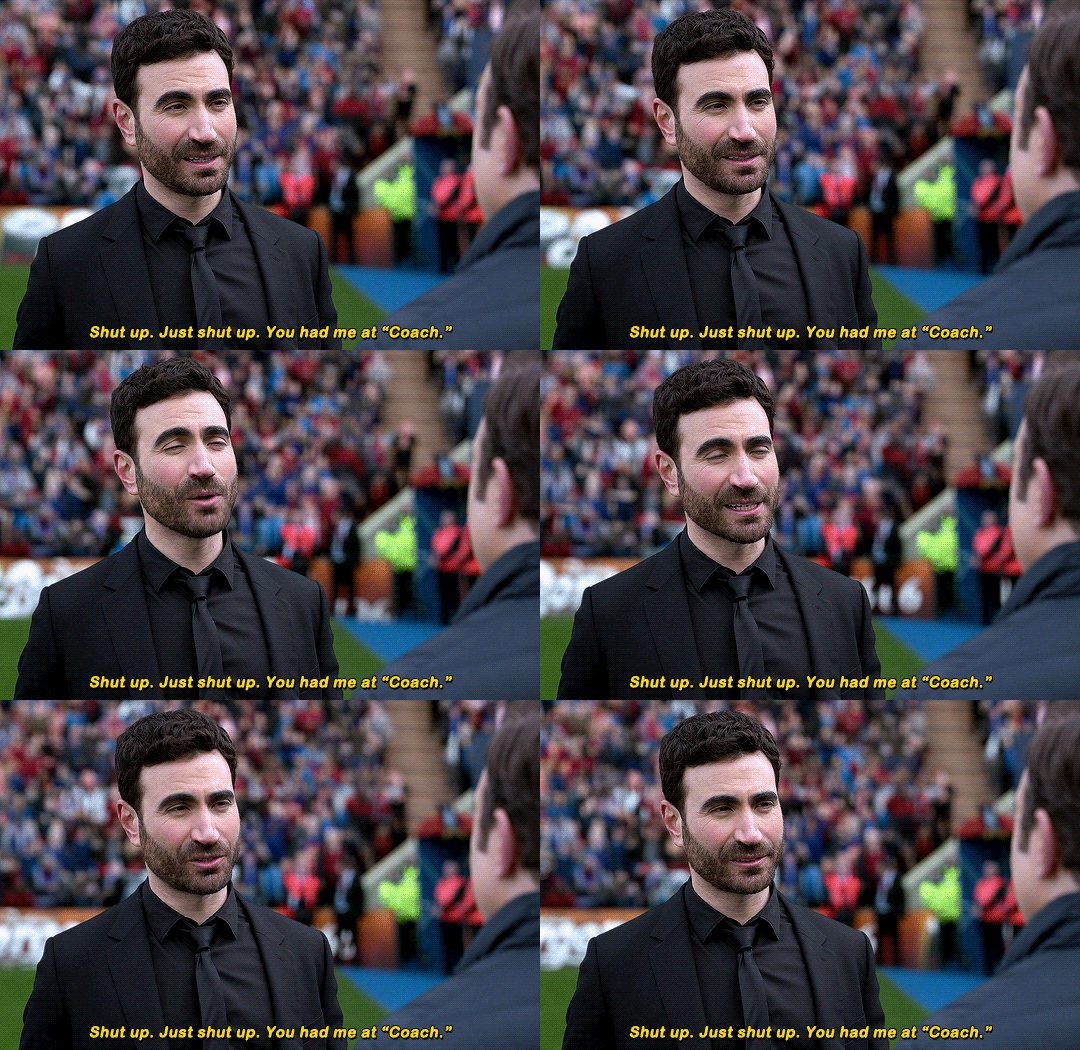
Ted Lasso, Rom-Coms, and Emotional Vulnerability

Why is it important that a show about men who play soccer did a rom-com homage?

Dickinson Behind-the-Scenes: An Interview With the Artisans

Meet the artists who brought the Apple TV+ series to life!

If You Like This, Watch That

Looking for a new TV series to watch? We recommend them based on your preference for musicals, ensemble shows, mysteries, and more!

Showing posts with label frequency. Show all posts

Monday, August 1, 2016

Comic-Con Roundtable Interview: Riley Smith (Frequency)


When Frequency premieres in October, one of the most compelling elements of the show is the central relationship between Raimy Sullivan (Peyton List) and her estranged father, Frank Sullivan (Riley Smith). Before seeing the pilot, I wasn’t sure how the storyline — based on the 2000 film of the same name — would play out and if I would be captivated by a show about parallel timelines and time-travel. After watching the pilot at Comic-Con, however, I was utterly sold on the show thanks in large part to the incredible emotional core, and the relationship between Peyton and Riley’s characters. While at Comic-Con, we had the opportunity to sit down with Riley Smith at a roundtable and discuss his complex character, Frank’s relationship with Raimy, and what the future holds for Frank.

As you likely noticed from the promotional trailers and from our interview with EPs Jeremy Carver and Jennifer Gwartz, The CW’s Frequency tells the story of an estranged father and daughter, rather than a father and son. When asked about the switch, Riley Smith noted that he was a fan of it: “I feel that the father/daughter relationship is the sweetest thing in the world. […] When I read the script, immediately that’s what popped off to me. That element is going to be so much stronger for a series and for us as actors to play out.”

While Peyton List’s Raimy lives in 2016, Frank Sullivan exists in the past — more specifically, 1996. “It’s literally like walking back in time,” Riley said about the opportunity to time-travel to an era with significance for him. “I knew [the 90s] so well. Oasis’ ‘Wonderwall’ is my [character’s] opening song, and I got chills when that came on. Because that was my song when I was driving in Iowa as a senior in high school trying to get the nerve to move to California to be an actor.”

As the EPs noted in our interview, Frequency is a mix of a few different kinds of shows. The Sullivans are a broken family, and so one of the most integral elements of the pilot is the strained relationship between Raimy and Frank, and the solid relationship between Raimy and her mother. But in addition to being a family-centric drama, Frequency is also a genre show and one that incorporates elements of a police drama, too. When discussing the tone of the story that the show is telling, Riley noted that it is “deeply rooted in the characters and in the relationships,” which is extremely evident while watching the pilot. Relationships are central, whether it’s Raimy’s relationships with her family, her co-workers, or her boyfriend. As Riley then accurately pointed out, the successful basis of any show — but especially Frequency — is one that is firmly grounded in its characters and their central motivations.

“The sci-fi, time-travel elements will take care of themselves,” Riley pointed out. “If we play the scenes as real and as deeply-rooted as possible, all the surroundings? That’s the surroundings. […] We [as actors] can’t get caught up in that. We have to stay true to the words on the page and the dynamic of the relationships, and our goals as characters.”

Perhaps one of the most interesting elements of Frequency (and the thing that could make it an extremely tricky show down the line like Doctor Who or Legends of Tomorrow) is the sci-fi element of time-travel and timelines. Raimy makes choices within the pilot episode that don’t just affect her and her own future, but the future of the people she loves and is ultimately trying to protect. And while the idea of parallel timelines can get convoluted pretty quickly, Riley also discussed the frantic energy and figurative “ticking clock” that the show has, akin to 24 (a show he also used to be on). Frequency’s premise now hangs on the idea that though there may not be a race against time, Raimy is also going to be fighting time and the consequences of her actions.

Because of the premise of the show — especially in the pilot — Raimy and her father Frank are separated by the span of 20 years. When asked whether or not Peyton and Riley got the opportunity to see each others’ scenes in order to play off of them, Riley revealed that he and Peyton have actually been acting partners for the last decade! “Peyton and I vowed from the pilot that we would be there for each other, off camera for the whole [show] because it really makes a difference,” Riley said. “Peyton and I have been acting partners for ten years. […] We’ve worked for countless hours on so many things that we did get, so many things we didn’t get. We’ve never actually physically worked together in a scene on TV though, until now. And so all that history and work we put in shows across that bond we had as father and daughter. So it was very important to us — because we had that bond and we know each other so well as actors — to be there for each other off camera.”

Riley then went on to mention that he wants to try to be off camera for scenes with Peyton for the whole series, but it will get tougher as the show has begun a tighter and quicker shooting schedule. Regardless of whether she’s physically present, Riley mentioned that he hears Peyton in his head, and knows how she would deliver a line.

Riley’s character, Frank, is complex and layered. He’s not necessarily the villain of the pilot, but he also doesn’t always act in the way that he should (prime example: sacrificing his family for his job). But Frank, in spite of his issues, is turned upside down by contact from Raimy in the future. “His whole world is turned upside down,” Riley said. “But what I love about Frank is that he’s an anti-hero. He’s a flawed human being. And me, personally, as an actor […] it’s hard to find a lead role that’s flawed. A lot of times and in a lot of ways they’re generic and perfect. And I’m not that guy and don’t want to play that guy. So I needed to find a guy who was flawed but who you could get behind and root for. And that was Frank.”

“In isolation, he doesn’t have a lot of trust,” Riley continued. “He’s basically given up everything he has and loves for this job. […] But ultimately […] Frank realizes, like a lot of people realize, at the end of the day? It’s about family. That’s all you really have. And the other stuff doesn’t matter because it’s all going to be taken away from you.”

Frequency debuts on October 5 on The CW. Be sure to check it out, listen to the full interview with Riley Smith below, and stay tuned to our site for more interviews with the cast and others post-Comic-Con coverage!

Friday, July 29, 2016

Comic-Con Roundtable Interview: Creators of Frequency


When Frequency debuted its pilot during Comic-Con’s preview night, I was surprised at how much I loved the series. To the show and network’s credit, the teasers playing on The CW didn’t give away too much of the show’s plot, while still managing to pique my interest. Based on the 2000 movie of the same name, Frequency tells the story of Raimy Sullivan (Peyton List), a detective whose father (Riley Smith) died 20 years earlier. Raimy’s memories of her father are tainted by anger and bitterness, as all she remembers is that he abandoned her family when they needed him. Unbeknownst to Raimy, there was a lot more to Frank Sullivan than met the eye. So when a freak lightning strike allows her to communicate with him via a ham radio in 1996, Raimy learns things and makes decisions that impact her future significantly.

We sat down at Comic-Con with the Frequency’s creator, Jeremy Carver, and executive producer Jennifer Gwartz to discuss the show. 

And if you’re wondering whether or not you need to have seen the movie in order to appreciate the television series, never fear: you don’t! I had never seen the film but was captivated by the story and by the way that Frequency grounded itself in character development first, and then time-travel shenanigans and police drama second. But if you are a fan of the film, you might notice something a little bit different about the television series — the show chooses to gender-swap the main character. When asked what was behind the gender swapping (from a father/son relationship in the movie version of Frequency to the father/daughter version in the television show), Carver noted: “For me, I just thought it would be much more of a challenge. I always loved that central relationship in the movie. But when I thought more and more about it, the idea of making it father/daughter just felt more dynamic to me. […] I haven’t seen a relationship like this [on television], at least not in the shows that I’m watching. So it felt more exciting and more dynamic and not so tried and true.”

When you watch the pilot of Frequency, you might be wondering exactly what kind of show it is. Because while there are supernatural and time-travel elements to it, Frequency is about more than Raimy communicating with her father in the past. It’s about her present, and all of the moments that led her there. She has a very familial relationship with Satch DeLeon (Mekhi Phifer), who works on the force with her and a case presents itself in the pilot that will thread throughout the remainder of the series. So what kind of show is Frequency, then? “I would consider this show to be of three parts,” Carver noted. “You have a mystery/police drama, a family drama, and the genre part of it. And they’re sort of all mashed together. […] There’s no one template for each episode. There’s a sense of unpredictability for each episode that hopefully people will get excited about. […] One of the fun things about the show is that while we have a propulsive mystery with a ticking clock, we have all of these other issues sort of standing in the way. […] There’s no one template for the show. And while that makes it a little trickier to break these stories, I think it ultimately is going to be more rewarding to watch.”

Frequency certainly isn’t the first television series to be adapted from a film (just last year, CBS adapted the short-lived television series Limitless, based on the 2011 Bradley Cooper film), and it won’t be the last. While shows with source material like comic books, novels, or movies might find it easier in some ways to adapt to a new format, there are always still challenges. Especially when timelines are involved, as with Frequency. Carver said that, “I think one of the other challenges might be cross-time communication and the butterfly effect.” But unlike a show involving time travel like Doctor Who or Legends of Tomorrow, Carver said that “we never want people to feel like they have to keep a rule book by their sides [while watching the show]. […] You will pick up on what the rules are but we aren’t going to spell them out for you.” One of the most frustrating and challenging aspects of shows involving timelines or time travel is remembering all of the different versions of history and keeping the rules, as Carver noted, of each straight. Thankfully it seems like the Frequency writers are cognizant of the fact that audiences get frustrated whenever they’re asked to keep track of storylines and timelines and rules of time travel.

Speaking of time travel, it’s pretty evident just by looking at the shows on television this upcoming season (Legends of Tomorrow, Timeless, Time After Time, Making History, and Frequency) that time travel has become the new vampires or zombies. Audiences have always been fascinated by time travel, from Doctor Who to movies. But now more than ever before it seems like time travel has captivated audiences. And Jeremy Carver has no idea why, but surmises: “In our show there’s an element of wish fulfillment and the idea of having a second chance. I think that was one of the appeals to me about the show. But why’s there so much time travel? I’m sure there’s something about the times we’re living in and people looking to escape.”

Jennifer Gwartz then chimes in, “our [show] was developed two years ago. So we were ahead of the trend, regardless!”

Frequency is a show that relies heavily on the emotional relationship between Frank and Raimy Sullivan. Though there is a lot that is packed into the pilot, the episode never loses its central focus. Everything that Raimy does and everything she is centers around her past. While there are definitely procedural elements to the pilot, the cases and Raimy’s job are not at the forefront of the show in terms of importance. The case presented is easy to follow, and the show uses the relationships Raimy has — both with people on the force and with the job itself — to define and elevate her character. Peyton List and Riley Smith have incredible chemistry together already, and are able to nail some really complex emotional nuances within the span of forty minutes. 

If you’re even remotely curious about Frequency, I highly recommend that you check it out when it debuts on The CW on October 5th.

Listen below for the full interview with Jeremy and Jennifer, and stay tuned for more interviews from Comic-Con!

Wednesday, July 27, 2016

#SDCC: Pilot Preview Palooza 2016 [Contributors: Jenn, Maddie, Chelsea, and Jen]


One of the benefits of going to Comic-Con is attending Preview Night, where you and hundreds of your closest friends get to watch a few of the upcoming television pilots. I didn't get the chance to go to Preview Night last year, but was really excited when I realized I would have the opportunity to this year. In total, our team watched five different shows (Riverdale, Powerless, People of Earth, Time After Time, and Frequency) and we all had fairly similar reactions to each. Here, we're going to tell you what we thought of the new fall and midseason pilots, including which are worth your time (and which you should just run far away from right now).