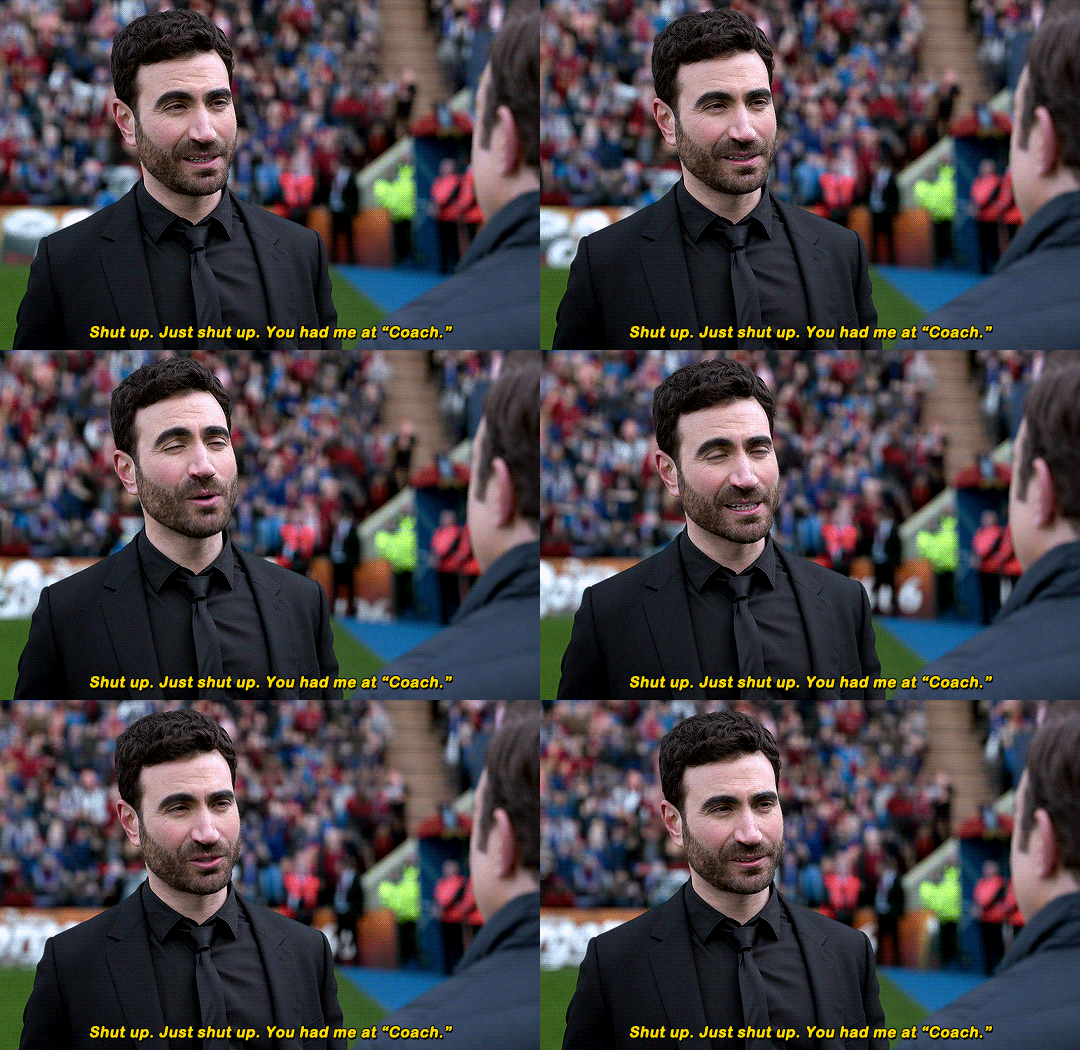
Ted Lasso, Rom-Coms, and Emotional Vulnerability

Why is it important that a show about men who play soccer did a rom-com homage?

Dickinson Behind-the-Scenes: An Interview With the Artisans

Meet the artists who brought the Apple TV+ series to life!

If You Like This, Watch That

Looking for a new TV series to watch? We recommend them based on your preference for musicals, ensemble shows, mysteries, and more!

Thursday, February 7, 2019

What Crazy Ex-Girlfriend is Doing Right During Its Swan Song [Contributor: Jenn]


It’s been a busy few months for me, which means that I’ve slacked a bit on the Crazy Ex-Girlfriend reviews. Apologies, readers! I thought I’d talk about the past few episodes though in this post, because it summarizes my feelings about the show’s final season better than a single review could. A lot has happened this year already in West Covina, and the fact that I’m not sure where the series is going to land in its finale actually makes me rather excited at this point. We’ve watched Rebecca grow and then backslide (in an incredibly realistic way), and we’ve gotten the chance to see other characters’ personal and professional journeys unfold. We’ve left some reunions up in the air, and we’ve seen certain characters gain closure. There have been insanely fun musical numbers and an entire episode dedicated to romantic comedies.

So let’s dive into what’s really working this season on Crazy Ex-Girlfriend, shall we?

LET’S START AT THE END


Instead of starting with earlier episodes, I want to begin with what I feel was the strongest story Crazy Ex-Girlfriend has done recently — realistic backsliding in terms of mental illness. As we know from last season, Rebecca was diagnosed with borderline personality disorder (or BPD, as I’ll refer to it throughout). After her diagnosis — which came on the heels of her suicide attempt — Dr. Shin, a licensed psychiatrist, recommended group therapy and medication to cope with her disorder. Rebecca, having been on medication for a lot of her life, is resistant to the recommendation of pills. It’s understandable, honestly. I know family members who refuse to be put on medication for their mental illness because they watched a loved one suffer under different medication. She doesn’t believe they will help her and honestly? She’s afraid of what she’ll turn into if she’s on them.

So Rebecca refuses the medication, but faithfully attends group therapy and continues her one-on-one sessions with Dr. Akopian. For a while. But things start to go awry in the most recent episode, “I Need a Break.” What we haven’t seen recently this season is more important than what we have, it turns out. We haven’t seen Rebecca in therapy. We haven’t seen her reading or journaling or processing her BPD. What we have seen is her relationship with Greg rekindle.

And the moment something begins to go wrong, Rebecca spirals. It’s easy to distract ourselves from our personal baggage when we’re in relationships. In fact, it’s why a lot of people use dating as a coping mechanism. It’s why people rebound after a serious relationship fails — if they’re focused on someone else, they don’t have to look inward at the mess that is eating away at them. They don’t have to fix what’s broken. They can convince themselves that they’re fine, really. Happy. Better.

When Rebecca is happy, she can throw all of her emotions and energy into whatever is seemingly sustaining her. When it’s a relationship though, it’s dangerous. Rebecca does what many of us do: assume relationships and happiness and love with fix all that’s broken within us. While she is happy, she feels better. And therefore, she doesn’t feel the need for therapy.

But that’s not true healing: it’s distraction. And it can only last for so long before we slip down and hit the darkness again.


Dr. Akopian warns Rebecca of this when she visits her. Rebecca is exasperated at her therapist’s response — why can’t Dr. Akopian just be happy for her and her relationship with Greg? Why does she even need group therapy anymore? She’s fine! Rebecca says that she’s fine. She’s happier than she’s ever been, and she’s got her BPD under control.

What Rebecca doesn’t realize (or does, but fails to acknowledge) is that we can only keep our baggage and darkness at bay for so long when we don’t really deal with it. When we avoid our pain, eventually, it resurfaces. And when it does, it does so at such a rate that we can’t shove it back down quick enough before it begins to hurt us and others. We spiral. We sink. We try every coping mechanism we know is harmful for us. But we don’t care. We need to do anything and everything to keep ourselves from feeling shame, sadness, disappointment, or discomfort.

So when Greg and Rebecca get into a fight because she’s not truly dealing with her stuff, Greg walks away to give his girlfriend some space. He’s worried about her, too, it turns out. He’s a recovering alcoholic and he knows that even when you’re happy, you need to go to meetings. It’s often when we’re seemingly the happiest (the times where it’s easier to ignore our issues) that the pains of our past bubble up again. Instead of taking the time to self-reflect and pause, Rebecca crashes and burns pretty hard. She binge-drinks. She tries to hook up with Nathaniel (who turns her away) and Josh (who also turns her away). Both men are concerned for her safety and well-being, but Rebecca can’t see the forest for the trees. She ends up ashamed, alone, and sleeping on a bench outside of Dr. Shin’s office.

And Dr. Shin recommends medication. Rebecca is still resistant, citing that her previous medicines made her feel like a zombie. She doesn’t want to live that way because the last time she was on medicine, she nearly died. But Dr. Shin assures Rebecca that he and Dr. Akopian have worked together and they both have determined medication that will be helpful for her.

At the end of “I Need a Break,” Rebecca takes one of her pills. It’s a brand-new era for her, and I’m interested to see how the rest of this story plays out. One thing I will say that’s consistently been encouraging in this show’s final season is Rebecca’s willingness to own her mistakes. If we don’t acknowledge what’s broken within us, we can’t grow. True vulnerability requires honesty — not just with ourselves, but with others. Rebecca’s been honest with herself (for the most part, this episode aside) about what’s right and wrong. She’s admitted her misdeeds and she’s made amends. She’s used her internal growth to further external healing.

That’s incredibly encouraging, isn’t it? If we can acknowledge where we’ve fallen short and admit it to ourselves and others, we invite healing. When we keep our baggage buried, constantly shoveling more dirt into the graves of our past mistakes, it doesn’t get resolved; it just seeps into every part of our lives. Rebecca’s willingness to even own what she did at the end of this episode is huge progress. She doesn’t know if Greg will forgive her, but that’s a moot point anyway. She knows she needs to be honest or else she’ll just keep getting sicker.

And speaking of people getting sicker...

POOR PAULA


Paula hasn’t had a huge storyline this season, and I lamented the fact that she was fairly underutilized last season too. But what we do get the chance to see (through flashbacks in the opening sequence of “I Need a Break”) is that Paula has been doing a LOT in the last few years. Not only has she carried her own family’s baggage, but she’s carried the firm in Rebecca and Nathaniel and Darryl’s absences, and she’s carried herself through law school and she’s carried her friends through crises. It’s exhausting. She hasn’t slowed down and it’s beginning to affect her physically.

We don’t know what’s causing Paula’s illness in the most recent episode until close to the end — she’s having a heart attack. First off, kudos to the show for portraying symptoms of female heart attacks. They’re a lot different than the symptoms men endure. Second, poor Paula. She’s been living at a breakneck pace for so long that it was bound to catch up with her. In a series where the running joke is that no one really does any work, Paula has been keeping the firm and her family afloat. Admittedly, some of her storylines have been weaker in the last season than others, but this year finally seemed to be looking up! She celebrated her law school graduation with friends (in an episode where we got to see Josh and Nathaniel compete and understand why Valencia and Hector are rivals), and Rebecca’s finally at a place where she seems stable enough that Paula doesn’t have to constantly give advice (I said “seems,” of course).

Moving forward, we don’t know what this will mean for Paula’s career or her relationships, but we do know one thing — she has really good friends who have, unfortunately, taken her for granted somewhere along the way. I know I have. It’ll be interesting to see how the rest of her story shapes up.

LIFE IS NOT A ROMANTIC COMEDY, BUT IT COULD BE


Falling into the “character growth” column of the checklist this season are the Crazy Ex-Girlfriend leading men: Greg, Josh, and Nathaniel.

Greg returned (played expertly now by Skylar Astin who adopted some mannerisms of Santino Fontana and his classic sarcasm), a better and healthier individual. Truly, even though he’s still a guy who hates nearly everything, he’s grown. He’s acknowledged his shortcomings and is actively trying to be better. He continues to attend meetings and he’s stayed sober. He hasn’t punched any walls, and he was self-aware enough to recognize that Rebecca was spiraling before she did. He’s grown a lot and that’s what “I Can Work With You” focused on for both Greg and Rebecca — Rebecca acknowledged that they’re different people than they were. Greg came over to tell Rebecca how he felt about her while she was babysitting Hebecca, and that showed growth. Moreover, he was able to practice forgiveness instead of anger — even when Rebecca deserved condemnation. I really love the fact that Greg is the same person with the same quirks, but evolved. That’s how we all should strive to be.

Even Josh has become a better version of himself! He moved out of Hector’s mom’s house and in with Rebecca. In spite of some initial awkwardness on Rebecca’s part (because she’s attracted to nice guys now), the two managed to make their roommate-ship work. And Josh has grown up a bit, choosing to be a thoughtful roommate who just tries to help. I’d compare him to a well-meaning Jason Mendoza (The Good Place) at this point — a dude who tries to help, even if it goes horribly awry in the eyes of others. He even rebuffs Rebecca’s advances, knowing that she’s not in a good place and they’re not a good idea. He went to the grocery store to buy her embarrassing healthcare items in “I Need Some Balance” (an episode where the commitment to symbolism was mad impressive, if highly underwhelming plot-wise). Josh is a nice guy.

And now Nathaniel is a nice guy too.

He’s come a long way from the self-centered, smarmy dude who Rebecca dated to make Josh jealous. He’s thoughtful and trying his hardest to unlearn patterns of behavior. But he genuinely cares about Rebecca’s growth — something I thought was important growth from last season’s finale, where he seemed to not care about what she did or who she was, just that they were together. Rebuffing her advances the week after he resolved to let her go was a good indicator of how he’s growing.

And speaking of the rom-com episode, “I’m Almost Over You” was so good. It was easily the most seamless homage-style episode I’ve seen in a while (R.I.P. to the kings of homage episodes: Psych and Community). Since Crazy Ex-Girlfriend in itself is a romantic comedy, having a rom-com within a rom-com wasn’t just great for the meta jokes (Why IS there always a karaoke scene with cameras spinning? Why is there no logic in makeover montages? Why is there always a vague BIG PRESENTATION?), but also for the point it needed to make: Nathaniel had to let Rebecca go.

Most of “I’m Almost Over You” is spent with Nathaniel dreaming himself to be the lead in a rom-com, where Greg and Rebecca are still together and he’s trying to win her back. To do so, he recruits Maya (who’s made a return) to fake a relationship with him because she’s trying to make another girl jealous. The result is every classic rom-com trope in the book, and it’s beautiful in its twist — rom-com Nathaniel ends up predictably falling for rom-com Maya but within the dream, Maya changes into Rebecca, who gently pleads with Nathaniel to let her go and let her be happy.

One person who doesn’t get enough credit on this show is Scott Michael Foster. I’ve adored him since he was the slacker, lovable Cappy in Greek and he’s brought such a wonderful layer of tension, comedy, and fun to this role. He hasn’t always been a part of the series and sometimes I forget that because he fits so well into the show’s structure. In the rare moments we get to see Nathaniel’s vulnerabilities, it’s a treat to watch Foster’s acting. But the end of “I’m Almost Over You” was even more poignant, as Nathaniel — in tears — doesn’t want to let Rebecca go but knows he must.

How many of us have been in the same place at one point in our lives or another? When Nathaniel wakes up from his dream, it seems to be the catharsis he needed to truly move forward.

WHERE WE GO FROM HERE


We only have a few episodes left of Crazy Ex-Girlfriend, a show that brought hilarity, songs, and incredible storytelling to our screens over the past few years. There’s still a bit of story left to tell and threads left dangling. What about Valencia, Heather, White Josh, Darryl, and Hector? How will their stories conclude? Plus, now that Rebecca is on medication, how will it impact her and her relationships? Will the series end with Rebecca single or in a relationship? What about Paula’s future, and the future of the firm?

Because Rachel Bloom and Aline Brosh McKenna are brilliant, I know that they have something silly, heartwarming, and poignant up their sleeves for the final season. And, much like going down a slide at Raging Waters backwards, I can’t wait to enjoy the rest of the ride.

Brooklyn Nine-Nine 6x04 Recap: “Four Movements” (Goodbye Again, Gina Linetti) [Contributor: Alisa Williams]


“Four Movements”
Original Airdate: January 31, 2019

Last week on Brooklyn Nine-Nine, Gina told Jake she was leaving the precinct to pursue her dreams, and this week, Gina must tell the whole team and turn in her two week’s notice. Gina declares that over the next two weeks, each member of the team will receive an authentic, unique “Gina Moment” to remember her by. Also in typical Gina fashion, her announcement is accompanied by a gymnastic routine (she hired a body double for that part), custom sweatshirts for everyone (Amy’s says “Arnie”), and a dance number complete with back-up dancers in gold bodysuits. Gina’s interpretive dance has four movements, each 45 minutes in length, she tells the team.

Though we don’t get to see the dance, we do get an episode that is divided into “Four Movements” as we say goodbye to Gina over her last two weeks at the Nine-Nine.


FIRST MOVEMENT


It turns out, Holt has been teaching Gina chess for the past four years, and in exchange, she’s been teaching him how to properly trash talk. Gina has never beaten Holt at a game and she’s determined to do so. They play round after round, Holt beating her each time, while they discuss life and Gina’s decision to quit. Holt tries to convince her that she needs a plan, that healthcare is expensive, that she should think of her daughter, that she could pursue her dreams while still working for the Nine-Nine — all of the arguments we’d expect from Holt. Gina asks him how planning his life down to the letter has worked for him, and he tells her he’s achieved every goal he’s set out to do.

But Gina reminds him this isn’t true: despite careful planning, he didn’t receive the commissioner position. Sometimes the best laid plans don’t work out, she says, and this is her Gina Moment for Holt. Life is crazy and unpredictable no matter how you plan or don’t plan. Holt realizes she has a point, and gives her his support.

Gina also declares herself the winner of their last chess match even though she definitely did not win. But that’s how life works, she says. You make up the rules as you go, and you declare victory.

SECOND MOVEMENT


A tearful Amy tells Gina and Rosa she wants to do a ladies lunch to say goodbye to Gina. Gina’s not too excited about the idea, and Rosa couldn’t care less. Rosa, in fact, hasn’t displayed any emotion about the announcement that Gina is leaving. Gina tells Amy that her parting gift to her will be to “fix” Amy — to make her more like Rosa, cool and detached.

While they’re out at lunch, Amy presents Gina with a gigantic binder. It is all of Gina’s tweets turned into book form, which is something she had mentioned she’d always wanted. Gina tells Amy this is worse than crying and says she put way too much work into this book. She demands Amy burn the book in the trash barrel behind the precinct to toughen her up.

But Amy can’t do it, and she decides she doesn’t need to be fixed. She tells Gina and Rosa that she’s allowed to feel emotion and to be sad and cry about Gina leaving. Gina says that was her real Gina Moment for Amy — to “just be yourself.” Even Rosa starts crying at that important life lesson, and the reality that Gina won’t be around to impart her little nuggets of truth much longer.

THIRD MOVEMENT


Jake is planning Gina’s going away party, “Gina-a-rama,” and wants it to be super splashy and over the top, just like the woman herself. He decides they need a celebrity and bounces around for who has the connections to make that happen. Terry has a friend who works private security for Mario Lopez, so they zero in on him. They find out from Terry’s friend that Mario will be at the Manhattan Social Club that afternoon, so Jake and Gina dress up like the uber-rich to infiltrate the swanky establishment in hopes of seeing the man who played A.C. Slater on Saved by the Bell, and was the childhood crush for both of them.

Once they trick the doorman into letting them in, Jake distracts Mario’s security guards so Gina can beg him to come to her party at the bar later, under the pretense that it’s a charity benefit for “hungry monkeys.” But when Mario arrives that evening, Gina turns him away at the door, much to Jake’s horror. After Mario’s gone, Gina explains that this was her Gina Moment for Jake: to remind him that she doesn’t need some celebrity or swanky party. All she wants is to hang with her friends and have a few drinks. “You guys are all the splash that I need,” she says. Plus, she confesses, she’s always wanted to turn a celebrity away from her party, so this was also her Gina Moment to herself.

FOURTH MOVEMENT


Gina’s two weeks are officially over. It’s the start of a new week at the Nine-Nine, and the first day without Gina. Boyle and Terry are disappointed because Gina had said everyone would receive Gina Moments but neither of them got one. When they walk into the precinct, though, Gina is there! She says she’s just there to clean out her desk and wrap up some last things. As her Gina Moment to Boyle, she gives him back the Boyle Sourdough Starter which she won in a bet a while ago. She has nothing for Terry though, and he is super disappointed.

On Tuesday, Gina is there again, and she’s there on Wednesday as well. And on Thursday. It seems she’s having trouble leaving and keeps making excuses for why she still needs to be there. She finally admits to Jake that she’s scared to leave. Jake calls an emergency meeting with the rest of the team to figure out how best to support Gina so she’ll have the courage to leave.

But when they walk in on Friday, there’s a copper statue of Gina texting on her phone and a video message from her. She begins by saying that all of Terry’s kind words for her really made a difference. Just as he starts to get teary-eyed about that she yells, “Psych!” and declares that his Gina Moment. He’s bummed until she admits his real Gina Moment is that she signed him up for an International Yogurt of the Month Club, and his first yogurt, from Austria, is in the fridge waiting for him. He declares he received the best Gina Moment of all.

Gina continues, saying she was never actually scared, she never doubted herself or an instant, it’s just that there was a shipping delay with her statue and so she couldn’t leave until it arrived. And now, it appears, Gina Linetti has officially left the Nine-Nine.

Bullets on the Bulletin Board:

  • “Amy, I wish I could do a ladies lunch today, but I’m out of town.” 
  • “Wow, we said ‘whilst’ twice in this conversation.” “I know! This place is really rubbing off on us.” 
  • “I never have second thoughts. That’s the luxury of having great first thoughts.”

Wednesday, February 6, 2019

Ask An Author: Four Dead Queens' Astrid Scholte [Contributor: Megan Mann]


I'm a sucker for good dystopian fiction.

And I mean a good dystopian fiction. I don't want to read about zombies or nuclear warfare. I want to read about circumstances that have led countries astray and have gotten aforementioned countries into places where they're now using bizarre caste systems. I don't seek out the dystopian genre these days like I used to, having been burned too many times before, but when one of these novels strikes my fancy, I give it a shot.

Four Dead Queens by Astrid Scholte didn't even need a shot. The cover did all of the work and got me hook, line and sinker. The toppling collection of glittering crowns and the bold title let you know that this was going to be one heck of a ride.

And let me be the very first to tell you that this was a ride you won't want to get off.

Four Dead Queens follows thief Keralie as one of her routine jobs sends her spiraling into a life-changing situation. She listens to her boss, Mackiel, when he says to steal a case of comm chips from an Eonian messenger. Kralie thinks that the high-priced item would sell at auction, catch a pretty penny, and be another notch in her belt. But when the messenger shows up at the auction house and the chips are never put on the block, she knows that something is wrong. It's only when Keralie figures out that she's been played and she swallows the comm chips does that she understands the reigning monarchs — the four queens of Quadara — have been murdered.

What follows is a twisting, turning, looping rollercoaster of mystery and intrigue. There's nothing to prepare you for the lightning speed in which you'll flip through the pages. You want to find out how each queen meets her demise, who the killer is, and why the murders have taken place. No clues can quite prepare you for the insanity that is Astrid Scholte's debut novel.

Thankfully, I was able to talk to Asrid and pick her brain about Four Dead Queens (in the least spoilery way possible for you all) and who she dreams would be cast in the perfect film adaptation. Keep reading to see what she has to say!

What was the catalyst for the story of Keralie, Varin, and the four dead queens of Quadra?


Astrid: I had previously written two YA fantasies that I had failed to get an agent with and I was brainstorming what my next manuscript would be. I wrote a list of all the things I loved, not only in YA but in TV and movies, including forbidden romance, royal intrigue, deception, hidden secrets, shifting agendas, and unexpected twists and turns. I’ve also loved murder mysteries since I was a kid and thought it would be unique to set a murder mystery in a fantasy world.

The main catalyst was when I had a dream about sitting in a horse-drawn carriage wearing an elaborate Victorian-style dress and a futuristic silver car flew past, I wondered what kind of world would exist with such contrasting technologies. That was how Quadara was born!

I have to admit, it seems like half of the fun of writing a dystopian novel is coming up with names for characters, locations, and government. Would you say that’s true?


Absolutely! I love playing around with new words and worlds. Writing fantasy gives you absolute freedom, but at the same time, you need to establish rules so that the world, and the people inside it, feels believable. The fun part is working out the boundaries for the world to exist in, and then see how far you can bend it, without breaking.

Okay, let’s jump right on in. The book starts with a bang: a robbery and a murder. It’s what sets the whole story in motion. What made you decide to do that?


I knew from the beginning I wanted to have a thief as the main character — someone who isn’t necessarily “good” from the outset — and have them entangled within this deadly plot to kill all the queens. I wanted the main character to have to decide to “do the right thing,” which wasn’t what they were used to doing.

As for the murders, I wanted to jump straight into the action and have the murders play out on the page, from the queens’ point-of-view, as I thought that would generate the most drama. Because Four Dead Queens is mainly a murder mystery/thriller that just happens to be set in a fantasy world, I knew the pacing would have to be breakneck and have the rules of this complex nation unravel as the mystery does.

I want to talk about how you have a society entirely ruled by not just one, but four women, for hundreds of years. Talk about girl power! What do you hope female readers take from that choice?


In this current climate, I think it’s really important to see female characters not only working together but supportive of each other. Each queen has a very distinct personality and different background and culture, but they come together to ensure the peace of the nation. I wanted to show that we should support each other, regardless of where we come from and how we may differ from each other. Ultimately, it’s about tolerance and finding and creating your own family.

Keralie and Varin may come from different quadrants, but you discover over time that they feel trapped by the hand they were dealt and wish to be free of the constraints placed on them. Was that mirroring intentional?


To a certain extent, yes. I love the opposites attract and hate-to-love tropes, but at the same time, I wanted the love interests to bond over a shared goal. They both want to change their situation, break through restrictions, and be who they’re meant to be. In finding themselves, they also found each other.

Of all the crazy twists, the comm chips and the assassin’s identity reveal were the most insane. How did that come to be?


I actually didn’t know who the killer was for a third of the first draft! I was brainstorming who could be the culprit and when I hit on a specific idea, I knew it was the winner! I love hearing readers’ responses to the ending!

If Four Dead Queens were to get turned into a movie (which I very seriously see happening), who would be your dream cast?


I would absolutely love if Four Dead Queens became a movie or TV series! As a visual writer, I clearly see the characters and scenes in my head before writing.

My dream cast would be:

  • Queen Marguerite: People have remarked that my painting of Queen Marguerite looks like Jessica Chastain, and there’s a reason for that! I would love if she played the auburn-haired Queen of Toria.
  • Queen Stessa: Banita Sandhu looks exactly how I would imagine the youngest queen on screen.
  • Queen Iris: Isabel Lucas has the right regal look for the stern but compassionate queen.
  • Queen Corra: Letitia Wright would be wonderful as cautious and controlled Queen Corra.
  • Keralie: Dove Cameron would be perfect for the charming and brash young thief.
  • Mackiel: Darren Criss, I was so impressed with his performance in The Assassination of Gianni Versace: American Crime Story. He can play both charming and dangerous, key for Mackiel.
  • Varin: While he’s a little old, Jeremy Irvine would make a great Varin!
(Megan's note: Not only would everyone be insanely perfect, but Letitia would crush Corra's stoicism after playing an A.I. in Humans. I told Astrid months ago that Jessica Chastain is simply the only choice for Queen Marguerite. You'll agree.)

What books would you recommend our readers pick up?


I adore the Lady Helen and the Dark Days trilogy by fellow Aussie, Alison Goodman. I love the blend of the supernatural and historical. It’s clear how much passion Goodman has for the Regency era and it’s like being transported back in time with such exquisite detail.

Four Dead Queens is currently available for pre-order and will hit shelves February 26th. Make sure you order your copy today, and find Astrid on Twitter and Instagram!

Monday, February 4, 2019

Grey’s Anatomy 15x11 Review: “The Winner Takes it All” (Parents) [Contributor: Julia Siegel]


“The Winner Takes it All”
Original Airdate: January 31, 2019

If you thought there were too many stories to follow this season on Grey’s Anatomy, then you'll really enjoy the latest episode. With a much-needed break from the cacophony of background plots, the spotlight shines on Catherine’s surgery to remove her mega tumor. Since the surgery impacts many of the show’s main characters, we still get to see a lot of the series regulars. On top of the surgery of the season, Meredith takes the day to reconcile her past in a wonderful subplot with her dying father, Thatcher. At first glance, it doesn’t appear that much occurs in this episode, but these events will have a positive, long-lasting impact.

CATHERINE


The day of Catherine’s surgery has finally come, and Tom Koracick and Amelia are as ready to operate as they ever will be. The pair spends the time before the surgery nervously trying to amp each other up by discussing all the reasons the operation must be successful. This is definitely the most nervous Koracick has been, which reveals a deeper level of character as the episode progresses. Catherine takes a few moments to reflect on her past, present, and future with Jackson as well. In what feels like an elaborate goodbye, Catherine shares memories and plans for every possible outcome with Jackson.

Before the surgery begins, Jackson surprises Catherine by playing her favorite song in the OR, inciting an impromptu dance party. Everyone knows that dance parties are a staple on Grey’s Anatomy, but I don’t think we have ever seen one occur before an event. Catherine treats the moment like her possible last of mobility, which is fitting. Amelia and Koracick keep the music and good vibes going for the first part of the surgery, which is a not-so-subtle device for the audience to fully understand that everything is going as planned. When they think that they have the tumor isolated and ready for dissection, Amelia and Koracick realize that the tumor is rooted deeper than they first thought.

In a risky move, they decide to flip Catherine from her stomach onto her side to operate from both the front and back at the same time in hopes of fully resecting the tumor. They continue operating, but find that every move they make winds up harming Catherine’s motor function in her arms. While watching in the gallery, Richard has a great idea and tells Amelia and Koracick over the intercom that they should resect small pieces of the tumor and use his cancer-detecting pen to determine how much more to cut. See, those surgical innovation contest projects from last season still matter and have not been forgotten!

The pen works as advertised and allows Amelia and Koracick to get as much of the tumor out as possible without compromising Catherine’s ability to move. When Catherine wakes up from the surgery, she is able to move all four extremities. While the surgery is considered a huge success, Amelia and Koracick are sad to tell her that they had to leave a small node of the tumor behind. Catherine says that she is fine with living with a little cancer because it means she gets to live and continue her career. She has many months of recovery ahead of her, but this is not the last of Catherine Fox... which should be good news for the mental health of Richard, Jackson, Koracick, and Amelia.

THATCHER


One of the most anticipated moments of the season has finally arrived: Jeff Perry is back as Thatcher Grey. It has been eight years and many tragic life events since Meredith and the viewers have seen Thatcher. In Perry’s defense, he was in the whole seven season run of Shonda Rhimes’ other powerhouse series, Scandal. Since Scandal ended, we can finally get that Thatcher closure we all need. At the beginning of the episode, Meredith tells Richard that she has taken the day off to spend with him during Catherine’s surgery. Richard says that he doesn’t need her to stay with him and would rather see her go visit her almost-dead father.

Meredith caves and decides that she should go see Thatcher one last time, if only to please Richard. Apparently, Thatcher is living somewhere close to Seattle for a bit, since Meredith quickly gets to his house. It is really nice to see Thatcher excited to see his eldest daughter and actually show positive emotions toward her for once. Unsurprisingly, it doesn’t take Meredith long to blame Thatcher for not being in her life. She makes some great points about him not being around after Lexie’s death or when Derek died. Surprisingly, Thatcher reveals that he did come back to Seattle for Derek’s funeral and was in the back.

Meredith can’t believe that her father showed up for her without ever telling her, acknowledging his presence the day of, and not talking to her at the funeral. Thatcher tells her that he couldn’t talk to her because she was barely there herself. Remember when Meredith was literally a ghost, barely making it through the day and then disappeared for a while? Meredith realizes that maybe her dad hasn’t been the horrible drunk he once was these past few years, and starts to open up to him. He tells her about the new life he made for himself traveling and teaching in Africa, and they even share some memories from Meredith’s childhood. I think Meredith has always wanted to make amends with her father, and they both seemed to be very happy that they got the chance to be forgiven.

It isn’t surprising that Meredith is with Thatcher to the bitter end. Thatcher apologizes for not being able to know his grandchildren. A teary-eyed Meredith tells him all about her three kids, which prompts Thatcher to tell her that he wants her to give his grandkids a box of his things. Meredith agrees and holds Thatcher’s hands as he takes his last breaths. Meredith has now witnessed both of her parents die, but Thatcher’s death is less jarring since she was able to finally make peace with him.

A last sweet moment in the episode shows Meredith giving Zola, Bailey, and Ellis the box of African masks and items from Thatcher; she tells the kids that their grandfather loved them even though they didn’t know him. This was a really nice ending to the tumultuous story of Thatcher Grey and showed that all characters are redeemable.

Sunday, February 3, 2019

The Flash 5x12 Review: "Memorabilia" (Do You Remember?) [Contributor: Deborah MacArthur]


"Memorabilia"
Original Airdate: January 29, 2019 

This week, The Flash rolls out an old sci-fi trope: the memory-sifting device that traps the user and then threatens them with the possibility of death while sifting through memories. Yeah, this one’s a classic. It does have variations, though: sifting through one’s own memories, through dreams, or — as is the case for “Memorabilia” — the memories of other people. The Flash puts a further twist on the premise by sending two teams of heroes through two separate sets of memories. One trip ends quite happily, while the other does not.

YOU DON’T KNOW MY MIND


The episode starts off with some adorable: a West-Allen family outing at an ice skating rink. Well, the rest of the team is also there, but it’s made clear that Barry had the idea for Iris, Nora, and himself to go skating together. That’s interesting, since Barry (playfully) leaves Nora in the dust while trying to teach her, allowing Iris to step in and be the more patient parent. These moments are always really cute, but does anyone ever overhear Nora calling people roughly her age “dad” and “mom”? We know Cicada heard her that one time — does he assume the Flash is older than he looks or something? Or is Central City weird enough that literally no one questions its weirdness?

Speaking of Cicada and weirdness: Sherloque has ordered the delivery of a machine that allows people to dip into each other’s minds. Team Flash’s plan for the episode is to connect with comatose Grace, Orlin/Cicada’s adoptive daughter, and wake her up so she can call off Cicada’s attacks. After mentioning that thoughts and memories could be viewed by people who use the machine together, Sherloque slyly volunteers Nora and Barry for the procedure. Nora, who monologued a message to Future Eobard Thawne at the beginning of the episode, understandably does not want to risk her father seeing what’s going on in 2049.

So when everyone is gone, Nora sneaks up to the machine and goes into Grace’s brain alone, assuming it’ll just be a quick, simple hop onto a little girl’s brain waves and out again before anyone realizes. Wise and well-examined decision, there, Nora. You really are your father’s child.

Inside Grace’s memories, Nora finds the little girl’s consciousness and can actually interact with her. Unfortunately, the portal Nora planned on pulling Grace through in order to wake her up disappears before they can get through it. Nora and Grace wander around the girl’s memories (many of which are obviously warped by nostalgia) in search of the portal, but they can’t find it. No big deal, save for the annoyance of being trapped in the mind of a kid — until things turn sour and Grace, having caught on to Nora being a meta and having spent her comatose hours overhearing her uncle’s anti-meta growls and grumbles, turns on Nora.

As all this is happening within Grace’s memories, Team Flash have discovered the unconscious Nora and realize they should probably go in and get her. When Iris and Barry hook themselves up to save their daughter, though, they don’t end up in Grace’s mind — they end up in Nora’s. While this would have been a perfect opportunity to have the other shoe drop on Nora’s duplicitous, pro-Thawne actions, Barry and Iris really only see some childhood memories. Barry is thrilled because he thinks he’ll probably never see Nora at the age she is in the memory, but Iris is less than happy about her future as a mean mom.

Iris and Barry’s trip to Nora’s past (and their future) turns out to mostly be a way for the both of them to come to terms with their roles as parents. They, unlike Nora and Grace, can’t interact with the past — only observe. Iris has to watch her future self shout at little Nora and she worries over the type of mother she’s destined to become.

Caitlin gets in contact with the memory travelers by using the brainwave device she used to need for communicating with Killer Frost. She tells them they need to break through false memories, and the portal will open up. Nora has to break down the overly heroic and happy image Grace has of her uncle, and Iris and Barry have to find the truth in Nora’s memory, which is that she’s replaced a loving, caring, and understanding Iris West-Allen with a villainous one because… kids, I guess?

These things have to be done while running avoiding getting caught by the memory’s “guardians” — Cicada for Grace, Reverse Flash for Nora. Barry and Iris successfully break apart Nora’s false memory, but Nora is not so successful. Grace is fully on Cicada’s side, to the point where it’s revealed that her guardian Cicada is actually an older version of herself. This, on top of an earlier reveal during Nora’s memory that Cicada continues killing long enough to rack up a body count of more than 150 people, makes me think that villainy might run in the family.

The intrepid brain-traveling family returns to proper life, having learned much about each other (but not the stuff Nora didn’t want them to learn). Iris learned that she really isn’t going to be as terrible a mother as Nora has led them to believe, and Nora has learned that she kind of made her mother the villain of her childhood for unfair reasons. The whole West-Allen family learns that, by Iris starting her blog/news site in 2019, she’s already started changing the future Nora knows, where the blog isn’t started until 2021.

Caitlin’s been learning stuff while they were gone, too — namely, that Grace has a hunk of dark matter satellite shrapnel in her skull, which might explain her deep slide into megalomania so early in life. Barry, meanwhile, has come out of it all with a plan: use the metahuman cure Cisco and Caitlin have been developing on Cicada.

Other Things:

  • Iris! Please, please hire a graphic designer for your website before you get any other employees. Your site is hideous.
  • Cisco and Ralph had a subplot. It was kinda nice.
  • Seeing the Flash Museum was really fun and full of cute little in-jokes: a cover of a real The Flash comic featuring the comic book version of Cicada, for example, and toy Flash phones with the show’s theme song as the ringtone. 
  • So Grace, the inspiration for Orlin to go out and kill all metas, is technically a meta thanks to some dark matter-infused shrapnel in her skull. Oh, the irony.
  • Barry says he wants to use the meta cure on Cicada even though Cisco and Caitlin promised each other they’d never use the cure on anyone who wasn’t a willing volunteer. Not to go all Eleanor Shellstrop at the end of a The Flash review here, but I seriously hope Team Flash says “fork you” to ethics and goes with that plan. If they won’t kill the guy who racks up over a hundred and fifty murders, a little shifting of the moral goal posts is the next best idea.

Saturday, February 2, 2019

Blindspot 4x11 Review: "Careless Whisper" (Super Fan) [Contributor: Jen]


"Careless Whisper"
Original Airdate: February 1, 2019

A crime novelist uses Team Blindspot for inspiration, but needs the real team to solve his murder.

CASE OF THE WEEK


Winston Pear is a famous crime novelist who decided to use Jane's story and the team as the inspiration for his new crime novel. His writing talent is debatable, although Kurt Weller is a big fan, but his focus for the new book is intriguing enough to get him killed. Pear was writing about the New York Ripper — someone Team Blindspot has never heard of. Pear had a lot of behind-the-scenes information on the team in his book, and they realize there's a leak in the FBI.

Enter Brianna, an FBI employee we've never met but who has enough personal information on Team Blindspot to play snitch to Pear. Brianna insists the New York Ripper was based on a real person. Pear discovered the murderer's identity and was killed by the Ripper. The team reviews the author's  research and clues. They realize the seemingly disconnected cases are connected after all.

The Ripper has a background in law enforcement and medicine based on the evidence, which initially leads the team to same person Pear suspected: Gerald Savitt. However, Savitt has an alibi for all the murders. It's then Patterson realizes they are operating from the same bias Pear was — all killers are male. Savitt has a step-sister named Iris Bricklemyer. Isn't that a great name? Iris is also a police officer and created dioramas with dead mice. (There is not enough yuck in the world...) The dioramas require skill with a hobby knife and surgical precious like a scalpel would. Furthermore, the victims are posed just like Iris posed her rats. So much yuck.

Unfortunately, the team identifies the Ripper too late. She's already at the crime scene as an officer and she kidnaps Jane, who has gone blind — a symptom of her worsening Zip poisoning.

It leads to a fairly cool fight between the Ripper and a blind Jane. What's interesting about Jane is she used to work purely from muscle memory, but now that she remembers everything. All of Remi's training, lessons, and previous experiences are informing Jane's abilities. It seems to make her a better fighter and, most importantly, one who can still come out on top even without her eyesight.


TEAM BLINDSPOT


The best part of "Careless Whisper" is watching the team play Pear's over-the-top versions of their characters. Pear's information on the team isn't exactly accurate. Rich is married and cheating on his wife with Patterson. Jane's headaches are because she's psychic. Kurt's "billowing biceps are threatening to rip rough his shirt." No, wait. That one's accurate.

It's an extremely fun way of exploring storylines Blindspot has zero intention of following through on (like Rich and Patterson) while giving fans a hilarious glimpse into the possibility. Rich and Patterson may be the best wife and husband team up next to Jeller, but they remain platonic coworkers. I'm good with Rich and Patterson as is, but if Blindspot were to ever go there, you wouldn't hear me complain. I've always been low-key annoyed all six Friends didn't pair off into romantic couples (Ross and Rachel, Chandler and Monica, and Joey and Phoebe), so feel free to be my second chance, Blindspot.

Back on Zapata's show: Reade has sent her back undercover to meet up with the hacker Del Toro. Unfortunately, the CIA kidnaps her just before the meet because of course they do. Madeleine sends one of her right-hand soldiers, Dominic Masters, to free Zapata from her CIA captors. Why does everything with Zapata feel like a waste of time? Why even kidnap her if she's just going to be freed a hot second later? I swear, this show gives me a headache.

It feels late in the game to be meeting a new player. Dominic Masters is played by Chaske Spencer, who was Sam Uley in the Twilight series. Yes, those movies. He feels important, which in Blindspot's world could mean crucial for a couple of episodes and then he's killed off unceremoniously. He's cute, at least. I'd be okay with a love triangle, but I highly doubt we have time for that.

Zapata fails to connect with Del Toro, but she lies to Dominic and tells him the hacker has agreed to the job. She didn't really have much choice. If Tasha showed up empty-handed then Madeleine would kill her. But now she needs to find a hacker, which won't be hard. There's two on Team Blindspot.

Zapata is the only team member who is not included in Pear's book because she was too combustible. The author couldn't envision a happy ending for her, according Brianna. Uhhh... since when? I know Blindspot is trying to keep the inevitable happy ending they are writing a secret, but the more they keep telling me Tasha will never have one (and, by default, Reade) the less I believe them.

KURT AND JANE


Now that Jane is no longer evil, we get to enjoy some quality happily married Jeller moments. Jane lets the cat out of the bag and tells everyone how Kurt read two of Pear's books on their honeymoon. She teases him relentlessly through the episode over his terrible taste in authors to fanboy over and it's glorious. Kurt is adamant he only read Pear's books on the plane during their honeymoon. Kurt Weller's sexual magnetism will not be in question. He won't stand for it. Not even for a minute. Bonus? Jane is pregnant in Winston Pear's book, so it's obviously non-fiction.

It would all be perfect if Jane wasn't dying from Zip poisoning. Going blind is a rather alarming symptom, particularly when in the presence of a serial killer. And then of course there was the grand mal seizure. Kurt and Jane put on a brave face, but it is obvious both are terrified. Jane is deteriorating rapidly and they aren't any closer to finding a cure.

Patterson and Rich are forced to tell Kurt Jane only has days to live after hearing about her worsening symptoms. Kurt Weller, wall of strength, finally crumbles into Patterson's arms and lets the grief he's been keeping at bay flood in. Sometimes crying is the only strong thing left to do.

So... can we just stop killing Jane every week? It's hurting my delicious mancake Kurt, and IT MUST STOP NOW. Someone inject her with these stem cells and let's move on to the (real) baby making. Please and thank you.

Stray Thoughts:

  • "I might be a super fan." I need that GIF.
  • "Isn't death goals the obvious joke?" No one can out Rich Rich.
  • A guy has a history of mutilating animals and he gets into the police academy? Not good!
  • Maybe Jane shouldn't be in the field while her brain is melting. Just thinking outside the box.

Thursday, January 31, 2019

RENT Live: In Defense of FOX’s Intent to Represent Life for More Than One Generation [Contributor: Araceli Aviles]


The show must go on, and it did this past Sunday with FOX’s semi-live production of the Tony Award winning musical RENT. There are already scores of articles debating the choice to air pre-recorded footage of the musical due to cast member Brennin Hunt’s last-minute injury. Some were fine with the choice, while others called out the creative team for poor planning (Hunt did not have an understudy). The one thing everyone can agree on is that the decision to reunite the original Broadway cast with their 21st century counterparts for a finale tribute to RENT creator Jonathan Larson was truly fitting.

Larson never lived to see the musical’s first off-Broadway production, let alone the tsunami of success his work has wrought. Not only did the musical catapult the careers of its original cast, but it became one of the most recognizable and impactful musicals in modern history. RENT was Larson’s masterpiece and passion project. It was his way of giving a shouting voice to a generation being told to hide in the corner and be silent.

That was what it was in the 1990s, but what does it mean today?

To the Gen-X and early Millennial generations, RENT was the musical we needed to hear. It’s as ingrained in our memories as the rise of N.W.A., Green Day, and the Dawson’s Creek theme song. All contradictory phases in pop culture to be sure, but nevertheless, all important markers of the late 80s and 90s. Many of this generation are now parents themselves, some to teens and preteens who like to say things like, “Mom, that music is so old.” [Insert outraged emoji here.] But many of these comments come from a lack of understanding of where these artists and phenomenons came from. RENT specifically came out of a generation that was not only being stigmatized and discriminated against every day, but people who were quite literally staring death in the face. Gen Z has their own social issues to contend with, but in many ways, the coping mechanisms have changed.

Each generation has its own social issues, of course. For the Baby Boomers, they were the social justice fights of the 1960s and the Vietnam War. For Gen-X, it was the AIDS epidemic. For Gen-Z, it’s mass shootings. This might seem like a gross oversimplification of the progress and history of the late 20th and early 21st century of Western civilization (especially in the context of musicals), but bear with me for a moment.

Each struggle was tangled up in a fight against discrimination and bigotry, but the HIV/AIDS crisis had a deeper layer to it. Not only did it place an increased stigma specifically on the LGBT community because of years of ignorance about the virus, but HIV was quite literally a death sentence for a decade. It took years — and far too many lives lost — to create drugs capable of effectively combating the virus (a fact confirmed in RENT). It took far longer for those who survived to shed the false and bigoted labels that came with an HIV diagnosis. Larson knew that, and he knew how important it was to put specific words to the indescribably pain of many.

But what really made the first incarnation of RENT so indelible in our minds is a spirit of friendship — of hope in the face of the disenchantment with the establishment and, above all else, making the most of love. Live or not, I believe FOX’s version pulled that off. You could see it in the joy and charisma Valentina puts forth from that very first pose of “Today 4 U.” You can see it in the instant connection between Brennin Hunt and Tinashe’s Roger and Mimi, which was palpable in one of the only live scenes of the broadcast: “Your Eyes.” And don’t even get me started on the masterful complexity that was the work of Vanessa Hudgens, Jordan Fisher, and Brandon Victor Dixon — all of whom turned out performances that you could feel coming from the inside out. The mark of a great performance isn’t just in the strength and caliber of the performer, but whether the performers themselves could feel the power in the work they were tasked with. Every single RENT Live performer did that. You could tell they loved what they were doing, and took their place in this show very seriously.

One of the hallmarks of RENT that made the musical successful is that it was set in a time and place where there was no escape from the struggle, except in defiance. By defiance, I don’t mean rioting or protesting, although that certainly has its place in the story. Defiance in terms of refusing to accept the hand you have been dealt until you absolutely have to. Defiance in terms of not giving into despair and reveling in the things you do have — such as your individual power, willingness to accept vulnerability as a strength, forgiveness, and ultimately, your voice. In other words, the ability to embrace what is and what could be, instead of hiding in the shadows; or in the case of Gen-Z kids, technology and its many false escapisms.

So to anyone who wants to quibble over the power of live versus semi-live broadcasts, I ask you to put that question into the “What’s Done is Done” category, in favor of a more important question: Can a new generation learn from Larson’s work? Can they learn about that time, and apply Larson’s message to a new road forward? Can they be taught to stand tall together like RENT’s ensemble during “Seasons of Love,” instead of hiding in cyberspace? It certainly answers the question of how to explain the musical’s importance to today’s youth.

Because anyone who believes that the HIV/AIDS epidemic has been eradicated in the United States isn’t paying attention. Anyone who believes that racial discrimination, homophobia, and homelessness is another person’s problem has their head in the sand. Just because we have made progress in the last two decades does not mean that Larson’s work is finished, and that is why RENT Live was a necessary production that deserves commendation.

It’s also why, though many won’t be dissuaded from criticizing FOX’s production of this musical, the cast carried the bookends of this production with them during their performances. Reuniting the original cast at the end of the live show was a sweet gesture, but more poignant is Larson’s message at the beginning of the broadcast. Had he lived, he would have been all over this production trying to perfect it. But in the end, his message would have been the same:

“In these dangerous times where the world is ripping apart at the seams,
we can learn from those who stare death in the face every day.
By reaching out to each other and bonding as a community,
rather than hiding from the terrors of life.”