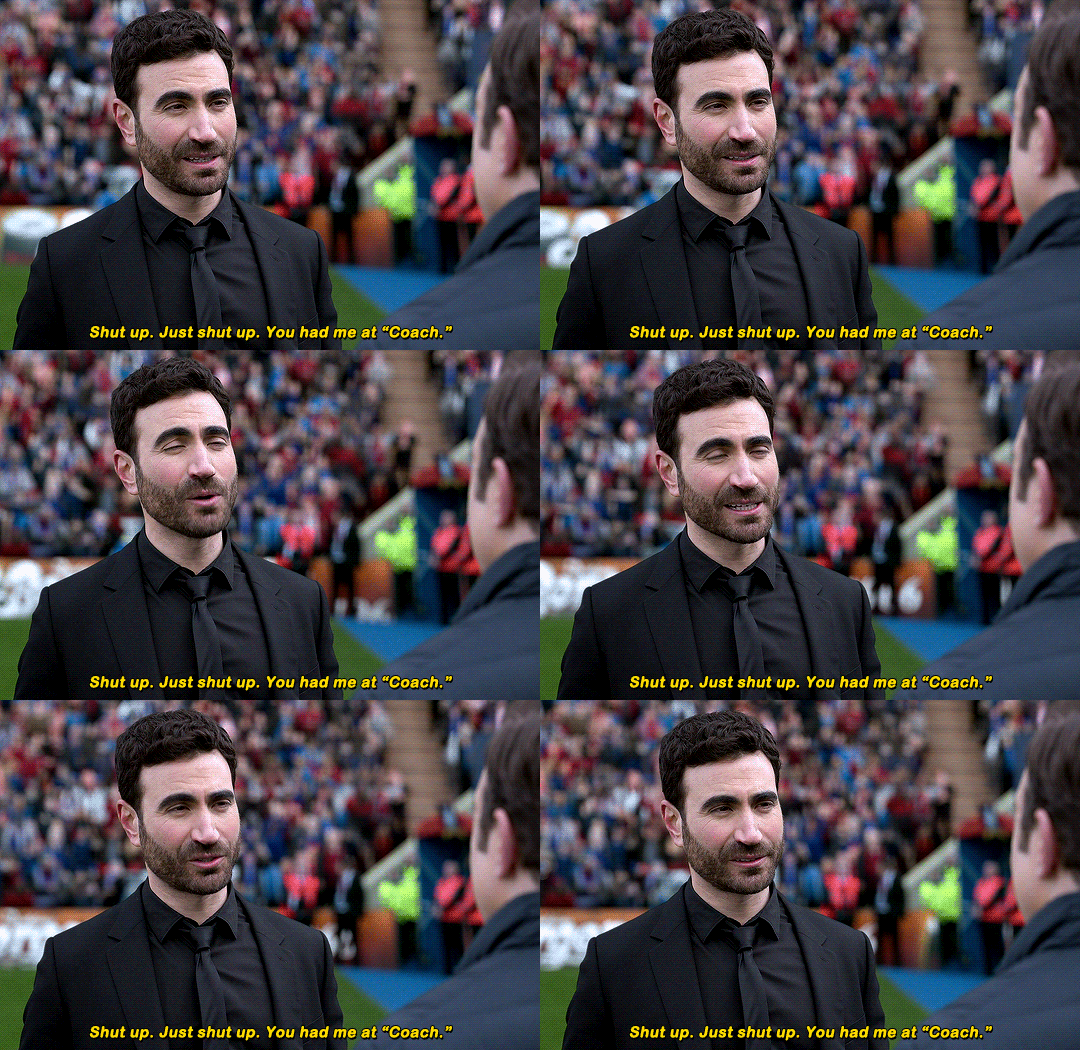
Ted Lasso, Rom-Coms, and Emotional Vulnerability

Why is it important that a show about men who play soccer did a rom-com homage?

Dickinson Behind-the-Scenes: An Interview With the Artisans

Meet the artists who brought the Apple TV+ series to life!

If You Like This, Watch That

Looking for a new TV series to watch? We recommend them based on your preference for musicals, ensemble shows, mysteries, and more!

Wednesday, April 27, 2016

Arrow 4x19 Review: "Canary Cry" (Someday I'll Fly Away)


"Canary Cry"
Original Airdate: April 27, 2016

We all cope with grief in different ways. There is no right or wrong way to deal with the loss of someone you loved. Some people get angry. Some people suffer from intense denial. Some lose themselves in sadness. Some simply feel numb. I've experienced all kinds of emotions when I've dealt with the loss of a family member — apathy, numbness, anger, sorrow — and the characters on Arrow are feeling the same emotions that most of us do whenever we encounter death. While there is no right or wrong way to deal with grief, there are productive and destructive ways. A productive way to deal with the death of someone we cared about is by allowing ourselves the space to grieve and to grieve honestly, whatever that looks like. If we do, we will find ourselves on a pathway toward healing. But if we deal with our grief destructively, it can break us and the people around us. We can use our grief to lash out at others, to lash out at ourselves, and ultimately it can be the very thing that changes us, hardens us, and destroys us.

In "Canary Cry," Team Arrow is dealing with the loss of Laurel Lance (not Black Canary, folks. Arrow did not kill Black Canary — they killed Laurel Lance, and I'll discuss the importance of that distinction in a moment). How did they do with their grief? Well, let's dive in and see because some of our characters could probably use a heavy dose of counseling.

THERE IS NO SUCH THING AS CANON


Before I get into the plot of the episode, why is it so important to me that everyone understand the fact that Arrow did not — as I have seen many angry fanboys (and girls) claim — "kill Black Canary"? Because in inappropriately placing their blame on the showrunners and inappropriately equating Laurel with Black Canary, they're actually devaluing the character they're claiming to love and support. Look, it's no surprise that Laurel Lance was a divisive character. You can argue all day with people who love her and with those who do not like her at all.

But Laurel was important in the framework of the relationships Arrow has created. Her storylines may have vanished and she may — toward the end of her character arc — not really had much impact on the stories Arrow was telling (it kind of sucks that the show found literally nothing they could do with her character so she merely existed in the background — wasted character potential annoys me) so killing Laurel off was the most logical thing to do in that regard. It made sense. She had no trajectory left, and no possible progression. But don't for a moment think Laurel was unimportant to the characters of the show. I think that sometimes we project our opinions onto our characters. If we didn't like Laurel, she must not be of importance to anyone else in the show, either. If you don't like Felicity, you probably think she's pointless, too. We tend to believe that whatever we feel toward a character is also felt by the fictional characters in the show.

That's not the case. Laurel Lance died as a hero, and she died as a woman that everyone cared about. I might not have loved her, but that doesn't mean Team Arrow felt the same way. Laurel is, if you think about it, the last person who tethered Oliver to the life he once knew and the person he once was. Though we know Sara is alive and thriving on Legends of Tomorrow, Laurel is — in a way — the only family Oliver and Thea had left. And now, with their father and mother both gone, Oliver and Thea only have one another as blood relatives, and their bond will always be the most important one in the show to me (sorry, Oliver/Felicity).

And in spite of their absolutely rocky and sometimes destructive relationship, Laurel cared for Oliver and he cared about her. She reminded him of who he used to be and how far he has come.

This all circles back around to why I'm frustrated with people saying that Arrow killed off Black Canary. No, they did not. Arrow did not do away with a comic book legend — they did away with Laurel Lance. And to make the two inseparable is to reduce Laurel to nothing more than a costume. Laurel was a dynamic character, and her death is about much more than the loss of a black costume and a mask. In not understanding this, in claiming that Arrow has done the unthinkable, has rejected canon (which, FYI, you should all totally read this piece in which the author explains how canon only exists in our heads; it's BRILLIANT), you're saying that Laurel only had value to you because of the costume she wore.

The character of the Arrow on this show has been many people — it's been Ra's, Diggle, and Roy for starters. And yet the death of the Arrow would not be the death of the show. Because there's a fluidity in terms of comic book characters. Your version of Black Canary might have died, but that is YOUR version of her. Perhaps someone reading the Green Arrow comics believes that version to be canon — not Stephen Amell. And perhaps you read those same comics and your version of Black Canary is the written one, not the one on this show. And that's totally and completely fine.

My canon version of Batman will always be Christian Bale. My canon version of Spiderman is Andrew Garfield. An no matter how many people in the past, present, or future embody Iron Man, my canon version will always be Robert Downey, Jr. Are those versions canon for you? Perhaps yes, or perhaps no. And that's the point. It would be absolutely absurd for us to think that ten, twenty, or thirty years down the line our grandchildren will not be reading comics or watching movies and television shows with different versions of the characters we once knew — that they won't also be claiming that their canonical version of a character is the only one.

(Literally, this happens with my best friend's parents who watched Doctor Who as they grew up. My best friend's Doctor is David Tennant; theirs is Tom Baker. See? Different canons; same character!)

So what happens when you say that the show killed Black Canary is that you project your personal canon and demand that everyone embrace it. Black Canary, to some people, will be Laurel Lance. To some people, it will be the comic book character only. But you cannot equate the two. You cannot say that everyone's canon needs to be a single epitomization of a character. And the problem these days with Arrow is that people demand that. People demand that the writers do things exactly like they're done in the comics, with Green Arrow and Black Canary getting married. Hey, if you ship those two in the comics, more power to you.

But understand that there is no one true canon and there never will be. In projecting comic "canon" onto Arrow, you're completely missing the point of a show that's an adaptation of the characters from those comics. So no, Arrow did not kill Black Canary. They killed the character who embodied their version of the comic book hero.

Whew. We good?

THERE'S A GRIEF THAT CAN'T BE SPOKEN...


There are a few things to know about the plot of "Canary Cry," but I honestly don't think they're of extreme significance (everyone plays the blame game except, refreshingly, Oliver; a teenage girl dresses up like the Black Canary because her parents were killed in Darhk's gas chamber; the team decides to do stuff). What's really significant in this episode is how everyone deals with the loss of Laurel. Oliver refuses to blame himself, because he spends the episode flashing back to post-Tommy's death and his interactions with Laurel then.

But Dig, Quentin, and Felicity are the characters experiencing the most shifting grief in the episode. Felicity blames herself for not being there, on the team, to somehow help with getting them out of there before Darhk would have killed Laurel. Oliver reassures Felicity that her guilt is misplaced, but that it's misplaced because in the most difficult, unanswerable circumstances, we cling to any answers we can find. This seems to reset Felicity, and it was a nice scene that allows me to believe in hope for those two as confidantes again. (For the record, I don't want them to get back together before the end of the season but I doubt the showrunners will see eye-to-eye with me on that one. Romance sells sweeps, after all!)

Going into the episode, Dig was the person I knew would be consumed with grief. After all, it was his trust in Andy that led them to Iron Heights and to Laurel's eventual death. If anyone has reason to feel guilt, it's him. And he does. His grief becomes anger — anger at himself, anger at Andy, anger at Darhk, and anger at the injustice of it all. Because Team Arrow keeps swinging and punching and yet, they keep losing. Every single time. Dig lost a good friend because of Darhk, and it's this pain and his perceived hand in it that causes him to lash out in reckless anger at Ruve.

David Ramsey's performance in the moment where Oliver finds and stops him from killing Ruve? So wonderful. There's this intensity there that we haven't seen before (and we have seen a lot of intensity from Diggle), and this raw grief. Oliver confronts Diggle about not becoming the villain of the story, no matter how responsible he feels or how angry he is. Dig's anger is justified, though, when the bad guys keep getting away time and time again. It's painful to watch and even more painful knowing that his friend is gone.

I love Diggle, and I'm glad that Oliver was the one to talk sense into him, but goodness gracious is everyone this season doomed to have an identity crisis? I understand that this is the primary theme of comic book shows, but it feels a lot like spinning wheels lately. One week, Oliver is doubting himself; the next, Diggle is. Thea's already had identity crises this season, and so has Felicity. I'm all for parallelism in themes and stuff, but this episode felt like it had no idea what other layer it could use plot/conflict-wise and decided to fall back on the old "we can't lash out, no matter how bad we are feeling" lesson that Oliver learns about fifty times a season.

... THERE'S A PAIN GOES ON AND ON


Quentin Lance deserves his own section of this review because his grief is unlike the grief of anyone else — a fact he states to Oliver in the episode. How many times can Quentin lose a daughter before he breaks? Well, apparently this is the point of no return. Because this time, there is no Lazarus Pit to bring her back. There is no magic that Nyssa can provide. Laurel is actually gone. And the worst part is that Quentin has lost his rock. The relationship between Quentin and Laurel always seemed to be a lot closer than that of Quentin and Sara. I always had the sense that Sara was closer to her mother (I'm closer to my mom in a lot of ways than my dad).

But Quentin and Laurel understood one another. They were cut from the same cloth — resilient, stubborn, with the same love for people and protecting them. They both suffered from the same addiction, too; their pain was shared. But it was more than that. No matter how rough their relationship, Laurel never left. She always stayed. She was there for her dad even when no one else was — even when her mother left. Laurel was there for her dad through AA meetings and the worst days and the best days. She might not have always said or done the right thing, but these two were a team. They loved and understood one another deeply, even when they didn't agree with each other.

Laurel was Quentin's rock. She was his steady support — his comfort and his constant. And losing her hurts in different ways than losing Sara. When Sara died, Quentin lost his baby. When Laurel died, he lost his rock. And though he spends a majority of the episode in denial, it's plausible because... well, this show did bring back Sara a few times, and everyone who is presumed dead nearly always returns alive. So watching Quentin unravel around Oliver was so difficult to watch and so painful, and yet so beautifully acted.

At the end of "Canary Cry," Oliver gives a moving eulogy for Laurel in which he reveals to the attendants that she was the Black Canary. He does this because Laurel's legacy was on the verge of being tarnished by a sixteen year-old girl in the episode's plot (yeah, a sixteen year-old girl outsmarted and nearly bested Team Arrow... wow, they suck). In order to ensure that everyone knew Laurel died as a hero, he revealed her to be not just a woman who fought for justice in the daylight, but fought for people every moment of every day.

Laurel was not without her faults, but I think that this episode served as a nice reminder that while the mask of the Black Canary can be picked up by literally anyone, it was Laurel's drive and ambition, sometimes to the point of recklessness, that made her the hero she lived and died as.

Observations & favorite moments:
  • Paul Blackthorne was the MVP for this episode. I... don't even have words to describe his brilliant portrayal of a grieving father. It was truly a tour de force.
  • This is the first week in a long time we haven't seen Lian Yu flashbacks. PRAISE THE LORD! NO MORE BLAND FLASHBACK CHICK! Instead, we got (pretty retconned) flashbacks with Oliver and Laurel. They made very little sense since they all took place post-Tommy's death and apparently Oliver and Laurel still had feelings for one another then? I honestly have no idea what the writers were thinking about, but sure, I'll totally believe that Oliver was in love with Laurel before he went away for a few months to the island. Whatever you say, show. I've stopped questioning most things at this point anyway.
  • This episode had amazing performances but overall was kinda "meh." It's not a bad episode, but I found myself being a little bored halfway through, especially when it came to Faux Canary's story.
  • Oliver calls himself "the world's leading expert in blaming yourself." Seems accurate.
  • I get that the Canary Cry is cool because of frequency and all of that, but man it's kind of a one-trick pony. After a few too many uses in this episode, it just became irritating.
  • Nyssa returned and I love her still.
  • "Sometimes we just need a reason when a situation is completely unreasonable."
  • Can we please discuss the fact that Felicity has trackers on everyone? I mean, I guess it's to keep them safe but uh, last season everyone was rightfully horrified when Oliver said he tracked Laurel to do the same thing. And Dig didn't know he had a tracker on him. So how is this any different? No thank you, show. No thank you.
  • "You cannot forget who you are. And we? We can never become them." If we made a BINGO game out of phrases from this show, I'm pretty sure "don't forget who you are" would be on one of them.
  • "She's always been there — she's my rock. ... She WAS my rock." Ohhhhhhhhh, my sweet Quentin. That hurt. It really hurt.
  • "You're just one illegitimate child away from an awesome Oliver Queen impersonation." You don't even deserve this ray of sunshine, Oliver.
  • Alex Kingston made her triumphant, straight-haired, American-accented return! Now go find a way to be on Legends of Tomorrow so you can reunite with Arthur Darvill, please. Thanks.
  • Barry, my sweet prince, returned.
  • "You have to find a way now. For Laurel. For the city. For all of us."
What did you all think of "Canary Cry"? Are you looking forward to the return of Andy Diggle? Hit up the comments below and let me know your thoughts!

The Flash 2x19 Review: "Back to Normal" (Unfortunately Ordinary) [Contributor: Deborah MacArthur]


"Back to Normal”
Original Airdate: April 26, 2016

Barry Gloomy Level is at a solid 10, people, and the gloominess is seeping into the rest of Team Flash! We’re at DEFCON: GLOOMY! We are enacting the buddy system, so please find your buddy — I recommend one of the baby animal variety, but to each his or her own. Secure fuzzy blankets and comforting drinks, prepare for a flood of frowny faces, and be aware that sad music is prohibited until further notice!

This is not a drill. I repeat: this is NOT a drill.

Adorable puppy GIFs will be provided at the end of the review, as per our mandated Crisis Guidelines, which can probably be Googled? Or maybe I just made them up in my head. Aaaanyway...


SCARLET SPEEDSTER SANS SPEED


Understandably, much of Barry’s gloomy demeanor this episode stems from the fact that he lost his Flash powers and has been turned unremarkably normal until the team can find a way to get them back. Barry has to fit his new normalcy back into his life, which I’m sure is pretty hard for someone who’s gotten used to speeding his way through everything for the past year or so. Like, how much do you want to bet that Barry forgot to re-set his alarm to something that gives him enough time to get ready without his speed and it went off about three minutes before he had to be at work? It’s a good thing that Barry’s got that ironic reputation for being constantly late that comic book writers attach to all heroes with superspeed.

Barry faces his normal life with the same degree of enthusiasm that I’m sure a lot of people face their normal lives (that is to say, not all that enthusiastically). He drearily gets ready for work, sadly rides mass transit, boredly waits in line for coffee, and — hilariously, from my point of view — looks at a broken coffee mug like it’s everything wrong with the world and Barry personally blames it for all his troubles. The coffee mug did nothing wrong, Barry! Stop projecting!

All in all, I think that this version of the old “Barry can’t be the Flash anymore” story was better executed than season two’s previous incarnation of basically the same thing: when Zoom broke Barry’s back and Barry was confined to a wheelchair for the episode “Gorilla Warfare.” Maybe it’s that Barry seems to have accepted his new fate as an regular ol’ forensic scientist (albeit one with insider’s knowledge on superheroes, villains, Infinite Earths, and other wacky things) with some grace this time, or I was just charmed by the montage we get at the beginning of the episode contrasting Barry’s average day when he had his speed versus his average day without. Either way, “Back to Normal” sits better with me than “Gorilla Warfare” did.

It’s not just Barry’s powerlessness that mimics “Gorilla Warfare,” either, because a few other key plot points crop up: Wells is mad at Barry and wants to save his daughter, Caitlin has been kidnapped again, there’s a supernatural/metahuman threat, and Zoom is still a top priority for Team Flash. I don’t know if this was all intentional, or if the show has really just been repeating the same stories and I haven’t noticed because I’ve been distracted by the feeling of being trapped in a room with a bunch of grim people watching that sad Sarah McLachlan ASPCA commercial on a loop.

HARRY’S TERRIBLE, HORRIBLE, NO GOOD, VERY BAD DAY


While the team is still absolutely focused on protecting the world from Zoom, whose next move is decidedly unpredictable, there is an immediate threat in the form of a super-strong metahuman who is so insignificant in the long run that Cisco doesn’t even give him a metahuman name. Poor guy. Cisco names everything, but not you — because you’re boring, and you talk too much, and your powers are cliche, and you’re gonna die, and did I mention that you’re boring?

Griffin Grey, the boring metahuman who has super strength and rapidly ages every time he uses it, seeks out Harrison Wells to fix him. Griffin thinks that Earth-2 Harrison Wells is actually Earth-1 Harrison Wells, who was actually Future Eobard Thawne, is responsible for the fact that he’s a teenager who looks 40. Harry is already having a bad day because his daughter, Jesse, refuses to be around him on account of him being a murderer and all, so getting kidnapped by a metahuman who never shuts up about his angst and pain? Not a good addition.


There’s no fixing Griffin, so Harry just assumes he can stall for time until the cavalry arrives — with the assistance of his estranged daughter, who is still mad but at least doesn’t want to see her father killed by a 40-year-old teenager with super strength — to save him. It basically works, as Wells (mostly) puts aside his urge to tell Griffin to shut up and keeps himself alive long enough for Team Flash to devise a rescue plan, equip the Flash suit with something that will absorb one of Griffin’s super-punches, and get Harry out of danger. The plan just involved tiring Griffin out until he aged himself to death but, hey — they can’t all be plots of pure, unrestrained genius. Especially not with this group. I mean, did you see last week’s episode? They tried making a deal with Zoom, for God’s sake! And got one of their team members kidnapped because of it!

SNOW AND FROST


Meanwhile, on Earth-2, Caitlin has to deal with Zoom’s creepy infatuation with her. As a show of faith, he releases Caitlin from her restraints and allows her to wander freely about his windowless, dank lair. She meets with Helmet Guy, who is still wearing a helmet and tapping on things, and her Earth-2 doppelganger. Not a whole lot else happens on Earth-2, but I thought it necessary to check in, since Caitlin’s experience has more to do with the “major plot,” while Team Flash’s adventure is just focused on the metahuman of the week.

It looks like Zoom (or “Hunter Zolomon”) really did fall in love with Caitlin, at least a little bit. Killer Frost was kept alive despite her betrayal of Zoom largely because she resembles Caitlin, and Killer Frost knows it. As soon as Caitlin weakens Frost’s carbine cage and releases her, she turns against Caitlin and attacks because being the only version of Caitlin Snow around Zoom is her best chance of survival.

Luckily for Caitlin, but unluckily for Killer Frost, Zoom arrives just in time to stop the metahuman’s icy attack and stabs her with her own icicle. Hunter Zolomon warns Caitlin that trying to rescue the remaining prisoner (i.e., Helmet Guy) means death for him, too. The good news is that Caitlin doesn’t die, but the bad news is she’s still trapped in Zoom’s lair, her friends can’t get to her, and she’s got her handcuffs back because Zoom works on the honor system.

Later, Hunter tells Caitlin that he’s feeling unfulfilled by his current supervillainy. He’s killed so many, but he needs to set more impressive goals for himself if he’s ever going to grow as a chaotic evil mastermind. He decides that he’s done conquering Earth-2 and wants to conquer other worlds to prove how truly powerful he is, starting with Earth-1. Hey, at least it’s a better goal than becoming the fastest fast person in all of the multiverse. Aim high, Zoom. It’s the only way to progress.

Thankfully, the news of Zoom’s impending attack on Earth-1 comes alongside Harry’s announcement that he’s going to help Barry get his speed back. By re-creating the particle accelerator explosion. What could go wrong?!

BARRY ALLEN PUPPY GIF OF THE EPISODE:

JUST BE HAPPY AGAIN, PUPPY


Other Things:
  • I’m not sure that the 1960s ska music was the best choice for Barry’s mope-montage.
  • Side story: Wally wanted to thank the Flash for saving him; failed to recognize Barry even when he pieced together the connection between the Flash and Joe.
  • Earth-2 people creating cell phone dead zones sounds super inconvenient.
  • I still really like The Flash’s use of Zoom. He’s unhinged and dangerous and they don’t try to make excuses for him.
  • “What, is [five majors] not common here?” “Girl, no, that is not common anywhere.” Iris, I love you, and you need to be around more.
  • "I’m guessing the suit will only absorb one of Grey’s punches. Anything more than that, you’ll be like a piñata! Only it won't be candy coming out, it'll be—" "Me?" "You. Yeah, you." Oh, man, I love these two actors to pieces.
  • Some really great acting in the scene between Wells and Jesse, by the way.

Blindspot 1x19 Review: "In the Comet of Us" (Generally Annoyed) [Contributor: Jen]


"In the Comet of Us"
Original Airdate: April 25, 2016

"In the Comet of Us" left me feeling pretty cranky overall with Blindspot.

CASE OF THE WEEK


I was a junior in high school when the Columbine shooting occurred. The world changed that day — no different than the Kennedy assassination or September 11th. There is a distinct "before Columbine" and "after Columbine" delineation in my life. Seventeen years later, there are still school shootings and each seems more horrific than the next. I am always nervous when a television show approaches this sensitive subject. I don't want them to glamorize it.

Truthfully, I didn't love Blindspot's use of the school shooting. Zappata matches numbers tattooed on Jane to a university's winning football record. Coach Jones, the defensive coordinator, is a personal friend of Reade's, because he attended the coach's football camp as a kid. Coach Jones often drove him home from practice. He was a source of support for Reade. If any of this sounding familiar, it's because it should. School shootings aren't the only real-world cases Blindspot is dipping into.

The shooters are two ex-football players named Levi and Tim who were sexually abused by Coach Jones as kids. They are about to come forward when their credibility is destroyed because they are busted for drugs. Levi believes the drugs were planted by the coach. The university and donors covered up the coach's abuse for years, and the shooting is the victims' way of exacting revenge. Levi and Tim shoot the coach and the dean (who both survive), but kill several innocent students. Weller is forced to shoot Levi.

The case is a direct reference to Jerry Sandusky and Penn State. I don't have an issue with Blindspot pulling "straight from the headlines" storylines. Law and Order: SVU has done it successfully for years. However, I do not believe mixing these storylines is the right call. They turned sexual abuse victims into killers, which muddies moral waters that do not need to be muddied.

There wasn't any deeper story apart from Reade's disillusionment that his beloved coach is a pedophile. What's more, the only survivors of the massacre are the perpetrators of the corruption and abuse — the dean and the coach. Levi is dead and there's no follow-up on Tim, the only surviving shooter and abuse victim.

Why on earth would these two men shoot innocent bystanders if the goal is to kill the coach and dean? Levi's explanation of "they just got in the way" is weak at best and illogical at worst. How on earth did unarmed students get in the way of two men with semi-automatics? Why are they trying to kill students with explosives if the target is the coach? It brands Levi and Tim as unfeeling killers and leaves little sympathy for sexual abuse victims. Is that really what Blindspot was going for? I understand many criminals have a history of abuse, but using school shootings and sexual abuse simply to reveal high-level corruption, like every other Blindspot case does, seems a poor use of these sensitive subjects.

The tattoo could have easily led the team to the university and coach. With a little investigation they could have discovered the abuse without the school shooting. Blindspot constantly promises the "most explosive episode ever" in their promos. By the end of the episode, the school shooting and sexual abuse felt like a sweeps gimmick. Neither subject is handled with the care and detail each requires.

TEAM BLINDSPOT


Blindspot used the multi-perspective narrative to give "In the Comet of Us" a little twist. The audience saw each character's reaction to the same event. It is an effective way to build the tension and provide additional insight into each character.

The "start of day" scenes for each character is almost like a check-up on their personal lives. Zappata attends a gamblers anonymous meeting. At first, she doesn't want to share. But after the shooting, she opens up. Her partner's murder is what began her addiction and feeds it to this day. The randomness of his murder made Zappata feel adrift. She understood the rules of gambling and it gave her a sense of control. However, that feeling of control is long gone because the addiction has taken over her life. It's really a succinct explanation of Zappata's addiction and makes a lot of sense.

Reade is still struggling with his break-up with Sarah, mostly because he's madly in love with her and doesn't want to be broken up. His tailor decides a bow tie will fix everything. Okaaaay. Reade has the most devastating encounter during the shooting. He comes face-to face with Levi, and is held hostage. Reade pleads with him to put down the gun and let the FBI to help, but Levi feels he's too far gone. "I'm already dead," he says.

It gives a brief glimmer of insight into his pain.  Both Rob Brown and Charles Brice did an exceptional job playing the scene.

Mayfair is busy with her own mess in her personal life. Her back-from-the-dead girlfriend returned because she needs money. Isn't that romantic? Sophia is living abroad in hiding and someone, she wouldn't say who, discovered her. She believes anyone involved in Project Daylight is being targeted and urges Mayfair to run away with her. Mayfair hands Sophia a bag of money and then tells her where to stick it. Mayfair doesn't run. I cheered. Yes, Bethany loves Sophia, but she can never forgive her for faking her suicide. I cheered again.

(I am not a Sophia Varma fan.)

KURT AND JANE


Truth time: Jane is ticking me off. I find myself getting more and more irritated with her with every subsequent episode. Oscar decides that he shouldn't be Jane's handler anymore. He believes their sexual relationship is complicating things. OH, YA THINK? Jane is almost in a panic at the thought of Oscar leaving her, and she begs him to stay.

This is when I press pause on my television and start yelling about Jane to my husband. At what point did Oscar's threat to kill Weller no longer become a big deal to Jane? Didn't she start working with Oscar to protect Weller? It had little to do with "the mission." When did Jane suddenly become so invested in the mission that lying to Kurt about returning memories is okay with her? Or is she lying to Kurt because she's still trying to keep him safe? If so, then why is she sleeping with the man who threatened to kill him in the first place?

The reason I can't figure out Jane's motivations is because Blindspot isn't overly concerned with explaining her motivations. She desperately tells Oscar to stay because he makes Jane feel more like herself. How exactly? Oscar hasn't actually illuminated any REAL information about who Taylor Shaw is. He gave Jane her favorite food and tea. Suddenly he's a swell guy with deep insight into Jane's psyche? Um, no.

Yes, I'm a Jeller shipper. I understand that I am biased. But with that said, I wouldn't have an issue with Oscar and Jane being a "thing" if Jane's motivations are fully explained. I respect the fact Oscar makes her feel safe. So, let's dig into how Jane reconciles her personal safety with Oscar's threats against Weller. Is Jane invested in the mission, or in Oscar?

It feels like whichever man provides Jane with the most insight into who Taylor Shaw was, that's the man she throws in with. Yes, knowing who Taylor Shaw was is important; but what's more important is figuring out who Jane Doe IS. Neither Oscar nor Kurt can answer those questions for her. I'd prefer to see less focus on what these men tell Jane and more focus on what Jane thinks and believes. Without that, Jane isn't really likeable right now.

Quite frankly, Blindspot is in too big of a hurry to make a love triangle between Kurt, Jane, and Oscar. They should have pumped the brakes a bit more between Oscar and Jane. They need to show how and why Jane suddenly trusts Oscar — to give us something deeper than him presenting her with her favorite beverage. It feels like the reasons for Oscar and Jane are sleeping together is because Kurt is sleeping with Andie... and because it's sweeps week. Everybody is sleeping with everyone during sweeps! Sorry Blindspot. Those plot points do not hold in the grander scheme of things.

As for Kurt, his heart-to-heart discussion with his father also ticked me off. Kurt's father magnanimously forgives Kurt for believing he killed Taylor Shaw. He doesn't want Kurt blaming himself or feeling guilty for their nonexistent relationship.

Gee, Bill, that's real swell of you. Did he somehow forget he kept his whereabouts the night Taylor Shaw disappeared secret from Kurt for twenty five years? Bill's secret played a significant role in Kurt's doubt. Kurt's doubt wasn't abated when Taylor returned. It was when Bill was honest about his attempted suicide. It's a secret Bill could have shared many years ago. Would Kurt have believed him? I don't know. Maybe. Maybe not. The point is they'll never know. The intent of Bill's forgiveness may be good, but his presentation needs work. He parks too much blame at Kurt's door step in the giving of it.

Stray Thoughts
  • "Glad you came over to my side." Reade and Jane bonding is the cutest. More please.
  • "What's with the bow tie, Bill Nye?" Zappata is the queen of sass on Blindspot. May her reign be long and prosperous.
  • Oscar telling Jane he can't be her handler anymore AFTER he sleeps with her again did nothing to make me like him more.

Castle 8x19 Review: “Dead Again” (Lurking in the Shadows) [Contributor: Hope]


“Dead Again”
Original Airdate: April 25, 2016

Well, folks. We’ve all had a week to cool off from THAT news, and now we’ve returned calm, collected, ready to — yup, nope. Sorry. I will be sticking with this series until at least the end of the season because if we do get the final, final scene instead of the cliffhanger, I need to see that. I’m also not going to turn my back on the rest of the cast, and I’m certainly not going to throw away the rest of Stana and Tamala’s hard work. This whole review could be another edition of Hope Rants for a Thousand Words, but it’s not going to be.

I will say, however, that it’s incredibly hard to watch this show after knowing what I know now. Every funny scene, every sweet scene, everything I would have loved has a dark cloud hanging over it, and I can’t shake that feeling of impending doom. Everything good makes me think of everything this show is throwing away. I can't believe the broad range of attitudes I've had toward this season so far. I loved the premiere, then it went downhill, then it looked bright again, and now it would be good if it weren’t for the series finale/end of the show as we know it looming ahead.

You guys might be familiar with the song “Riptide” by Vance Joy. In it is a notable line that I interpret in a way that could apply here: “I love you when you’re singing that song, and I’ve got a lump in my throat because you’re gonna sing the words wrong.” It’s not just that I’m nervous Castle is going to mess things up — I already know what it’s doing, and yet I’m sitting here, watching it anyway. Is it slightly torturous? Well, yes. Yes it is.

And still, I’m glad I’m watching. This was a great episode. It might have been one of my favorites of the season, if not for the large amount of foreshadowing that I can't help but interpret a certain way. It was funny, the case was intriguing, and the personal storylines were balanced enough to take up half of the drama. Ryan and Esposito didn’t have much to do, Alexis, Martha, and Hayley weren’t in the episode at all, but Lanie got more screentime than she has had all season. The would-be murder victim, who was almost killed three times, was just endearing enough to make it plausible that Castle could convince him he was a superhero. But someone, please — let Castle mature a little.

First it was genies, now it’s telepathy, superpowers, telekinesis, and invincibility? And not just a belief in those things — which is plausible enough because it’s Castle we’re talking about — but actively pursuing the suspected “superhero” and throwing things at him to see if it hurts? Maybe if Beckett wasn’t regulated to her desk and captain duties so much, she might have been around to be the ever-present, ever-needed voice of reason.

SOMETHING MORE


Castle starts off the episode on an odd, slightly unprecedented tone. I’m not sure I would call it out-of-character, or shoehorned into the episode, but it certainly is serving a purpose. What is that purpose? That seems to rest in the hands of ABC at the moment. But it’s clearly opening up a pathway for either Castle and Beckett to leave the crime-solving life for a normal one... or for them to regret not leaving it all behind.

Castle suggested that they go to Paris, to which Beckett argued that she had just gotten her job as captain. He, in turn, argued that being a captain was just the start, and there was so much potential for her career outside of all that crazy, high-stakes, occasionally off-the-reservation crime solving (see: LokSat). And then, he said, they could lead a “normal life.” But of course, they have their jobs and there’s Alexis to think about. This also got a laugh out of Beckett, who joked that he could never be normal. A week ago I would have seen that as a sweet throwaway line (and a true one at that), but now, it feels like foreshadowing. As if this “normal life” isn’t in their future. Specifically, his.

To make this theme a little more heavy-handed, the murder victim who wouldn’t die was just an ordinary man... who Castle decided must want more out of life. He channeled all of his feelings about being “happy with his life” and “getting out there” into his little mentee. He then regretted this because it (almost) gets the poor guy killed for the third time. Both the second and third time, Castle feels guilty for the “murder” — especially the last time, when Castle realizes he pushed the victim into being a hero instead of just keeping him safe.

It’s arguable that Castle would feel the same guilt if anything happened to Kate. He told her what he had found out about LokSat. He agreed to work with her. He couldn’t stop her if he tried, but he’s helping her, encouraging her, and not standing in her way. Should he have just kept her safe? Will he live to regret this? Or will they make a change to their lives before it’s too late?

THE OMINOUS RETURN OF LOKSAT


Speaking of heavy-handed foreshadowing that is probably only heavy-handed because of what we now know: Vikram found out Caleb’s alter-ego and tracked him to Los Angeles, where he was seen talking with that dude from the season premiere who put a bag of fluffy spiders over Castle’s head (the fluffy spider bag that was then thrown onto the floor to let loose the fluffy spiders to take over New York City and then the world. If a herd of giant fluffy spiders running around doesn’t make your skin crawl, then you’re made of tougher stuff than I’ll ever be).

Anyway. Vikram wanted to go full steam ahead into tracking down LokSat, but Beckett got him to slow down. However, not before he tripped a digital wire that alerted Caleb, who confronted and threatened Kate. She, in turn, forced Caleb to think about the kind of person he used to be and the person he is now. She tried to turn him to their side, which almost seemed fruitless, until the last scene of the episode, where Caskett arrived home to find Caleb sitting in the middle of the darkened loft.

He did something pretty surprising: he gave them the phone he had been given by LokSat (whose identity is even a mystery to him) and, in doing so, is giving Beckett the chance to trace its next call. This is not going to end well for Caleb, you just know it. And unfortunately, everything about this storyline is building up toward whatever the season/series finale has in store.

I’m thinking that LokSat, after all this build-up, has got to be someone who is already present on the show, or it will lose some of its impact. Sure, it could be some politician or crime lord, but what if it was Vikram? He’s overeager to the point of being reckless, and I get that this dude is inexperienced with crime-solving, but he’s also frightened by all this. Fear, you would think, would act to hold him back a bit.

However this LokSat case unfolds, the drama would be much more enjoyable if we didn’t know it can only end in one of two ways — Castle and Beckett starting a new chapter of their lives, or tragedy.


Notepad:
  • “What are you doing?” “Watching you sleep. Is that creepy?” “I think it’s sweet.” “I took some pictures.” “Less sweet.” “They’re part of a series. Usually you don’t wake up.” “And now it’s creepy.”
  • “I think it’s time we shake things up. Move to Paris. You know, search for buried treasure in Nepal. We could fly a hot air balloon across the Sahara.”
  • “But what if we didn’t?” Anyone else sensing a call-back to the line from 3x22, “you don’t want to look back on your life and wonder, ‘if only’”? 
  • “You’re on a rocket, sky’s the limit. And then you know what’s going to happen? We’re going to become normal.” “No, Castle, you’re never going to be normal.”
  • “Um, Lanie.” “Don’t ‘um, Lanie,’ that man was dead!”
  • “They start out as mild-mannered weaklings, and that’s you!” “Wow, thanks.”
  • “Sidekick? Please, I’m the mentor.”
  • “Let’s hope you don’t flash back to this moment, when you had the chance to live and you chose not to.” Well, crap, the foreshadowing of this scene was just unnerving. 
  • “Oh my gosh, is that what we sound like?” “I surely hope not. I mean, it’s cute but just… overly cute.” I love how these two finish each other’s sentences. I just love these two in general. Please, Castle, don’t break my heart.
  • The WRITER vest returns!
  • “Maybe it is time for a change.” “So long as I’m with you, I’ll go anywhere.” GO TO PARIS, DO IT NOW. 
  • “Remember who I chose to be today, because nobody else will.” 
  • “And when the time comes, we’re gonna make it count.”
  • So, next week involves a production of Hamlet, the second reference to Hamlet in the span of three episodes. Anyone else sensing foreshadowing to a whole lot of tragedy? Or is that just me? 

The Boss Was a Huge Flop, and Here's Why [Guest Poster: Julia]


It’s a rarity that a Melissa McCarthy movie isn’t hilarious or doesn’t perform well in the box office. Unfortunately, The Boss qualifies for both of these unsavory labels. With limited comedy that wasn’t previously shown, a thin script, and poor critic reviews, The Boss may be McCarthy’s lowest grossing wide-release.

TOO MUCH PROMOTION 


Who thought too much promotion could be a bad thing? After seeing the trailer prior to every film I saw for two straight months, The Boss lost its humor, since most of the comical parts were shown in the trailers. A few other “good” scenes were shown ahead of time in the TV commercials, which were frequently all over every channel. Seeing so much of the film ahead of time ruined the story for me, as well as the jokes.

I never usually think that a lot of promotion is a bad thing. Typically, the more a company advertises, a greater number of people can be reached. This, in turn, can lead to more people wanting to buy a product, or in this case, go see a particular film. For about two months, I couldn’t escape the promotions for The Boss. I got tired of seeing the trailer and commercials, even though I wanted to see the film. Maybe I see too many movies and/or watch too much TV, but it was overkill to watch the same scene being advertised continually.

When I saw The Boss, there were very few scenes that I actually thought were entertaining. Anything that was supposed to be funny was no longer amusing to me. Only two scenes in the entire film were hilarious, with one being the 20-minute end sequence. When comedy is spoiled ahead of time, there isn’t much of a point to actually see the end result, which is exactly what went wrong for The Boss.

THIN CHARACTERS AND SCRIPT 


An even larger problem with the film is that the story and characters weren’t written well. The story drags for a while and never really gets its footing. The characters were hard to become emotionally attached to, leading to lackluster performances. I can’t say anything bad about McCarthy’s acting because she is always good, even when the film as a whole isn’t. She brings her obscene humor and charm to her character and still manages to give a decent performance.

I was disappointed in two of the other top actors, Kristen Bell and Peter Dinklage. In my original article, “5 Upcoming Films That Feature Your Favorite Television Stars,” I had hoped that The Boss could help launch a better film career for Bell. Her performance wasn’t what I expected, as she simply didn’t act very well. Her character was a bit whiny and didn’t have a character arch. As much as I wanted to like her character, I couldn’t get past the shallowness of the writing. This was the true disappointment of the film because Bell, like McCarthy, is a good actress and deserves more credit for her work. She should have a more successful film career, but it hasn’t quite taken off for her yet. However, I’m keeping my fingers crossed that she will give a better performance in the summer comedy Bad Moms.

Dinklage also gave a poor performance as the antagonist of The Boss. His stoic acting didn’t add anything to the overall story. His character was pretty much worthless until the end of the film. Dinklage is another good actor that I expect more from, but he hasn’t been particularly stellar in his last two film roles (Pixels and The Boss).

THE CRITICS STRIKE AGAIN! 


Some people question whether critics’ opinions actually influence the public’s thoughts on films before they are released. I think the critics’ reviews do still matter, which is definitely a reason why The Jungle Book did so well. If you are a skeptic, then take a look at the ratings of all McCarthy’s films on Rotten Tomatoes: the only two films that have very poor reviews, in which McCarthy played the lead role in a wide-release, were Tammy (23%) and The Boss (19%). These also happen to be the two films that have done significantly worse than her other break-through comedies, according to Box Office Mojo.

The Boss had a successful first weekend release of $23.58 million and a number one finish at the box office. Its second weekend dipped 57.8% to $9.95 million, giving it a third place finish. That’s a pretty steep drop, which was probably due to poor critic reviews and word of mouth. The film has grossed $42.68 million, as of April 20, which is probably a lot less than Universal hoped it would make.

There’s a slim possibility that The Boss could turn itself around and perform better considering that there aren’t any R-rated comedies being released until May 20. However, it’s not very likely considering the user reviews on Rotten Tomatoes and IMDB are right around average, as of April 22. Out of 17,695 Rotten Tomatoes user ratings, only 48% of viewers liked the film. Similar results are in at IMDB, where 3,200 user ratings averaged 5.2 stars out of 10 stars.

Don’t expect a huge turn-around for The Boss, but at least we have Ghostbusters to look forward to! Let me know what you thought of The Boss in the comments section below.

Tuesday, April 26, 2016

Once Upon A Time 5x19 Review “Sisters” (Siblings) [Guest
Poster: Julia]


“Sisters”
Original airdate: April 24, 2016

Have you ever wondered what would happen if Zelena, Regina, and Cora all came together in the Underworld? If so, then the newest episode of Once Upon A Time is for you! As siblings reunite and meet for the first time, numerous relationships are explored. This week, hope and love finally win out in one of the most touching episodes of the season.

LIKE MOTHER, LIKE DAUGHTER 


“Sisters” kicks off with Hades and Zelena enjoying a picnic with a hidden agenda. Hades asks Zelena to help him restart his heart to allow him to go back to the real Storybrooke with her. However, if Hades leaves the Underworld, then the heroes will be trapped there. Zelena is troubled by the proposal and isn’t sure what action to take. By saying yes, she would be forced to embrace the wickedness inside her and become Hades’ evil henchwoman/wife. By saying no, she would be turning over a new leaf, like Regina wants her to, but gain an enormous enemy in the process. For the time being, she decides not to give Hades a solid answer.

As cunning as ever, Regina has watched these events unfold through a magic hand mirror. She confronts Zelena in her home to ask what she is going to do with Hades’ proposal. Zelena reveals her love for Hades and her hope of changing him for the better. Regina doesn’t believe that she can change the god’s ways, since he has been stuck in the Underworld for centuries. Regina feels that the only way to stop her sister is to use the one thing Zelena can’t resist: their mother.

Through some intriguing flashbacks, we are reminded of how evil Cora was, which Zelena definitely inherited. Cora’s wickedness allowed her to call upon the daughter she abandoned to save the daughter she loves from a sleeping spell. Long story short, Regina and Zelena met as children, found out they were sisters, and had their memories erased by Cora to destroy the hope and love. The separation more than likely propelled Zelena over the edge to use her magic for evil instead of good.

Back in the Underworld, Cora and Zelena meet for the “first” time face-to-face, and the meeting transitions from heartfelt apologies to twisted agendas. Cora wants to use magic water on Zelena to get her to forget Hades, which is the only possible solution she can come up with for Regina’s problem. Maybe Cora should have thought that through a bit more because Zelena saw right through her act. Cora manages to save the day by telling her daughters the truth, which was a big shocker considering her character.

As Regina and Zelena are given back the memories, they realize, in a heartwarming moment, that they never should have doubted the power of family. Zelena makes a choice in that moment to be with her family and be the good person she always wanted to be. As a fan of the hope the show provides, I was very happy to see Zelena’s character arc take a major turn. She has almost completed her arc, since she has now accepted change in her life. The only thing left for her is to accept love. Cora saw her character arc come full circle, as she was finally able to move on to a better place. Before doing so, Cora showed that love can change a person, even the most wicked of people.

TWIN POWER 


Let’s not forget about our other siblings; anyone remember the twins? The fateful meeting of David and James finally occurs, and it goes pretty much as expected. James’ jealousy persuades him to lock David up to enable his master plan of impersonation. Surprisingly, Emma doesn’t see through James’ farce and puts her full trust in him, thinking he is David.

Emma and “David” go to meet up with Robin and the baby, when everything turns south. James unveils his deceit as Cruella De Vil joins the party to reveal the grand scheme of stealing Robin’s baby in order to have leverage on Hades. Cruella wants to use the baby to force Hades to bring her back to life. Their plan is almost successful — until the evil duo tries to throw Emma and Robin off the pier into the River of Lost Souls. Hook and David show up in time to save the day. David and James have their long awaited showdown, leading to James being thrown into the river to endure an eternity of suffering.

LIKE FATHER, LIKE SON 


At the end of the day, hope has come back to the Underworld in fashion. Everyone showed their commitment to the mission and to each other. Rumple decides to show this in his own, twisted way. Early in the episode, Rumple talks to the sleeping Belle and tells her that he has to use dark magic to solve their contractual problem. He appears for a minute at the beginning of the episode and then disappears. Halfway through the episode, I wondered why Rumple was shown if he didn’t have any impact on this week’s main story or even the sub-story. My question was answered at the very last minute, when Rumple mysteriously appears.

Zelena has been prompted by Regina to accept Hades’ love to try and change his ways. Zelena goes to meet Hades at the diner to profess her love, when she is stopped outside by Rumple, who takes advantage of the situation like Zelena did to Belle in the last episode. Rumple throws a major curveball into the equation when Peter Pan steps out and announces they are teaming up. With ruthless, despicable father and son reunited, anything can happen. Rumple and Pan kidnap Zelena as the scene fades out.

Now, there are so many directions this storyline can go. Since both Rumple and Pan dabble with dark arts, it’s easy to think that they will torture Zelena in order to force Hades to do their bidding. I doubt that Rumple will just use Zelena as a simple threat to get Hades to rip up their contract. The worst case scenario is that Pan goes rogue again and tries to use Zelena for his own twisted purposes. I doubt that Rumple can trust his father, so who knows what will happen. No matter what, family has been the core of the second half of the season on Once Upon A Time, and will definitely be the deciding factor of how the season concludes.

Monday, April 25, 2016

Pretty Little Liars on DVD: Got a Secret, Can You Keep It?

(Photo courtesy of Warner Brothers Home Entertainment)

Pretty Little Liars' Sixth Season is Now Available on DVD/Digital HD!

A quick synopsis:
As the sixth season begins moments after the season five finale, Aria, Emily, Hanna, Spencer and Mona are trapped outside the “dollhouse” where their tormentor, Charles, has been keeping them — with nowhere to run. Angered by their attempted escape, Charles’ games take a more demented and darker turn. As the girls struggle to survive, Ezra, Caleb and Toby (recurring guest star Keegan Allen) continue the fight to find the girls with or without Rosewood Police Department’s help. Charles’ story begins to come together, with the Liars eventually solving the puzzle and unmasking Charles, finally putting an end to the “A” game. The second half of the season jumps five years forward, with new secrets, new lies and a whole new look.
One of the most addicting shows that I've watched over the past few years is Pretty Little Liars. I don't know what it is exactly about the series that captures my attention. Perhaps it is because it frequently frustrates me, yet compels me to watch more. Perhaps it's because of the fashion or the relationships that Spencer, Aria, Emily, and Hanna have with one another. Maybe it's the constant push and pull of mystery and intrigue, with equal parts humor and sass. Or it might just be the fact that the show is such a perfect guilty pleasure that it transports you from your reality into the quiet, seemingly-sleepy world of Rosewood, Pennsylvania.

This past week, Pretty Little Liars released its sixth season on DVD and digital HD. Warner Brothers Home Entertainment was kind enough to send me a review copy of the DVD before it was released, and if you're a fan of the series, you definitely need to own a copy of this.

First off, the DVD packaging is beautiful. The cover art and inside sleeves are vibrant and detailed without being overtly so. The discs themselves (of which there are five) are also very intricate and beautiful, and all are varying shades of green (which I weirdly appreciate in terms of color pallet consistency). But what really sells DVDs for me are their special features, so I'll spend some time discussing those. I love Netflix. I really do. But the thing about it that is maddening is that it doesn't offer blooper reels or extra content — both things I value, sometimes more than the episodes themselves. I love binge-watching episodes of Friends on Netflix, for example, but sometimes I just want to watch Matthew Perry mess up half a dozen takes on the blooper reel.

(Photo courtesy of Warner Brothers Home Entertainment)

EXTRA SPECIAL FEATURES


Pretty Little Liars' discs are chock full of extra and special content features (around 30 minutes' worth, actually). The first disc has a feature called "We Heart the PLL 'Ships," which is a fun look into the pairings on the show (pre-time jump), with the actors and the executive producers weighing in on what makes Spoby, Ezria, and Haleb so great. This feature is fun if you're fans of any of those pairings (though it does kind of leave off Emily, perhaps because she didn't really have a steady partner throughout the series like the other girls), and is a nice trip down memory lane. Both the actors and the executive producers note that part of what makes Pretty Little Liars so intriguing — and its ships so beloved — is the showcasing of push-pull dynamics between the characters. The best love stories, after all, the EPs discuss, are ones in which characters learn from one another and become better because of their relationship (while encountering friction along the way).

In this feature, you'll also get to hear the EPs and actors discuss some of their favorite ship moments from the first few seasons.

Also on the DVD is a really fun feature titled "A PLL Prom." This was probably the most engaging one, as the EPs and behind-the-scenes set talent discuss all that went into the creation of the prom, not just in terms of props and scenery but also wardrobe. You probably picked up on the fact that Aria's dress is supposed to be an homage to Snow White. But did you know that each Liar has a story and fairytale homage behind her dress, too? Check out this feature for the glimpse into the wardrobe and the accessories (seriously, those accessories are so cool) as the actresses explain that each of their looks has its own story.

And since the prom's theme was "Enchanted Forest," all of the amazing behind-the-scenes set talent got to explore what that meant thematically and practically for the scene. There's a giant hourglass in the prom, for instance, that took four men to constantly tip, turn, and lay on its side in order to maintain continuity from shot to shot. Additionally, all of the lanterns hanging up at various heights near the dance floor? Those were from Inception!

Learn more secrets about set and costuming on this really fun feature.

(Photo courtesy of Warner Brothers Home Entertainment)

Also fun are the special features "Inside the 5 Years" and "A Homecoming: The PLLs Return." The cast and EPs take a look at what the time jump meant for their characters (including headcanons from I. Marlene King, the rest of EPs, and the girls), as well as what it meant for their fashion sense. That last bit is focused on in the homecoming feature, where the cast and producers talk about what it was important for them to reflect in each of the Liars' updated wardrobes. They discuss how Hanna's has evolved into high fashion, Spencer's remains practical but stylishly professional with pencil skirts and dresses, that Aria's evolved from wild to a more tame and still expressive style, and how Emily has embraced a more put-together California casual. Sasha Pieterse also talks about Alison's wardrobe was completely overhauled in order to provide her with a more tailored, teacher look.

Overall, these features were a fun glimpse behind-the-scenes into the world of Pretty Little Liars and the minds that create and maintain the series. Apart from the special features, the DVD also includes a lot of deleted scenes, in addition to the episodes themselves.

If you haven't already purchased your copy of the sixth season on DVD or Digital HD, do so today!

(Photo courtesy of Warner Brothers Home Entertainment)