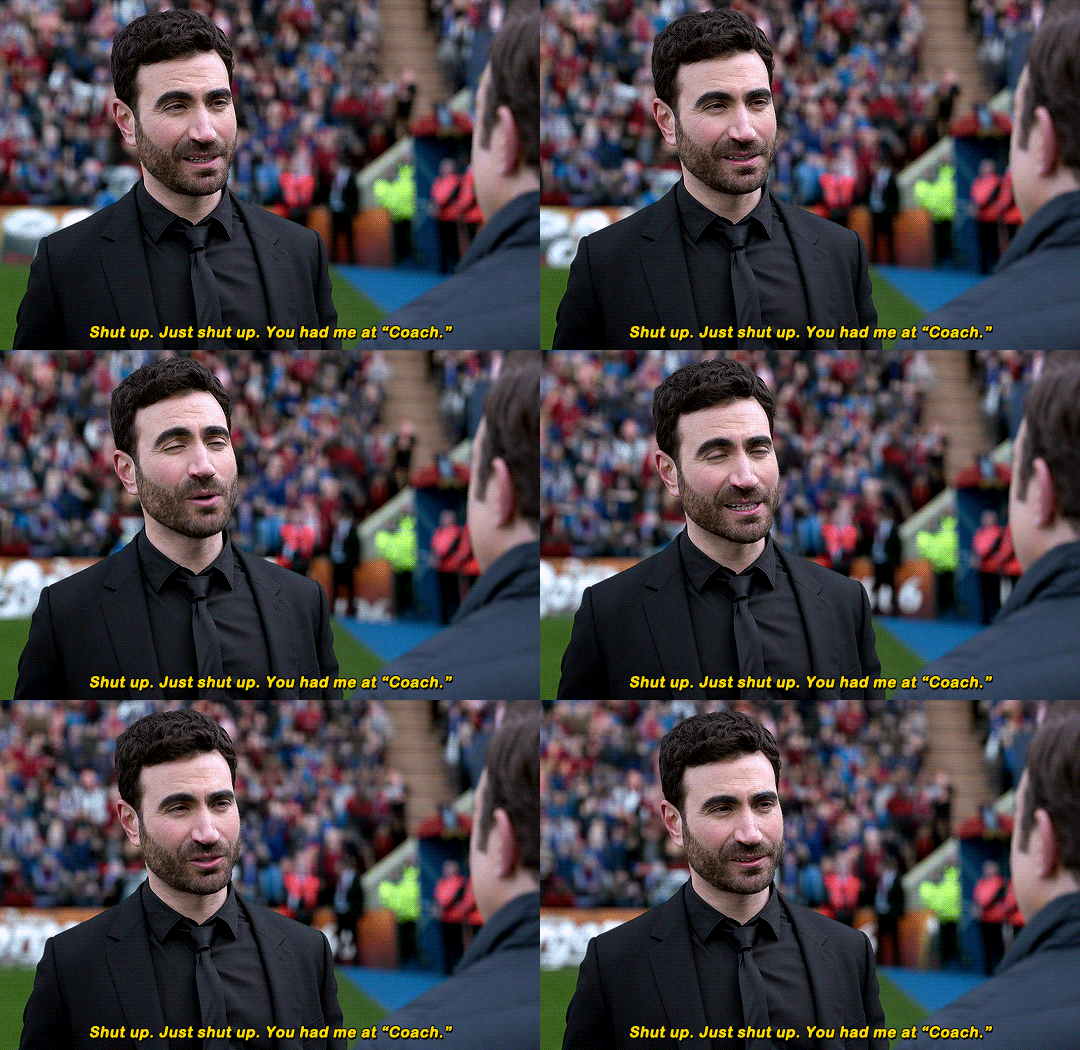
Ted Lasso, Rom-Coms, and Emotional Vulnerability

Why is it important that a show about men who play soccer did a rom-com homage?

Dickinson Behind-the-Scenes: An Interview With the Artisans

Meet the artists who brought the Apple TV+ series to life!

If You Like This, Watch That

Looking for a new TV series to watch? We recommend them based on your preference for musicals, ensemble shows, mysteries, and more!

Friday, April 26, 2013

4x11 "Basic Human Anatomy" (The Grass is Always Greener on the Other Side. Until It's Not.)


"Basic Human Anatomy"
Original Airdate: April 25, 2013

Have you ever wondered what life would be like if you could switch places with someone for just a day? I think, if we’re being honest with ourselves, we all have longed to swap lives with someone else. But here’s the funny thing about desiring to live another life – we never do it when we’re content in our own lives. The reason, of course, that we dream about what it would be like to live in someone else’s shoes is because we’re prone to a “grass is greener on the other side” mentality. When we lament the way that our lives turned out – our lack of jobs, fortune, romance, functional families, friends, etc. – we tend to covet the lives of people we feel are better off in those areas than we are. We long after a life that wasn’t ours to have, while those individuals are (likely) longing for lives that they don’t have as well. It’s a viciously ironic cycle, this coveting of someone else’s days. But we like to play pretend. When we’re kids, we play “house,” and use plastic swords to ward off invisible monsters. Because the truth is that we’re all dreamers, in some fashion, and reality… well, reality often squelches those dreams pretty quickly. So what does “Basic Human Anatomy” have to do with this notion of living vicariously through someone else? If you watched the episode, you’ll know that it has nearly everything to do with this idea. Troy cannot bear to face a conversation that he needs to have with Britta. The solution, for him, is the adult version of “playing pretend” (or, well, maybe not the adult version) by reenacting a body swapping movie with Abed. And at the end of the episode, no matter how painful the process, Troy has a second “Mixology Certification” moment of growth. And it’s pretty beautiful to behold, regardless of the bumps that were encountered along the way.


Friday, April 19, 2013

4x10 "Intro to Knots" (The Empire Strikes Back)


"Intro to Knots"
Original Airdate: April 18, 2013

War. What is it good for? Absolutely nothing. (Okay, look, I promise not to copy and paste the lyrics to “War” as the blog-review this week. Though, I admit that I was tempted to just to see how everyone would respond.) War is painful and it’s damaging. It’s something that we’d all rather brush under the rugs of our daily lives and pretend doesn’t exist. And truly, unless we have immediate family members, close friends, or other loved ones serving in the military, too often we find ourselves taking for granted the fact that so many people fight for us on a daily basis. I never really understood war, but I know that it’s woven into the fabric of our history. I remember studying battles in high school, learning about leaders and armies and tactics. I had the amazing opportunity to visit Rome this past summer and visited Julius Caesar’s grave, as well as the Roman Ruins. I stood in the place where great leaders delivered their nations through wars, where mighty empires like Rome rose and fell. So this episode of Community centered around the idea of an empire – the study group. In the past, I’ve discussed the significance of Megan Ganz’s first episode, “Cooperative Calligraphy.” In my review of it, I noted that it was at the end of this episode that the study group began to function as one unit. Rather than seven individual members, the Greendale Seven became one entity with one purpose: protect the group from outsiders, from anyone seeking to destroy it.

The group’s collective mentality has been both a blessing and a curse, as we’ve seen in this season’s episodes (most notably “Alternative History of the German Invasion”). Sure, the study group has survived paintball wars together, insane teachers, and Chang. They love each other. They spend, presumably, the majority of their time together. They always want to look out for the best interests of the group as a whole. But what happens when an entity is challenged by an outsider who discovers a crack in the armor of the group? What happens when stakes are raised for an empire? Because I do believe that the reason this episode was so tense (and by that, I do mean that it was brilliant in the sense that you could tangibly feel high stakes) was because it was supposed to be: there is more at stake this year for the Greendale Seven than there ever has been. Many of the group members are on the cusp of graduation. With that, however, comes a price: individuality begins to become a dominating force. Empires fall when the goals and desires of the individuals outweigh the goals and desires of the group at large. Nothing divides the study group faster, we see, than the issue of graduation. Watch “Cooperative Calligraphy,” however, because I do believe that the study group emerges victorious because they have learned from their failures. They realize that it is difficult to face an external enemy, but the TRUE enemy is the dissention they create amongst each other. THAT is the most destructive force of all. And it’s something that Cornwallis attempts to mine (and nearly does) throughout the episode.


Tuesday, April 16, 2013

4x09 "Intro to Felt Surrogacy" (Secrets Don't Make Friends)


"Intro to Felt Surrogacy"
Original Airdate: April 11, 2013

I’ve heard the adage “secrets don’t make friends” numerous times throughout my life, but never really paused enough to dwell on the meaning until recently. I have to argue that secrets, in the girl-world, DO make friends. The person who holds the secrets within a group of girlfriends is the most coveted person. She’s the one who has all the knowledge and all the gossip, which makes her the person everyone listens to. Once she loses that power – once someone else divulges a secret or piece of gossip – she isn’t as valued, and the balance of power shifts to the person with the newest, juiciest tidbits of information. Secrets may make friends in girl-world, but only if they’re the secrets of the others – the outsiders, the people apart from the group. Once a secret within a group is unearthed, however, the adage becomes active again. Secrets destroy intra-group relationships fairly quickly. And “Intro to Felt Surrogacy” is an episode that exemplifies this quite clearly. In it, we hear a seemingly innocent story from the group about a hot air balloon ride and (an inadvertent) trip into the woods. It’s not until later on in the episode that we realize the reason why the study group has been so awkward around one another. They each divulged a deep, dark secret in those woods.

But no one remembers a thing.

Friday, April 5, 2013

4x08 "Herstory of Dance" (In Which Britta Definitely Britta'd It)


"Herstory of Dance"
Original Airdate: April 4, 2013

The gap between being pride and humility can seem about as large as the span of The Grand Canyon. Or, this is what we think. In all actuality, there’s a rather fine line between humility and pride in our daily lives. For example, if I were to tell you that I am terrible at receiving compliments, a part of me would (honestly) want you to compliment me so that I would feel better. I’ll be honest: I get a surge of joy whenever I read a positive tweet or review from one of you. And that’s something that makes me human. We love to receive positive comments, and we harden our hearts and minds whenever we are rejected or criticized. Jeff Winger has never been a particularly humble person, and neither – for that matter – has Abed Nadir. Jeff is the person who has an ego the size of an inflatable apple and Abed once said that girls loved him because “let’s face it, [he’s] pretty adorable.” Pride and ego are much more noticeable traits in Jeff because they are his primary vices. Nearly all of Jeff’s actions stem from them: his behavior toward Rich, his views on Billiards class, taking an axe to the table, blaming Todd for the study group’s problems, etc. Abed’s pride doesn’t manifest  itself very often, and when it does, it displays itself in the form of relating everything to popular culture. Now, before I get a ton of angry e-mails, yes I am aware that Abed is a character who likely has Asperger’s. And yes, I understand that there are parts of Abed that will never respond “normally” to people or situations. But in “Herstory of Dance” (and “Messianic Myths and Ancient Peoples,” for that matter), Abed’s desire to be in control of the trope, in control of the pawns and pieces, and in control of the outcome lead to his demise. But it’s more than that, really. In both Jeff and Abed’s stories throughout this episode, their pride wounds the people around them. Jeff hurts Britta. Abed hurts his dates, Rachel, and Shirley and Annie. Hurting yourself and others is what happens when ego and pride take ownership of a person. But the beauty is that humility is the cure.


Thursday, March 28, 2013

Goodbye, Lizzie Bennet. It Has Been... So Good to See You.


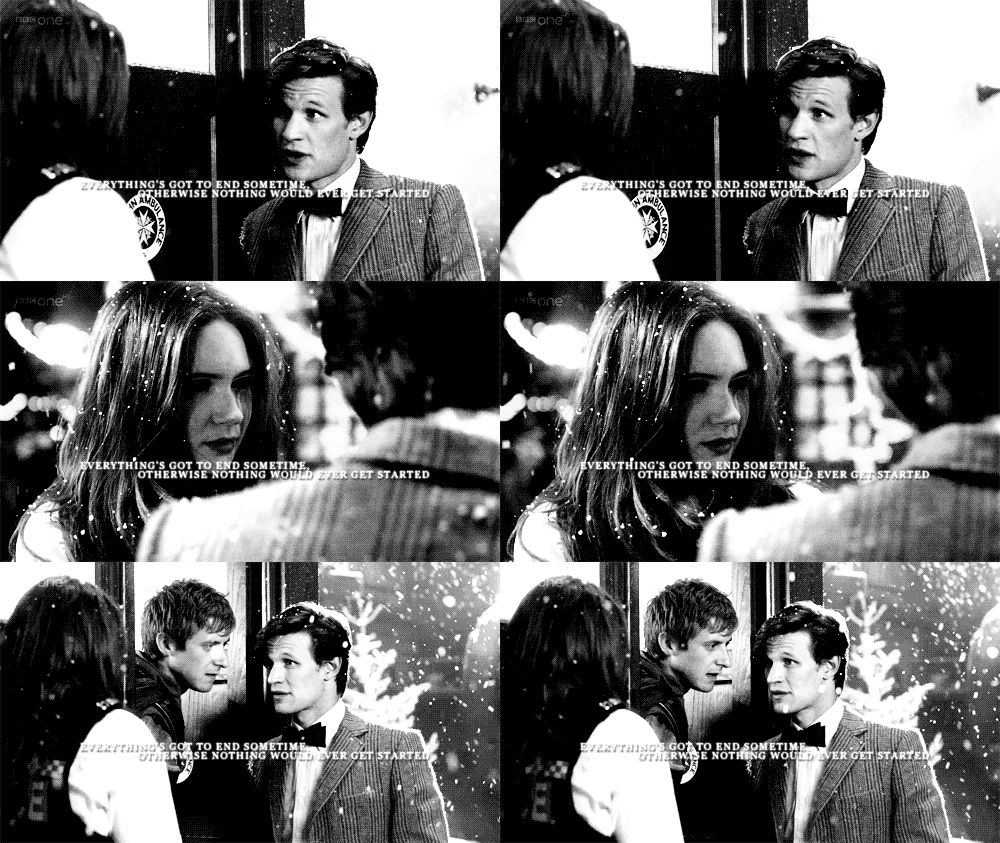
"Everything's got to end sometime. Otherwise, nothing would ever get started." -- Doctor Who


In case you are just tuning into this blog and don’t know me very well, let me introduce myself: I am Jenn. I am a writer. And I am very bad at saying goodbye. I talked about this quite extensively in my post “Endings And Beginnings (Why We Hate Them, But Why They’re Necessary),” in response to some fans’ reactions about Megan Ganz’s departure from Community (this blog is primarily dedicated to reviewing that show, so check more of it out if that interests you!). What I said in that post, I stand by wholeheartedly. I am VERY bad at saying goodbye to things and people that I love. I’m trying to get better – to reconcile myself to the idea of change, of newness, etc. – but it’s a process and I’m still finding my footing. Nevertheless, as someone who is quite comfort-zoned by nature, this isn’t easy or fun for me. But I’m learning. And nothing removes you from your comfort zone quite like bidding farewell to something or someone. If you couldn’t tell by the title of this post, today I’m saying goodbye to something that’s been rather near and dear to my heart over the past few months: The Lizzie Bennet Diaries.

But rather than write an essay-length post about what the show has meant to me (trust me, I’ll delve into that quite a bit in the coming paragraphs anyway), I thought I would speak to YOU all. To the people who created the show, starred in the show, and – yes – to you all, the loyal fans and viewers of the show. Because as much as we praise and celebrate the amazingly talented people who have made The Lizzie Bennet Diaries what it is, we too are a part of the experience. And each one of us contributed something to its existence.

So if you’re ready, grab some tissues (and maybe some Snickerdoodles or tea), and bid farewell to some of the most genuinely talented and immensely humble people I have had the pleasure of watching grow over the past year.


Sunday, March 24, 2013

4x07 "Economics of Marine Biology" (And The Verdict Is: Guilty Or Not?)


"Economics of Marine Biology"
Original Airdate: March 21, 2013

I’ve never really been a firm believer in the notion that first impressions make or break a relationship. To be quite frank, I don’t remember the moment I met most of the people I call my closest friends. It’s not that first impressions don’t have a significant impact on how you view someone short-term – they do, honestly. But I subscribe to the belief that how you treat someone long-term, how your relationship develops, and the memories you have after that are what you remember, more than that first encounter (unless you’re Lizzie Bennet or something, but that’s a whole other subject). The problem that even Lizzie Bennet has, and that we have as well, is reconciling the memory of our impressions of an individual with the current reality of who that person is. “Economics of Marine Biology” was actually about this topic, especially in our Pierce/Jeff storyline. Pierce, I am fairly certain, is about as beloved by fans as he is the actual study group. No one, really, tests Jeff’s nerves quite like the eldest member of the study group. But there’s a word that I came to associate with Pierce throughout the course of this episode that I usually do not: empathy. And this desire, this notion, to not only feel bad for Pierce but to want to HELP him is something that I – and Jeff Winger alike – was not used to, but something beautiful and tragic no less. Elsewhere this week, Troy and Shirley learn that the way they see themselves and one another needs a bit of refining. Troy’s always believed he can be the best at everything (to a fault), while Shirley always believes that she would choose the moral high road, no matter what. Dean Pelton and Annie also learn that their drives and desires can often lead them to compromise their character. The pair learns that their impressions of the value and worth of certain students and individuals (including Archie) greatly color their actions… for better or for worse. There’s, then, the focus on guilt – what happens when your actions harm you or those around you? And what, moreover, happens when you refuse to acknowledge the destruction you are causing?


Wednesday, March 20, 2013

4x06 "Advanced Documentary Filmmaking" (On Rebuilding Yourself)


"Advanced Documentary Filmmaking"
Original Airdate: March 14, 2013


Hey guys!  Obviously, I am not Jenn.  But I am her best friend, so that’s about the same thing.  I’m Jaime (@elspunko), known for my excessive use of capslock on Twitter and my occasional posts at Stories in the End.  Jenn’s a bit swamped this week, with a huge test for work and, like, staring at Jake Johnson’s face, so she asked me to fill in for her on this week’s Community review.  But enough about me, guys.  It’s time to learn about Changnesia.