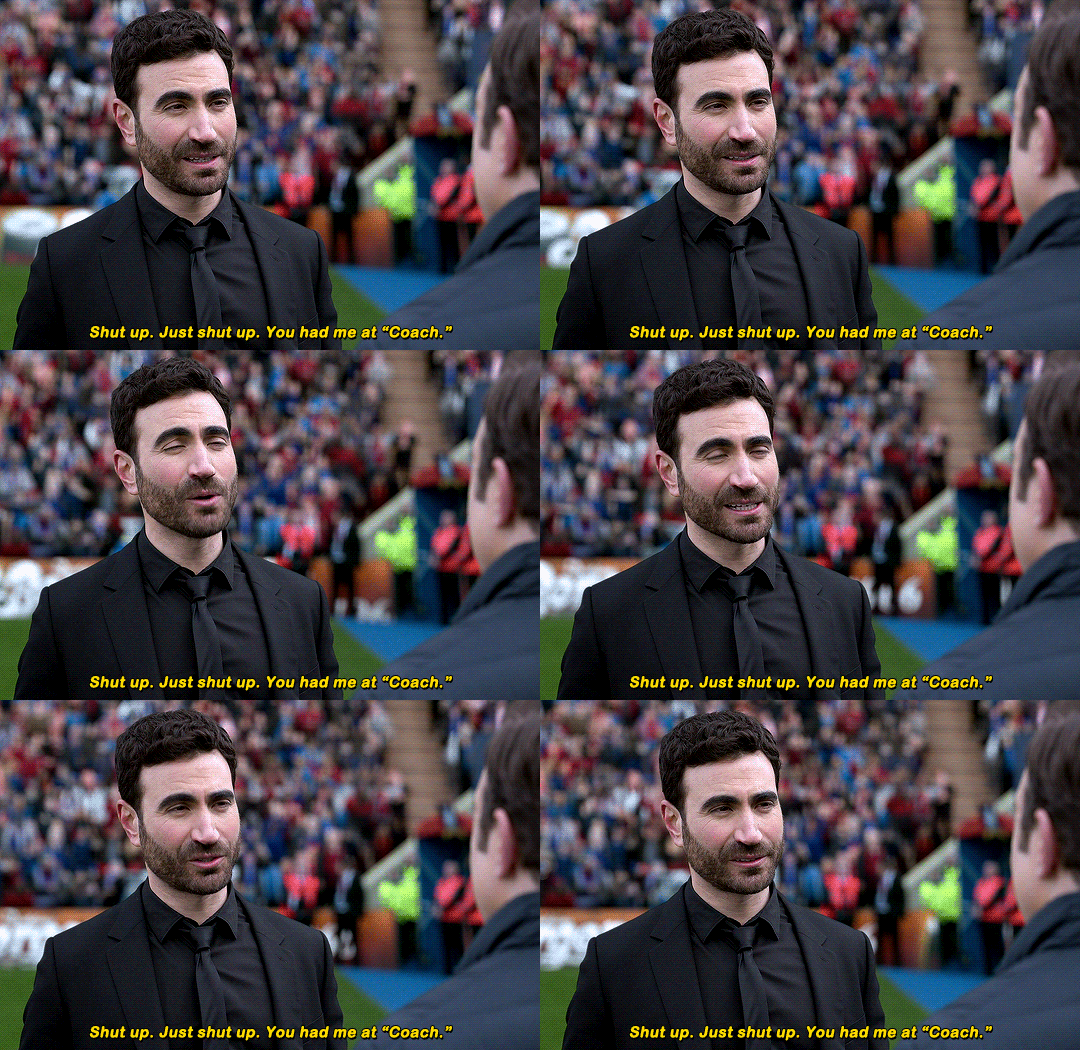
Ted Lasso, Rom-Coms, and Emotional Vulnerability

Why is it important that a show about men who play soccer did a rom-com homage?

Dickinson Behind-the-Scenes: An Interview With the Artisans

Meet the artists who brought the Apple TV+ series to life!

If You Like This, Watch That

Looking for a new TV series to watch? We recommend them based on your preference for musicals, ensemble shows, mysteries, and more!

Tuesday, March 19, 2019

Ask An Author: Night Music's Jenn Marie Thorne [Contributor: Megan Mann]


New York is a magical place. It's considered one of the most important food cities in America, it's home to Broadway, an inordinate amount of books, movies, and television series have been set there, it's a worldwide fashion capital and girls from around the world vie for a chance to be part of the city's illustrious ballet companies. It's also known as a city that embraces dreams and offers up a world of possibilities both large and small. If you can make it there, you can make it anywhere.

However, Cartier and caviar aren't the only things that New York is known for. As a mecca of American and global culture, New York is home to one of the most famous halls of classical music: Lincoln Center. Famed musicians and singers from around the world have graced its stage and wowed audiences for decades. But I bet you wouldn't expect that to be the subject of a YA novel, right?

The worlds of New York and classical music is, in fact, at the epicenter of Jenn Marie Thorne's newest release Night Music. Ruby Chertok is classical music royalty. Or at least her family is. Her mother is a world-renowned pianist, her dad is one of the most notable composers and conductors in modern classical music, her sister is a first chair violinist, her brother is a conductor and composer, and her oldest brother has always been incredibly gifted in terms of music. No matter how hard she tries, Ruby just doesn't feel like she belongs. She can play piano, but not as well as the rest of her family and she can't really compose. So where does this leave her?

In the summer of her contemplation — and eventual liberation from bottom of the totem pole to forging her own path — Ruby meets Oscar. He's an internet phenomenon that her father has personally brought to the Amberley School of Music to make his mentee. He sees potential for Oscar, but he also sees dollar signs and donations. Of course, Oscar doesn't know that he's being used as a pawn as he creates his first symphony because he's under so much pressure to succeed.

The pressure to find yourself not only in the classical music world, but in the world itself is at the heart of Night Music. Ruby is desperate to find her purpose while Oscar just wants to find his place in a world that doesn't accept who he is or who he loves. It's a dual coming-of-age story that explores the steps we need to take to figure out who we are and what we want out of life.

Luckily, I was able to talk to Jenn Marie Thorne about her lovely new novel.

Congratulations! Night Music is finally out there! How does it feel?


Jenn: It’s a little surreal! Night Music has had a long journey from initial idea to publication. My totally unscientific theory is that the longer you’ve worked on a book, the harder it is to let it go and hand it over to readers. But at the same time, the response has been really positive so far, and of course I’m proud to have it out there.

Classical music, whether it be through composing or performance, is an interesting choice for a YA story. What inspired that?


The first spark of the idea was actually for a fantasy novel, if you can believe it. I was interested in the idea of a non-magical person in a magical world with a sort of failed birthright falling for a very powerful magician. The idea kind of got stuck there until I realized why I’d come up with it in the first place, as a way of processing my own disappointment over not pursuing a career in music.

I’ve always loved classical music and studied classical voice for many years; but deep down, I always knew I didn’t have the natural ability that would enable me to really make a go of it. It’s hard to accept that the thing you love doesn’t fully love you back — but it does help to write a whole book about it!

What was the research like for this project? Did you go and experience the magic firsthand?


When I lived in New York, I spent a lot of time at Lincoln Center. I probably shouldn’t admit this, but my friends and I used to buy really cheap seats for the Metropolitan Opera, then sneak into empty seats in the front row during the first intermission. I did, of course, research the music world in more detail with the help of a few friends who are professional musicians. I must say, I’m desperate to get back to New York after spending so much time there in my imagination over the course of writing the book.

(Megan's note: I, too, have bought cheap seats and moved down during multiple Broadway shows. Broke, but cultured, you know?)

Music is also a huge part of NYC culture, especially the Met Opera and Lincoln Center, but are very rarely the center of the NYC story. Why do you feel that is?


Well, there’s a lot going on in New York, right? And much of it is probably more accessible than the classical music world. I think to people who aren’t avid fans, Lincoln Center can feel a little insular and off-putting. Another reason I think you don’t see music as a central theme as much as, say, ballet is that it’s really hard to write! There’s that old expression, “Writing about music is like dancing about architecture,” and I do think it presents a daunting challenge.

Something that's clear throughout the story is the difference between Ruby, Oscar, and Jules. Ruby has it all while Jules is struggling, but Jules is much more confident than Ruby. Oscar has all of the talent and charisma, while Ruby's family is a classical music legacy and she's extremely shy. Did you want to create those differences between the characters or was it organic?


I would love to say that I carefully planned and outlined each character to serve as a useful counterpoint to each other, but it was a happy accident in this case.

Funnily enough, Jules was the first fully-formed character that I got my head around, then the adult characters, then Oscar, and Ruby arrived last — probably because she’s the character who’s closest to myself and I’ve always found it excruciating to write about myself.

What wound up informing the confidence levels of each of the characters was their histories. Jules is essentially a foundling with a fantastic guardian, and as a result, she’s been able to bolster her confidence in a way that’s often a bit defensive. Oscar comes from a loving and supportive home, whereas Ruby’s upbringing has been extremely haphazard and left her feeling like an add-on who should just be grateful to be along for the ride.

Another thing I found interesting was Oscar pointing out that his talent, his love of classical music, and desire to be a composer made him the odd one out even more than his ethnicity did. Why do you think that is? Do you think there's a sort of racial bias in terms of classical music?


There’s an absolute racial bias in the classical music world, despite the prevalence of blind auditions today, and the problem starts early. Nonprofits like the Sphinx Organization and Castle of our Skins provide music education for Black and Latinx children and promote the work of Black musicians and composers, respectively. There’s a lot left to be done on a systemic level to acknowledge and address the diversity issue within classical music. That being said, I think anyone being raised outside of the classical music bubble with Oscar’s level of genius would feel like the odd man out.

There's a lot of mental struggle throughout the book. Ruby is constantly wondering what she can do to have an impact as she navigates moving out of her family's spotlight, while Oscar starts having dark days filled with panic attacks. I would say that most people in the arts are often riddled with anxiety. Did you want to highlight that for any particular reason?


Maybe this is my own personal lens, but it seems to me that anxiety is a huge issue for a lot of teens and adults that often isn’t explicitly portrayed in fiction, so in Night Music, I wanted Oscar and Ruby to deal with the pressures that have been placed on them in a way that to me felt authentic.

Okay! Now to the fun questions! If this were to become a movie, who would be in your dream cast?


I’m so bad at casting my main characters, because they are so particularly themselves in my brain that I have a hard time picturing someone new in the role. I’ve got some adults, though, for the supporting cast: Bryce Dallas Howard for Nora and Mandy Patinkin is Marty Chertok. This doesn’t often happen, but he was head-canon as Marty before I even started writing the book!

(Megan's note: Oh my GOD. I cannot unseen Mandy Patinkin as Marty. It's the most flawless casting.)

What was the writing process like?


Epic. I wrote a very quick rough draft before I moved to England, then almost completely rewrote it after moving to England. There was a lot of back and forth and incredible beta reader input and then one day, magically, it was in ARCs!

What did you listen to when you were writing this? (I think it would be hilarious if you had to write a novel entirely about music in complete silence!)


You’re not far off! I listened to classical music constantly while I wasn’t writing, especially the pieces featured in the story, but I am an extremely distractible person, so while I was doing the actual work, I needed silence or I would just, like, start singing opera and two hours would have passed with zero words written.

What would you like readers to take away from Night Music?


Your life is your own and it’s your one true art. Your worth is inherent, whether you’re gifted or not. Be kind, be brave, love wildly, and enjoy yourself.

And finally, what are you reading right now?


I’m finally reading Circe by Madeline Miller (who I went to high school with!) and it’s as incredible an achievement as everybody said.

Night Music (from Penguin Teen) hit shelves today! Make sure to pick up a copy for your spring break reading or for a lovely love story to devour in a weekend!  
Happy reading, friends!

Sunday, March 17, 2019

The Flash 5x16 Review: "Failure is an Orphan" (Things Happen!) [Contributor: Deborah MacArthur]


 "Failure is an Orphan"
Original Airdate: March 12, 2019

The main plot is back on The Flash, which means no more silly episodes about disappointing shark/gorilla battles that barely happen. Instead: Cicada! Dr. Ambres! Barry making questionable, but kind of nice, decisions! West-Allen Family Stuff!

Let’s go.

PERPETUAL CICADA


The episode begins with Nora in the future, where the still-caged Eobard Thawne is freaking out about timeline changes related to Cicada. Thawne pulls up a newspaper article on a confrontation between Cicada and Barry, assumed to be the last chance for Barry to use the cure on his foe. Nora claims she’s been trying to “engineer” such a moment the whole time she’s been in her past, which makes no sense since the cure’s only just been formulated. What would have been the point in getting Barry and Cicada to meet up without the cure? But whatever — turns out, a new timeline is trying to manifest, and the unpredictability of said timeline could ruin Thawne and Nora’s plans. Nora must ensure that Cicada is found before this new timeline comes along, and we have ourselves a ticking clock for the episode.

Nora is all-engines-go on the Cicada front, much to the annoyance of the rest of Team Flash — and the pride of Barry (which is adorable), until she turns on him and asks if he has his “convince Cicada to take the Metahuman Cure” speech down. Hey, Barry’s been ad-libbing inspiring speeches for five seasons now, I think he’s good. With the fun of watching his daughter organize the rest of the team thoroughly run out, Iris distracts Nora with a fake emergency at Jitters. Instead of a metahuman attack, it’s the reveal of an XS-themed coffee drink.

I’m actually really charmed by this little moment. It’s just a super cute West-Allen family moment without any drama or angst or secrets. Barry and Iris are just happy, proud parents who are thrilled to see their kid excited about something. The proud parents have also apparently been keeping a list of things they want to do as a family with Nora, including road trips, karaoke, teaching Nora to drive, and a Star Wars movie marathon. Adorable!

The adorable-ness is interrupted by an actual, not-a-distraction metahuman emergency, however. An acid-based meta is drinking chemicals in a college classroom. Weird, but we all have our quirks. After Barry uses his science knowledge to briefly neutralize the acid man, Nora notices the acid burn patterns and recognizes them as the same ones in the future picture of Barry battling Cicada. Surprisingly, Nora doesn’t withhold this information and just straight-up tells Barry that he’s going to confront Cicada later.

This knowledge puts Nora even further into a frenzy over the Cicada thing. Since Barry’s still trying to figure out how he’s going to talk Cicada into taking the metahuman cure, Nora tries inspiring him with some direct quotes from his history of big, heartfelt speeches to villains. The sticking point in the case of Cicada, though, is the fact that Orlin Dwyer doesn’t actually care if he lives or dies, and Barry doesn’t know how to appeal to that kind of mindset.

Whether Barry is ready or not, the time to meet with Cicada has come. Killer Frost helps pull a little switcheroo when Cicada chases the acid meta from earlier into an alley, safely depositing Acid Master into a cell while she freezes Cicada’s dagger to a wall and uses a breaching device to skedaddle. I think it probably would’ve been a wiser plan to breach the knife out with you, KF, but you go ahead. The Flash shows up to talk Cicada into taking the cure, but since we’re only twenty minutes into the episode at this point, it goes poorly.

With the failure to get through to Cicada weighing on Barry, it’s time for Joe to provide a classic pep talk that basically boils down to “appeal to Cicada as Barry Allen, not as the Flash, since Cicada hates the Flash and stuff.” Good advice, Joe. In exchange for this good advice, Barry gives some advice of his own to Joe regarding his little subplot with Cecile stealing his thunder with her lie-detector powers during the interrogation of Dr. Ambres. Man, this episode is really nailing the West-Allen family interactions. Case in point: the next scene’s little moment between Iris and Nora, in which Iris confesses she’s pushing that whole list thing on Nora because she wants to get as much out of her time with her daughter as she can. Aww!

Bolstered by his chat with Barry, Joe apologizes to Cecile and they tackle the case of Dr. Ambres together. They manage to figure out a motivation for siding with Cicada (the doctor’s fiancé was killed by metahumans during the Zoom season) but even the Joe-Cecile interrogation tag-team isn’t enough to jar Ambres from her hesitation to help. She says that CCPD’s two choices are “kill [Orlin]” or “put [Orlin] in jail” and… uh, does the good doc not realize that murder, regardless of the murderer’s feelings on dark matter, is a jailable offense?

Bizarrely, neither Joe nor Cecile bring this up, instead choosing to reveal the creation of a metahuman cure as a way to “save” Orlin’s life. After Ambres agrees she’ll try to get Orlin to cooperate, Cecile senses she’s hiding something else, and Dr. Ambres reveals that Orlin’s niece, Grace, is a meta! Dun dun duuu— wait, the audience already knew that.

After a brief meeting with Team Flash, Barry reiterates that he’ll be confronting Cicada as Barry instead of the Flash. When the time comes, I gotta admit — as stupid as the whole “just talk to the maniacal serial killer” plan sounds on paper, Barry delivers a pretty fine speech. Mostly, it’s about how Orlin’s choices, should he continue his vendetta as Cicada, are limited: he can adhere to his anti-meta plan and kill Grace, who is a meta, or he can let her live and force her to grow up in a world where she’s terrified of the murderer killing people like her. Barry draws on his (admittedly strange) experience as a father to relate to Orlin on a human level, even unmasking to show how serious he is about just wanting Orlin to try the cure. I notice the continued failure to mention that Orlin has to go to jail.

Oh hey, I spoke too soon. During Orlin’s agreed neutralization/surgery (on account of his sucking chest wound opening up when his powers are gone) Joe mentions he’s going to jail for a long, long time. Thank goodness someone on this show is finally being logical. Unfortunately, before Orlin can be sutured up by Dr. Ambres and shipped off to jail, the power goes out and a new Cicada leaps through the S.T.A.R. Labs window. Caitlin quickly freezes Orlin’s wound (not sure that’d work, but fine) and Dr. Ambres skedaddles with her patient while Team Flash confronts Cicada II: Destructive Boogaloo.

The power outage means Dr. Ambres is too slow to get out out of dodge, so when Cicada II shows up to steal the still-unconscious Orlin, things do not go well. The doctor begs for her life, but Cicada II stabs her with the newly-empowered Cicada dagger anyway. It’s revealed at the end of the episode that this new Cicada is a future version of Grace (which pretty much everyone saw coming), but I don’t really get why Grace would stab the only friend and ally her uncle had throughout the whole Cicada ordeal. Maybe the glowing head wound made her crazy?

Other Things:

  • “You two did this.” “You made her.” “You’re responsible.” Hee.
  • Hey, if Team Flash spritzed the meta-tech devices like Cicada’s dagger with the cure, would it neutralize the dark matter?

Grey’s Anatomy 15x17 Review: “And Dream of Sheep” (Erratic Behavior) [Contributor: Julia Siegel]


“And Dream of Sheep”
Original Airdate: March 14, 2019

This episode is brought to you by a delusional doctor and his nowhere near approved baby in a bag idea. Dr. DeLuca Sr. is off the rails and causing problems left and right, yet his own son is still blind to the truth. Things quickly go from bad to worse, leading to bad blood between family members. Mental illness is at the forefront at the episode, including looking at Helen Karev and Bailey’s statuses. Elsewhere, could romance be budding for two doctors who have both experienced loss?

BREACH OF PROTOCOL


A majority of the episode is dedicated to the DeLuca family science project of growing fetal lambs in bags. Yes, you read that right. If this sounds crazy to you, make sure you go rewatch the previous episode before watching this one. DeLuca Sr. is moving at a fast and furious pace to show that his idea is functional. Carina still doesn’t believe that her father is mentally stable enough to be running the research project and continues to voice her concerns to whoever is willing to listen. DeLuca Sr. proves his daughter’s point when he verbally attacks her after they lose one of their two baby lambs just a few days into the study. It is clear that DeLuca Sr.’s emotions change abruptly and that he is outwardly displaying signs of bipolar disorder, but Andrew won’t open his eyes to the truth and protects his father.

DeLuca Sr. kicks Carina off the study and goes back to work like nothing ever happened. Elsewhere in the hospital, a married couple is brought to the ER with injuries from a car accident. The woman is five months pregnant and happens to be Teddy’s patient. Owen tells Teddy that he is willing to work on the woman and she can take the man since the case might get tough. Teddy denies Owen’s cautions and runs full steam ahead on her patient, who is suffering from bleeding in her abdomen. Tests show that one of the woman’s uterine arteries is bleeding, and Teddy knows that there is a possibility that the baby might not survive. News travels around the hospital quickly, and Andrew accidentally spills the beans to his father, who quickly makes his way to the woman’s bedside.

Alex, Carina, and Andrew arrive right as DeLuca Sr. finishes his pitch to the parents-to-be to let him save their baby with his revolutionary sack, which is nowhere near being ready for human trials, let alone FDA approval. All of the doctors involved are beyond upset that DeLuca Sr. is giving the couple false hope when he knows that they cannot legally or ethically experiment on the baby. DeLuca Sr. begs Alex to let him save the life of the baby, and Alex does the right thing by shutting him down and not allowing him to play mad scientist with a fetus. The woman continues to go downhill and loses the baby when surgery becomes the only option.

DeLuca Sr. can’t believe that Alex wouldn’t give him the chance to save the baby and goes into another verbal attack. Alex shuts down the study, and DeLuca Sr. decides to leave and take his work back to Italy. Through all the chaos, Andrew finally sees how unstable and unhinged his father has become. He realizes that he should have stuck by his sister and believed her claims. It’s a little late for Andrew to come to the obvious conclusions, as he has strained his relationships with his father, sister, and Meredith in the process. Andrew’s behavior about the study and his father has left Meredith with a stale taste in her mouth, and this new relationship may be coming to a close before it even begins. Honestly, it’s good that Meredith is seeing that Andrew isn’t mature enough to handle a relationship with her now before they get too serious, because there’s no way that it could ever work out long term.

ADMITTING ONE'S PROBLEMS


Mental illness is discussed thoroughly throughout the episode not only with DeLuca Sr., but also with Helen and Bailey. Helen has been staying with Alex and Jo for a week now and extended her trip to stay longer. Alex is very happy that his mother has been doing so well, given that she is in a strange place and outside of her normal routine. He truly believes that she has made a lot of progress and has gotten better. Bailey runs into Helen in the hospital cafeteria and has a conversation with her about her trip. Helen admits that even though she is having a great time in Seattle, she is very nervous about her return trip home. She isn’t sure whether she can do the reverse trip, which is why she has extended her trip without setting a date to leave.

Bailey tells Alex about her conversation with his mother to let him know that she isn’t comfortable asking for help. Alex takes the news the wrong way and accuses Bailey of being prejudiced towards mentally ill people. Bailey firmly reminds Alex that she is a person living with mental illness and that even though one may seem all together, it can be very difficult to ask for and accept help from others. Bailey rips him a new one until Alex understands her point. At the end of the episode, Alex asks Bailey to take back the chief job for two days, that way he can travel to Iowa with his mom. Bailey accepts and is happy that they are on the same page again.

FINDING YOUR ROOTS


While Alex struggles to understand his mother, Jo wants to dig deeper into her family tree. The results from her genetic testing are in, and Jo asks Maggie for support since they are both adopted. Maggie is happy to lend a hand to Jo and reads the DNA report for her. Jo is happy that she has nothing scary hidden in her genes, and Maggie tells her that she should continue to look for more if she really wants to. Jo asks intern Parker if he would be able to find her potential cousin, who is listed on the genetic testing report as a near-certain match, and he is more than happy to look into it for her.

The search leads Jo to wonder whether she should try and find out who her birth mother is. She takes it as a sign that she should find the truth when she encounters Maggie taping a segment for a local TV morning news show about how she came to learn about her famous surgeon parents. Jackson tells Jo not to be fooled by the process because it might not be all sunshine and rainbows. He tells her about how he met his birth father a few years ago and how much of a disaster that was. His warning seems to sink in, but Jo decides to ask Parker to widen the search to find her birth mother. Parker tells her that he was curious on his own and already found her. It turns out that Jo’s mother is living in Pittsburgh, so the Karevs might be taking a trip to Pennsylvania in the near future.

MEDICAL CONFERENCE GETAWAY


In the comedic relief side plot, Amelia and Link find themselves continuously bumping into each other when they attend the same medical conference on alternate pain relief. The chemistry that first started to appear a few episodes back during the opioid overdose crisis takes center stage, with both characters realizing their awkward tension quickly. Amelia tries to avoid Link, yet fate keeps pushing them together. She eventually gives up and decides to go to Link’s lecture, which he tells her might not be the best idea. He was right, as Amelia leaves quickly when she hears him talk about prescribing opioids to a teen athlete years ago, who later died from a car accident while under the influence.

Link catches up with her later to fully explain that she missed the good part of the lecture and didn’t hear him talk about how he has been fighting since then for better opioid reform to prevent addiction and death. Amelia is surprised to hear Link’s views and decides that he isn’t so bad after all. Link proposes that they tackle the problem together, since they both have a personal stake in it. They start their partnership by engaging in some “alternative pain relief” with no strings attached, but I think we all know that this isn’t a one-time fling.

Friday, March 15, 2019

Blindspot 4x15 Review: "Frequently Recurring Struggle for Existence" (The Problem is the Solution) [Contribtor: Jen]


"Frequently Recurring Struggle for Existence"
Original Airdate: March 15, 2019

Jane comes face-to-face with her Remi past in "Frequently Recurring Struggle for Existence."

CASE OF THE WEEK


The team is notified of an armored truck robbery and matches the serial number on whatever was stolen to Jane's Hermes tattoo. The company that owns the truck will not reveal what was stolen. However, they are a weapons developer and defense contractor so whatever was stolen can't be good.

Patterson finds puzzle pieces in the numbers and the image matches the computer chip tattoo. The "I" in ASiA is the only letter that's not capitalized in the tattoo. "Si" is silicon on the periodic table. Silicon is a semi-conducter used in computer chips. Rich realizes the Hermes tattoo is actually Mercury (same God, different name). If you add their two periodic table numbers of mercury and silicon it equals 94. The periodic number for plutonium.

Whoever robbed that truck stole plutonium for a nuke. Well... crap.

The team brings in David Kirkpatrick of the Defense Intelligence Agency, and he is an expert at nuclear weaponry and tech. Do you know how many times we've done nuclear bombs on this show and we're only meeting this dude now?

One of the robbers is someone David Kirkpatrick has been trying to catch for many years — Greta Smalls. She sets up a meet with Russian mobsters on the dark web to buy an explosive device for her newly-acquired the plutonium. Patterson and Kirkpatrick pose as Greta and her unknown partner to "buy" the explosive device off the Russian mobsters. The mobsters get arrested by the FBI. However, Kurt and Jane are on the next floor up pretending to work for the Russian mobsters and sell the explosive device to Greta and her partner.

The unknown partner turns out to be Cameron Gibbs who goes way back with Remi. Gibbs was an army pencil pusher Remi befriended, so she could steal his ID badge to obtain necessary files for Sandstorm. The army accused Gibbs of stealing files and dishonorably discharged him. He was so angry at the army for discharging him when he was innocent that Remi groomed him for Sandstorm. She turned him into a murderer.

Talk about your chickens coming home to roost.

Kirkpatrick is a rambling idiot in the field. He unfortunately cannot deactivate the device and keep the tracker on it because I don't know why. Honestly, he was pretty useless. Why did we need this character? Haven't Kurt, Jane, and Patterson deactivated enough nuclear devices by now to be experts in the field?

Gibbs is going to kill Weller because that's how Remi trained him, but he can't kill Jane because he cares too much about her. He locks her in a stairwell and of course Jane's radio to Weller stops working. This is Kurt Weller we're talking about though and a simple goon with a gun isn't taking him down. He stops Greta and she gives up the meet location — an event honoring the military. The man who signed Gibbs' discharge papers will be there. Kirkpatrick may have deactivated the device, but Gibbs still has the plutonium and will make a dirty bomb instead.

Jane confronts Gibbs and tries to stop him by telling the truth. She confesses she is the person who ruined his life and not the army. She tells Gibbs he can learn to be better like she has. Unfortunately, Gibbs decides the best way to hurt Remi is to blow up all the innocent people she's trying to save. Kurt shoots him before Gibbs has a chance to detonate the dirty bomb.

TEAM BLINDSPOT


Blindspot can be kind of heavy at times, so they try to inject some ridiculous scenarios and humor via the character of Rich Dotcom. This week Rich has created a "Tattoo Squad" board game. He's made Team Blindspot into game pieces and unveils it as a celebration for Jane and Tasha's return from the dark side.

Jane loves the sentiment behind it and while the rest of the team groans their way through the presentation, she is really supportive. Jane appreciates the levity Rich brings to her life and their relationship is really one of the sweeter pairings on the show. It is hilarious when Rich hands Jane his game piece because he insists on being Jane.

The team reactions are all on point. Tasha barely registers what Rich did, Reade is just irritated, but Kurt is ticked off his game piece is a lot shorter than Patterson's, which is absolutely on brand for Weller. Patterson takes the game seriously and is annoyed the face on her game piece is half melted off. Rich produces an unblemished mini Patterson at the end of the episode while the two play the game. Now I just need these two to move into a nursing home together in their old age.

Keaton wakes up from his coma and tells Tasha where to find a zip drive which contains a detailed record of everything he had her do. The zip drive will clear Tasha's name, but not Keaton. He takes the fall for most of her behavior, even though it was Tasha choosing to go rogue. She refuses to let Keaton take the blame and searches for a way to exonerate them both.

Keaton admits he didn't loop Reade in because he knew he'd talk Tasha out of the undercover job. I agree with Keaton. Deep down Reade knows he carries a lot of sway with Tasha, even though he argues she never listens to anyone. Reade is more angry with himself than he is Tasha because he knows at multiple points in this road he could have stopped her if he just said something. Of course, this doesn't spur him to be honest about his feelings because it's not the season finale yet.

KURT AND JANE


The mysterious key Shepherd left Jane leads to an old Sandstorm hideout. The FBI collect everything there and bring it to headquarters. It's basically a "Remi, here is your life" bonanza. Shepherd collected and stored things she knew were meaningful to Remi. Jane finds a blanket and is so overwhelmed, she runs out of the room.

At first I thought the blanket had something to do with her daughter, but Jane tells Kurt a story about curling up in bed in that blanket with Shepherd once on a cold morning. Cuddling was something Shepherd wasn't known for and this brief moment of affection was one of the happiest moments in Remi's life. Jane thinks Shepherd was planning to use the hideout as a recovery room to reawaken Jane's memories and turn her into Remi again.

Her parents were murdered in front of her and she was raised by a terrorist so we're definitely grading on a curve in terms of happiness. This blanket is a brief moment of joy in a life filled with pain. Remi was starved for love. It's one of the ways Shepherd controlled her because deep down, Remi wasn't a killer. She had a good heart that just needed to be reawakened with some love and affection. (Thank you, Kurt Weller).
Jane: I'm so tired, Kurt. I'm tired of fighting. I'm tired of trying... tired of remembering. I just wanna forget.
Between the overwhelming memories from the Sandstorm hideout and her confrontation with Cameron Gibbs, Jane is at her emotional limit with all the Remi stuff. We've listened to Jane wish for her memories back countless times, but this is the first episode she wishes she could just forget everything again.

I'm always down for Kurt comforting Jane, but honestly his approach needs some work. Kurt tries to rationalize everything Remi did by always telling Jane that it wasn't her. Except, it was her. He may not want to admit it, but now that Jane has her memories back Remi is part of her. It's a side she cannot ignore.

Jane: If I don't start taking responsibility for the things Remi did, I don't know what's going to happen to me.

Jane tells Gibbs she was his problem and his solution. It's the same with Jane. Remi is her problem and her solution. The only way Jane is going to come to terms with all the things Remi has done is by taking responsibility. All the lies and cover ups have to stop. Telling Gibbs the truth was dangerous, but also necessary. It doesn't mean every time Jane accepts responsibility for Remi she'll get a happy ending or being able to fix the destruction she caused. Cameron Gibbs is a perfect example of this.

However, it was an important step for Jane because she faced what she did. As much as she wants to disassociate from Remi and pretend she has nothing to do with who Jane is (like Kurt says), that would be a lie. If Jane is going to survive, if her relationship with Kurt is going to survive, she cannot live any more lies. She has to stand in the truth. This is only way she'll truly be free from Shepherd and Sandstorm. Facing Remi everyday is the only way Jane can earn redemption and hopefully forgive herself someday.

Stray Thoughts:

  • Reade tells Zapata to lean on the team, but we all know she just wants to lean on him. Get it girl.
  • Kurt, Dave, and Reade talking about Ghost Protocol and Tom Cruise was so funny.
  • It low key ticks me off whenever Kurt tries to argue Jane isn't Remi. He doesn't have to love who Remi was, but he has to accept her. This isn't a split personality disorder. Remi is every bit a part of Kurt's wife as Jane is.

Monday, March 11, 2019

The Flash 5x15 Review: "King Shark vs. Gorilla Grodd" (All Talk, No Versus) [Contributor: Deborah MacArthur]


"King Shark vs. Gorilla Grodd"
Original Airdate: March 5, 2019

Anyone who’s read my reviews knows that I love when The Flash goes Comic Book Stupid. Regular stupid, where the characters act like idiots or the plot makes no sense? Bad. Comic Book Stupid, where angry man-sharks battle it out with psychic genius gorillas? Excellent. This is the kind of nonsense I watch for, so you can guess how thrilled I was to read the title of this week’s episode.

And you can guess how disappointed I was when the episode actually aired. Honestly, The Flash, what is it with you getting my hopes up with cool episode titles and then dashing them? First “Gorilla Warfare” and now this.

SOMETHING’S FISHY


Team Flash officially has a metahuman cure. All they need to finalize their breakthrough is a volunteer to test whether it works or not, but of course most metahumans they’ve encountered in Central City would have no interest in getting rid of their powers. But, uh... really? No villains in Iron Heights who might want to be able to transfer to a regular prison rather than spending life in a cell for bank robbery and jewel heists? Just thinking back to the villains on the show, I’m sure some of them wouldn’t mind getting rid of dark matter. Did you ask Norvock? ‘Cause that guy has a snake in his head and I know if I had a snake inside my head I’d want to get rid of it.

But alas, the only person Barry has in mind is King Shark. I guess that makes sense. Not many people want to be a giant angry fish. So Team Flash plays a visit to Lyla (still bitter about that time Barry erased her baby, by the way) and Lyla directs them to the ARGUS-sponsored King Shark rehabilitation lagoon run by Tanya, the wife of King Shark’s former human self, Shay Lamden. Well. One of them is from a different Earth, so they’re not technically married, but I guess Tanya and Shay are similar enough that there are still feelings there. She communicates with King Shark via a mental amplification system like the one Team Flash developed to help Cecile with her psychic powers and help Caitlin communicate with Killer Frost.

That connection between the Lamdens despite one being a fish man is, by the way, the primary emotional weight of the episode. That’s right: the title promised me Megashark vs. Super-Gorilla and delivered The Shape of Water. Which is fine if you’re into romantic dramas between a woman and a fish man, but I’m into ridiculous comic book monsters punching and/or biting each other, dag nabbit, so I’m miffed.

Anyway, King Shark gets turned back into Shay fifteen minutes into the episode. Barry stabs him with the antidote to save Cisco from being eaten, which causes something of a rift between Cisco, Caitlin, and Barry since they promised the antidote would only ever be used on people who volunteer.

Okay, let me rant about this “the antidote can only be voluntary” deal real quick. First, Barry’s decision to use the antidote against King Shark was correct. It just was. The show trying to frame Barry as anything other than correct makes Cisco and Caitlin look comically naive. King Shark was rampaging (for reasons we’ll get into later), he was hardly in a state to be reasoned with, and Cisco was about to get eaten. Barry couldn’t use his powers against King Shark without putting Cisco at risk and he couldn’t let King Shark eat his best friend, but there wasn’t enough time to think up something clever to subdue the enemy and get Cisco out of danger. So he used the antidote. He was right.

Second — and I’ve raised this before — how is it better to throw metahuman villains in jail forever than it is to give them the antidote and allow them to serve out a basic prison sentence? Because the metahumans who go into Iron Heights do not come out. They can’t come out. There’s no rehabilitation program for them and they’re too unpredictable and difficult to re-capture, so once they’ve behind power-dampening bars, they have to be there forever. The argument that keeping their powers is more morally just than simply dosing them and letting them live their lives outside of a prison cell is ridiculous and the only reason the show keeps bringing it up is to sow manufactured drama where there just isn’t any.

Rant over. Moving on, Barry’s (unnecessary) apology to Caitlin and Cisco about giving King Shark the cure is interrupted when the two suddenly turn on him. Cisco gets zipped into a holding cell, which give Caitlin time to hand the Lamdens’ mental amplifier over to — dun, dun, DUN! — Gorilla Grodd! And, uh, if Gorilla Grodd’s sudden presence in Central City was ever explained this season, I’ve forgotten it. He’s just here now.

Gorilla Grodd uses the psychic crown device to stretch his mind control powers across Central City, thus becoming a near-unstoppable villain. But wait! After some reconciliation between Shay and Tanya, now’s the perfect time for Shay to do a typical self-sacrifice and turn back into King Shark. Grodd can’t control King Shark. Yes, he caused King Shark to go berserk at the beginning of the episode, but that was due to the psychic crown (probably). Shay will just turn back into a shark, somehow keep his human consciousness despite not having the crown that helped him control his animal impulses, and give the audience the King Shark vs. Gorilla Grodd battle the episode’s title promised. It’s... fine? It lasts like a minute or two. The CGI is cool.

Once the battle is done, King Shark is stuck as a shark but I think he and Tanya are still a thing? Uh... anyway, Team Flash doesn’t even try to use the antidote on him again because, somehow, Caitlin knows that the antidote only works once despite never using it on anyone before. Hey, aren’t these people supposed to be scientists? Doesn’t some level of trial and error come with that label? The etymological root of trial is TO TRY, people.

Whatever. Barry, feeling (unwarranted) guilt over his (totally warranted) decision to give King Shark the antidote, comes up with the team’s next outrageous plan: offer the metahuman cure up to Cicada. The insane serial killer, Cicada.

Sigh. Yeah, remember in the first paragraph of this review where I outlined the difference between regular stupid and Comic Book Stupid? We’re in the former more than the latter.

Other Things:

  • Holy moly, Iris was so separated from the main plot that I just realized I didn’t mention her at all. Here we go: Iris is scared of going to her office because of the horror stories she heard from Nora about Cicada killing her, or friends and family, over and over again during last episode’s time loop. Jesse L. Martin is (thankfully!) back, so the episode uses this as an opportunity for Iris and Joe to get father/daughter bonding in. I love the both of them. I wish they’d gotten to do more.
  • Did anyone else think it was really bizarre when Tanya made up a bunch of stuff to get King Shark to take the antidote at the start of the episode? Like implying the antidote would work especially well on fish people?
  • Who made King Shark’s giant cargo pants?

Friday, March 8, 2019

Blindspot 4x14 Review: "The Big Blast From The Past Episode" (Welcome Home, Zapata) [Contributor: Jen]


"The Big Blast From the Past Episode"
Original Airdate: March 8, 2019

Let's just ignore the one year time difference between my last Blindspot review and this one. Sorry guys! I am back, miraculously unspoiled, and binging the rest of season four so we can close out this show's fifth and final season together. "The Big Blast From The Past Episode" is a lot about bombs (always with the bombs) and officially welcoming Zapata back to the team after her rogue mission to take down Madeline Burke. Also, Kurt and Jane decide after eighty episodes it's a bad idea for them to lie to each other. YA THINK?

CASE OF THE WEEK


The case of the week revolves around a case Team Blindspot solved two years ago when Reade was assistant director and corrupt Eleanor Hirst was running the show. Jane had disappeared, Kurt was searching for her, and Patterson was developing her wizard game. I am extremely glad we missed out on the majority of this team timeline because it's a low point in the show. Jane leaving Kurt, her missing daughter, all the lies Jeller told, and the cheating can stay in the past where it belongs. Let us never speak of it again.

Someone is setting off bombs in New York City because the team convicted the wrong person for the  Williamsburg bombings. The new bomber will continue wreaking havoc until the FBI confesses to framing Lily Terrace. Anyone else thinks it's a little wonky to prove someone is not a bomber by bombing? That's criminals for you, I guess.

First, a little background on the case: Lily's family owned a mom and pop grocery shop until Swift Shop, the Blindspot version of Instacart, put them out of business. Lily bombed customers who once purchased from the family grocery store but then switched to Swift Shop. Her mother was dying of cancer and they were essentially going out of business. So Lily embraced the rage.

The problem is the FBI only had circumstantial evidence against Lily. This is the first case they brought Rich in to help and he found doorbell camera footage of Lily delivering the bomb. However, Patterson discovers the footage was doctored. The date stamp was changed to put Lily there at the time of the bombing, but in reality she was just delivering groceries. The fact Patterson cannot be fooled is why she the Han Solo to Rich's Chewie.

Before we get into the doctored footage, we need to discuss the massive Fifth Amendment violations in this episode. They are enormously egregious and it took me right out of the episode. Lily immediately asks for her lawyer, but Kurt and Zapata continue to question her. Zapata coerces Lily into confessing by telling her Reade will make sure she can be at her mother's deathbed.

FIRST OF ALL, the minute a suspect asks for an attorney, the interview is done. Finished. Do not pass "go." Anything the agents ask after that moment is inadmissible.

If Lily voluntarily restarted the conversation without prompting then Kurt and Zapata could have started questioning her again. Suspects can make basic requests  such as for food or using the bathroom  but the minute he/she starts discussing the crime voluntarily, the police can begin questioning again. However, all the suspect has to do to stop the questioning is reassert their right to remain silent and ask for an attorney. Then it's game over again for the cops. Is everyone very clear on Miranda rights now? THIS IS IMPORTANT.  If you are ever arrested, zip it and wait for your lawyer.

Lily asks for a lawyer. Zapata and Kurt want to chat while they wait. Lily reiterates she won't answer any of their questions. Zapata and Kurt continue to question her. Then Zapata tells Lily she will never see her mother again unless she confesses.

This entire scene is ludicrous. Forget about the doctored tape: there isn't a judge on the planet that would allow this confession into evidence. Lily asked for a lawyer, reiterated her right to remain silent, and they kept asking questions! Hirst remarks while watching the interrogation that it's borderline coercion. It isn't borderline anything. IT'S COERCION.

I hate it when Blindspot expects us to be stupid in order for a plot to work. Don't be stupid, my friends. Know your rights.

The team members are idiots in the episode too. The only team members who could have doctored the footage are Reade, Zapata, Hirst, Stuart and Weitz. Gee, I wonder who it could be? First, they accuse Rich of doctoring the tape so he could get a job at the FBI. Sure, because the FBI typically offers employment to convicted criminals for helping them. ARE YOU KIDDING ME? I was righteously indignant on Rich's behalf. He's earned more loyalty than this.

They settle on Stuart (the dead man), but wrack their brains to figure out who could have helped him. It couldn't be the acting director of the FBI, who was a U.S. attorney at the time, and completely  morally repugnant? I just want to smack everyone in this episode. I'm gone for a year and they turn stupid on me.

Of course, it was Weitz; and the length of time it takes Kurt and Jane to figure this out is just embarrassing. He has to go to Eleanor Hirst (another blast from the past) and make a deal to obtain completely obvious information. Stuart confessed to Hirst that Weitz convinced him to doctor the footage, so there was evidence to go with the completely illegal confession. Kurt gets Hirst some more comfortable accommodations and she tells him about Weitz. Kurt Weller, why are you a dummy?

As far as a suspect for the new bomber goes, the team decides it is Lily's father, Albert Terrace. He's a science teacher and some chemicals that can be used to make a bomb are missing from the school pool. It's the investigate equivalent of "TA-DA!"

Weitz refuses to admit to the doctored footage publicly despite Reade's protests. Albert Terrace ends up in a stand off with local police. Weitz has him killed by a drone rather than risk the team in an attempt to arrest him.

Kurt and Jane are horrified at this decision, but Reade and Zapata are fine using the drone. Umm... okay? So, the FBI is just going to kill people they suspect of murder without the bother of due process? YIKES. This episode is wildly disconcerting in terms of defendant's rights. There's a reason we have a trials, people!

Everyone believes Lily is guilty because of the signed confessions regardless of the doctored footage. Sure, because innocent people never confess to crimes they didn't commit. Has anyone on this show ever watched Dateline? Good grief. Regardless of Lily's guilt or innocence, the new bomber is right. Team Blindspot did not obtain her conviction legally.

No one arrests Albert Terrace either. No one asks him any questions or even puts eyes on the man. He's just blown up in a house by a drone.

Jane shakes her fist at the sky because "government corruption!" and rails about this behavior being the reason she was loyal to her kooky mother and Sandstorm. Jane makes some good points but on the other hand, most people don't join terrorist groups when the government breaks the law. We're bouncing from one extreme to the next. For the love of all that is holy, can someone find the middle ground? That's where the sane people live.

Weitz receives a phone call from the real bomber. No, it wasn't Albert Terrace after all. He was just a patsy Madeline Burke's henchman Dominic Masters set up. Now Dominic has something to hold over Weitz and will be expecting favors in return. Honestly, Weitz is the worst and already corrupt. They really didn't need to go through this whole bombing escapade to get him to work for Madeline Burke.

TEAM BLINDSPOT


Zapata is back, but is she really? There was tension between her and Reade before she left and there's tension now that she's back. Zapata left for the CIA because Reade didn't have trust in his team and was holding her back from the field. He also refused to admit he was in love with her.

Reade wouldn't give Zapata a reason to stay even when she asked for one because he knew she was unhappy and didn't want to hold her back. At least they are consistently idiotic in their personal life as well as their professional lives. If we're doing stupid then let's just be stupid across the board.

The two admit they are not good at discussing their feelings. This is like saying I'm not good at nuclear physics. Reade wonders if Tasha would've stayed if he had asked her too. Yes, you moron, because she's in love with you and you're in love with her. None of you are allowed to make decisions without me because you're terrible at it.

Tasha said it would've made a difference in the moment (that's code for Jennifer is right) but she would have ended up at the CIA eventually because she's all dark and twisty. Well, that was about twenty seconds of honesty before we landed right back in Idiotville. I understand this is where Zapata and Reade are most comfortable. They've put down roots there, but I'd like to move them to Deliriously Happyville.

Reade ultimately welcomes Zapata back to the team with no grudges, and promises to have her back with the CIA. It's a small step on their road to reunion, but it is better than nothing.

KURT AND JANE


How did Kurt and Jane become the anchor couple on Blindspot? When did that happen? I should just stop asking questions and take the win. They play marriage counselor for Reade and Zapata most of the episode. Kurt tells Reade to stop pouting and decide whether Tasha is part of the team or not. I'm always here for Kurt telling Reade he's being a pain because it is his usual M.O. and it's exhausting.

Zapata is really sad she doesn't have a locker anymore and it's the cutest, which launches Jane advising her reentry onto Team Blindspot. Zapata is mostly worried Reade will never accept her again (or tell her he loves her) and doesn't know if she can be part of the team anymore. Jane reminds Tasha about the time she was a secret terrorist planning the destruction of the United States government and everyone is cool with her now. If they can get over that then surely they can forgive Tasha. It just takes time.

This is laugh-out-loud ridiculousness in any normal circumstances, but it's Blindspot and nobody really cares that Jane was a terrorist. That said, there's literally no one on this show who can be ticked about people lying. They all lie all the time.

At least Kurt and Jane are in a healthy place and can admit lying is bad for their relationship. DO YOU THINK SO, CHILDREN? I'VE ONLY BEEN SAYING THAT FOR FOUR YEARS. I AM GLAD YOU FINALLY GOT ON BOARD.

All right, I might be a little ticked off about all the lying still.

Kurt threatens to expose Weitz, but he in turn threatens to expose Jane's terrorist past. This is a bad move on Weitz's part because he activates Kurt Weller's Wifey Protection Mode. There is no off button. He's just gonna go go go go go.

That's not to say Jeller has not grown older and wiser. They decide to have a nice glass of wine and talk about how great their relationship is before they take down Weitz. Personal and work like balance is extremely important. Cheers, kids.

We probably would've gotten a love scene if Patterson hadn't knocked on the door. Darn it, Patterson! She solved the puzzle piece Shepherd left Jane in her will. It's a key which Patterson created off a 3-D printer. Now that Jane has all her memories back she knows exactly where the key is to, but we have to tune in next week to find out.

Stray Thoughts:

  • "Remi, part of me understands him." Are we really doing that? It's all Jane; we don't have to differentiate like she has split personality disorder. I'd also like to remind her that she did a lot of awful things as Jane too.
  • "Anyone else get a Walter White vibe from this guy?"
  • How is Tasha not dead after being bashed in the head like that?
  • "Who's the hot plate of sweet potatoes?" HAHAHA. I'm using that line on my husband someday just to see his reaction.

Tuesday, March 5, 2019

Remembering Luke Perry: How The 90s Heartthrob’s Final Television Role Epitomized Who He Was [Contributor: Araceli Aviles]


The world is mourning the loss of one of the most recognizable faces of the 1990s. Actor Luke Perry died yesterday in Burbank, California after suffering a massive stroke last week. He was just 52. To say that his death has been a shock to the world is an understatement. The loss of an idol isn’t something one is ever prepared for, but the loss of a man so many people in Hollywood could call a friend...well, let’s just say shock is the only word I could come up with.

Luke Perry will always be known for his iconic role as Dylan McKay on Beverly Hills, 90210. His James Dean-esque swagger coupled with his heart of gold catapulted him to stardom almost overnight in the early 90s. Fans of Perry and his bad boy alter ego still yearned to see what would have become of his character more than 30 years after he inhabited the role. (Note that three decades later, the Brenda vs. Kelly debate is still raging.)

And as grateful as Perry was to have had that experience, you’ll find over 90 onscreen credits to his repertoire. That level of stardom tempered down a bit as Perry found numerous other projects to spread his wings on. No doubt his fans are consuming as much of his work as they can in the hours since his death.

One of his last roles was as Fred Andrews on the hit CW series Riverdale. If you’ve been to Comic-Con recently, you’ll know that Riverdale has reached a level of cult-fandom all its own — success which Perry was very familiar with. This time however, he got to play a role which most closely resembled who he truly was: a dad. And not just any dad, but the most humble, down-to-earth parent.

I was lucky enough to meet Perry at a Wondercon roundtable two years ago. Here’s the thing about working your way through Hollywood — whether it’s on camera or behind-the-scenes in whatever capacity — you start at the bottom, work your way up for years building connections, and fully prepare for your experiences with big stars to pass quickly and without too much impact. You get in, do your job, and five minutes later, the experience is over. But occasionally you will meet someone who leaves a lasting impression, someone who doesn’t give generic answers to your questions. Someone who is honest and humble and takes the time to shake hands with everyone at the table, even when you’re on a time crunch.

That was Luke Perry.


My immediate impression upon meeting Perry was that this was a guy who had quickly built bonds with the younger generation on Riverdale. In my joint interview with him and his on-screen son KJ Apa (who plays Archie Andrews of the original Archie Comics), you could see the relationship they’d built as friends. At that time, Perry had this to say about his relationship with his "son":

“A lot of times when we’re playing the scenes, we’re not necessarily father and son. We’re just a couple of guys. Depending on what the issues are, I have to step in and be the father. But I also think, I learn from my son. He teaches me stuff along the way. As a father, you look back and it makes you proud to realize that your son is someone you can lean on. I feel like he’s got my back.”

That was Luke Perry talking about playing Fred Andrews, but also about being himself. And so when it comes to this role, was Luke really playing anything? Or was he just being who he was? A father figure to these young kids thrust into stardom, an experience he was quite familiar with. A friend to co-stars young and experienced, sharing stories and talking about their day-to-day lives. How much of Fred was Luke, and how much of Luke was Fred?

When you realize that Perry’s final teen show role was more close to who he really was, it makes the heartbreak that much more raw. Because we’re not mourning a teen icon or a superstar or a fabled legend. We’re mourning a man who was as humble and kind as you’ve heard.

So to Luke Perry, from a working writer who met you for six minutes one March afternoon, thank you for your courtesy, your honesty, and your generosity in sharing a laugh or two.

Gone but never forgotten.